|
|
|
| ||||

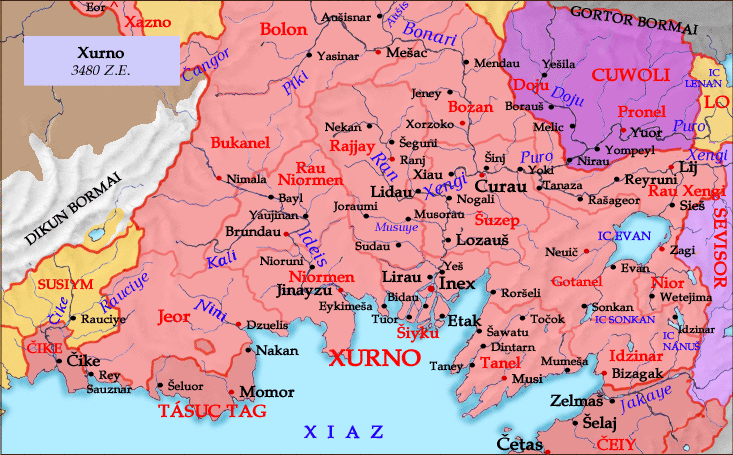 Xurnese, called by its speakers Corauši or Xornaurši, is the language of Xurno, the great Southern nation, and the southern anchor of the multilobed cultural unit which is Ereláe. It is spoken as a primary language by over sixty million people, and as an acquired language by many millions more, to say nothing of the influence it has had on other languages in the Axunaic cultural area (known as Xengiman, the Greater Xengi).
Xurnese is highly dialectalized; each province has its own distinct dialect, and those of the outlying regions (Xazno, Bolon, Jeor, Gotanel, Idenar) are virtually separate languages.
Corauši means ‘Curau speech’, referring to the imperial capital, Curau. Curau dialect is the standard for art, education, commerce, and government. As the fate of regional literature is national indifference, there is only a small amount of serious dialectal writing; most of this is concentrated in the largest cities, notably Inex, Lirau, Jinayzu, and Lij.
As a complication, the present capital is not Curau but Inex. The prestige of Curau as the Xurnese homeland and the home of its greatest writers has so far been sufficient to enforce a Coralaur rather than a purely Inegri standard on the nation; but of course a huge number of very influential speakers are native to Inex rather than Curau. As some have put it, the de facto standard is an resident of Inex attempting to speak Corauši.
The strength of the standard often leads both the Xurnese and outsiders to accord their language more unity than it really has. Xurnese nationalists even maintain that Čeiy speaks a form of Xurnese, although most everyone, especially the Čeiyu, considers Ṭeôši to be a separate language.
This document describes only standard Corauši Xurnese. There is a Language Agency (Šundaus) in Curau which defines the written standard. I’ve tried to follow actual usage rather than the Agency’s prescriptions; but its dictionaries and grammars are invaluable.
In fact Xurnese is a member of the Axunaic branch of the Eastern language family to which Verdurian also belongs. Modern linguists can trot out many similar words (e.g. rama/rana ‘frog’, tas/ta ‘we’, mul/mole ‘soft’) to show this, as well as dissimilar-sounding but related pairs (xu ‘bad’ / čelt ‘evil’, rae/lädan ‘go’, šic/hep ‘seven’).
The affinity has been disguised not only by sound changes, but by semantic and lexical divergence. Xurnese has inherited many words from the Wede:i civilization which preceded it in Xengiman (for details see the Axunašin grammar), as well as from the Skourene and Tžuro cultures it has interacted and struggled with.
Though we say Corauši derives from Axunašin, it’s actually more complicated than that. Before the rise of Axunai, Curau (then named Tural) spoke a variety closer to Mounšun, the dialect of Tannaza. During imperial times the speech of the delta supplanted local dialects throughout Šuzep, the middle Xengi, but without erasing some distinctive local vocabulary and language features. Old Xurnese, the language of the early Xurnese empire (fl. 2700) and the direct ancestor of modern Xurnese, derives from this somewhat divergent form of Axunašin.
Modern Inegri dialect was, in turn, strongly influenced by the language of Curau, which was for a time the larger city. So in some ways Inegri is not a purely straightforward descendant of Axunašin either.
The case is similar to that of Italian, which derives not from Rome but Florence.
The transliteration is the same, except for the affricates and fricatives:
labial alveolar palatal velar stops p t k b d g affricates ts tʃ ks dz dʒ fricatives s ʃ v z nasals m n liquids l r semivowels w j
The b/v distinction is not phonemic; this is a single phoneme pronounced [b] initially and [v] between vowels. I write the allophones distinctly as a frank concession to English speakers (and in imitation of Verdurian transliterations).
labial alveolar palatal velar affricates c č x dz j fricatives s š v z
The use of c and k does not follow Verdurian: c represents /ts/ and k is /k/. C is phonemic, though barely; cf. the minimal pair ceš ‘this one’ / teš ‘halves’. D and dz are also phonemic (cf. dus ‘house’ / dzus ‘in back of’) but even less so, since dz cannot occur finally. Using a digraph for dz reflects Xurnese usage; a word like jadzíes ‘sculptor’ may be written jad-zi-es, whereas c is never split up into *ts.
Somewhat confusingly, x and j generally derive from Axunašin x and j, but represent different sounds. J is /dʒ/ as in English, not Axunašin /ʝ/. X is /s/ initially and /ks/ (as in Axunašin) elsewhere.
(So, x and s have merged initially? Perhaps; but in Inegri initial x is pronounced /z/. Residents of Curau and Inex are aware of this difference and use it to imitate each other. Of course, only literate speakers do a good job of this; the writing system distinguishes between s/z/x.)
e is closed [e] except in diphthongs; o is closed [o] unless followed by an r or n. However, both tend to be more open in closed syllables.
front back high i u mid e o low a
Common diphthongs are ay /aj/, ey /ɛj/, oy /oj/, au or aw /aw/, eu /ɛw/.
Examples:
Xurno ['sur no] Curau ['tsu raw] šeguac ‘bury’ [ʃe gu 'ats] xurney ‘Xurnese’ ['sur nɛj] Corauši [tsɔ 'raw ʃi] jadzíes ‘sculptor’ [dʒa 'dzi ɛs] xurnéy [sur 'nɛj] Endajué [ɛn da dʒu 'e] súmex ‘epoch’ ['su mɛks] Meša ['me ʃa] Inex [i 'nɛks] cunde ‘thus’ ['tsun de] Šuzep [ʃu 'zɛp] Čeiy [tʃɛj] midzirc ‘judge’ [mi 'dzirts] Bolon [bo 'lɔn] cauč ‘dance’ [tsawtʃ] rešeji ‘looked’ [re 'ʃe dʒi] Niormen [ni ɔr 'mɛn] Jeor [dʒe 'ɔr] Bezuxau [be zu 'ksaw]
The transliteration used here is essentially that used by Verdurian and Kebreni scholars, with these differences:
It’s a perfectly serviceable transliteration, and if the b/v distinction is bad phonetics, it helps the Verdurians and it will help English speakers too. Aw/au are merged in Corauši but not in Inegri.
The Xurnese script is part logographic, part syllabic. The syllabic portion is extremely archaic; e.g. Inegri is written

 <wei-ne'x-ri>, which matches
<wei-ne'x> for Inex and Axunašin Weinex, but is hopeless for a transliteration. Fortunately the Xurnese recognize their pedagogic problem and dictionaries often provide ad hoc phonetic glosses for difficult spellings. These match the Verdurian transliterations in almost all cases, and I’ve used them to transliterate words not attested in Verdurian sources.
<wei-ne'x-ri>, which matches
<wei-ne'x> for Inex and Axunašin Weinex, but is hopeless for a transliteration. Fortunately the Xurnese recognize their pedagogic problem and dictionaries often provide ad hoc phonetic glosses for difficult spellings. These match the Verdurian transliterations in almost all cases, and I’ve used them to transliterate words not attested in Verdurian sources.
Corauši
XurneseIr nevu jadzíes mnošuac.
My niece is dating a sculptor.To am šus bunji dis kes denjic.
He hopes one day to govern a province.Syu cu šus izrues šač.
Myself, I don’t envy that province.pija, saučis, čaši, miruj
filth, die, helmets, brain - words from map below
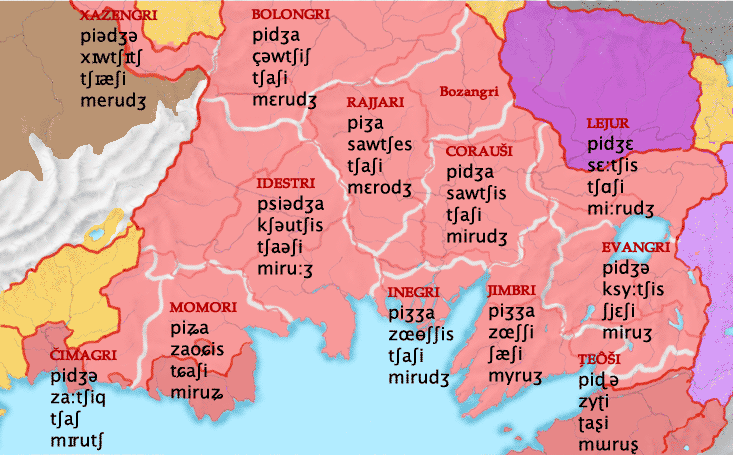
Dialect Region Provinces / States Corauši the middle Xengi, esp. Corau Šiyku Jimbri the Tanel peninsula Tanel, western Gotanel Lejur the upper Xengi Rau Xengi Evangri Lake Van and the southeast Nior, Idzinar, eastern Gotanel Idestri the Ideis valley Niormen, Rau Niormen, Bukanel Rajjari the Ran valley Rajjay, Bozan Momori Jeor Tásuc Tag; eastern Jeor Čimagri the Čiqay valley Čiqay Bolongri Bolon Bolon Xazengri the Hasun valley Xazno
The map shows the pronunciations of four words across Xurno: pija (Ax. pija) ‘filth’ , xaučis (xučik) ‘to die’, čaši (čiaši) ‘enemies’, miruj (meiruj) ‘brain’.
Some characteristics of the dialects, as exemplified by the sample words (but by no means an exhaustive description):
Inegri:
As Tásuc Tag is a separate state, there is a little less pressure to use the standard, but this mostly means that more New Jeori words are used.
In fact these are archaizing fantasies— or at best aids for teaching Axunašin. The grammarians assign ‘case’ according to the Axunašin etymon, inasmuch as Xurnese nouns derive from either the dominant or subordinate case in Axunašin. For instance buma ‘cow’ derives from the subordinate case bouma, while bus ‘bull’ derives from dominant case bouz.
‘Genitives’ are rare, and are best treated as a form of derivational morphology.
‘Gender’ is even easier— e.g. buma and bus are both goro gender, like their etymons. There is no gender agreement in Xurnese, but admittedly the plural paradigms usually correspond to the ancient gender— e.g. nouns ending in -a pluralize in -i (koma ‘house’ → komi) if they derive from the civú gender, but in -ay (rina ‘river’ → rinay) if they were goro gender. But instead of learning an arbitrary gender for many words, why not just remember the arbitrary plural?
The table below summarizes the most common patterns (excluding vowel changes). Quite a few plurals are predictable— especially for those with a good knowledge of Axunašin—but it may be easiest simply to memorize the plural for each noun. The lexicon gives plural forms for all nouns that have one.
Nouns in Plural Examples -a -i
-aykoma → komi
rina → rinay-c -p
-r
-yšuc → šup
gec → ger
juc → juy-irc -ircú nusirc → nusircú -č -š (but some -c) beč → beš -d -c red → rec -e -i nune → nuni -i -w
-útorei → torew
eči → ečú-k -ki reyk → reyki -um -we kasum → kaswe -m -mi dum → dumi -n -ni
-núraun → rauni
meyn → meynú-udo -udzú ammudo → ammudzú -o -u goro → goru -p -pi
-vúcip → cipi
teyp → teyvú-r -ri
-rúber → beri xor → xorú -s -c
-
-si
-m
-súros → roc
ujes → uje
mis → misi
dus → dum
yeys → yeysú-š -č
-šiješ → jič
seš → seši-u -ú saysu → saysú -x -s aušex → aušas -Vy -V’y zalay → zaláy -z -zi
-zúxiaz → xiazi
moz → mozú-C (vowel change) kon → keun
saul xuma a young man
sauli xumi young men
saulú payvú young fathers
sauláy zaláy young warlords
saulé yaté young masters
saulwe edwe young slaves
The adjective does not attempt to match pluralization by consonant or vowel change:
saul emur young husbands
saul nyew young emperors
saul imimes young sea captains
Some adjectives (indicated in the lexicon) have a separate root in the plural: reu mes beautiful woman, reuri mesi beautiful women.
Use the singular form with pronouns or unexpressed subjects (e.g. Saul izom We are young).
Adverbs are formed with the postposition ga: reu ga ‘beautifully’. (Axunašin -oyo survives in a few words as -yo, as in rumyo ‘a long time’, but these are now just lexical anomalies.)
Comparatives are formed with pali, dopali ‘more, less’; superlatives with dzulé, dzudo ‘most, least’: pali saul ‘younger’, dzulé saul ‘youngest’. The term of comparison may be expressed by subordination: yuti na pali reu more beautiful than flowers.
In form the high 2nd and 3rd person pronouns derive from forms meaning e.g. ‘your greatness’ (Ax. rir ezičou), ‘his/her greatness’ (toiš ezičou). These are attested in many forms showing varying levels of abbreviation.
singular plural high low high low 1 siu si tas ta 2 riezič ri miezič moš 3 tošezič to kiezič ke
The usage of the high and low forms was quite complex. The grammarians’ explanation was that ‘high’ forms were used for superiors; ‘low’ forms for inferiors. Examples:
The grammarians’ explanation does not explain why nobles addressed lower nobles with ‘high’ forms, as if they were superiors; and does not provide much guidance for speaking to equals. A better formulation might be that the ‘high’ forms are court forms, used to refer to the noble and the educated in social situations.
The high/low distinction has disappared, a victim of the egalitarian climate of the Revaudo revolution. Note that it was the high and not the low forms that survived— in effect, everyone would now address each other as peers of the educated class, which would have been how the Revaudo intellectuals addressed each other.
singular plural nom acc gen nom acc gen 1 syu i ir tas toy cir 2 yes yes oyes myes myes mir 3 pr toš toš tir, otoš kyes kyes xir 3 ob to to tir, oto
The accusative is retained only in the 1st person.
The genitives derive from Axunašin, with the 1s/2s -r ending generalized, except for the 2s and alternate 3s forms which consist of the adposition o plus the nominative form. (O is now a postposition, so these words are archaic in form.)
It is awkward to have just one 3s pronoun; Corauši has therefore innovated an additional one out of the archaic low form. Thus toš serves as a proximative, to as an obviative.
The 3rd person forms given above are used for animate referents only. For inanimates use ceš ‘this one’ or cuš ‘that one’ instead.
singular plural nom acc gen nom acc gen 1 syu ic ir ta to toyš 2 high yezič jezič jezič o mozič muzič muzič o 2 low ri ej rir moš mu mye 3 high toič toič toič o kezič kezič kezič o 3 low to toy toš ke ke key
singular plural nom acc gen nom acc gen 1 si i ir ta to tei 2 ri ej rir moš mon mei 3 to to tir ke ken kei
Adjective Person Place Time Reason Manner question ji ji • je jinar jideym tun jende which who/what where when why how this ci ceš inar idzum citun cinde this this one here now for this this way that cu cuš cinar cideym cutun cunde that that one there then therefore that way none do duox donar duoyo donde no,
nothingnobody nowhere never no way some bunji bunjisu amnar andeym amende some,
somethingsomeone somewhere sometime somehow many maus maussu mausinar mausiga mausende many many people many places often in many ways every ez ezisu eznar ezdeym ezende every,
everythingeveryone everywhere always wholly
For inanimates (things), use ji / ceš / cuš (from the person column) but then do / bunji / maus / ez (from the adjective column). The anaphora in the ‘some’ row can be translated ‘any’ in negative sentences.
Verbs no longer have second person forms in standard Xurnese. Third person forms are used with the second person pronouns (which, as we have seen, developed from respectful third-person expressions).
The following chart shows the three regular conjugations or verb classes, using the regular verbs kalis ‘please’, reše ‘look at’, and čir ‘cook’. Irregular forms are common, and will be discussed below.
(A few verbs have an infinite in -i; they conjugate with the verbs in -e.)
Sound change rendered the ordinary past tense of Axunašin too close to the present, and it was replaced by the past intensive.
Present Perfect -is -e - -is -e - 1s kal-ú reš-ú čir-ú kal-ijú reš-ejú čir-ijú 3s kal-e reš čir kal-ije reš-ej čir-ij 1p kal-um reš-om čir-um kal-ijum reš-ejom čir-ayjum 3p kal-uc reš-ayc čir-uc kal-ijuc reš-ejayc čir-ayjuc Past Future -is -e - -is -e - 1s kal-ije reš-eju čir-ije kal-ip reš-eyu čir-iye 3s kal-ayš reš-eji čir-iji kal-ayp reš-ey čir-í 1p kal-ayjum reš-ejum čir-ijim kal-yum reš-eum čir-im 3p kal-ijayc reš-ejuc čir-ijeyc kal-yayc reš-euc čir-yeyc
The present intensive became the perfect tense.
There are no 2s or 2p forms in Corauši. (There are in certain dialects, notably Bozangri and Xazengri.)
Some mnemonics:
Mnemonics:
Present Perfect -is -e - -is -e - 1s kal-idú reš-imú čir-imú kal-ugú reš-ogú čir-uswe 3s kal-ide reš-im čir-im kal-uge reš-eux čir-aux 1p kal-idum reš-imom čir-imum kal-ugum reš-ogom čir-usum 3p kal-iduc reš-imayc čir-imuc kal-usuc reš-osayc čir-usuc Past Future -is -e - -is -e - 1s kal-idije reš-imeju čir-imije kal-anye reš-enyu čir-anye 3s kal-idayš reš-imeji čir-imiji kal-an reš-en čir-an 1p kal-idijum reš-imejum čir-imijim kal-anum reš-enum čir-anim 3p kal-idijayc reš-imejuc čir-imijeyc kal-anayc reš-enuc čir-anyeyc
The perfect and future forms are regular: izejú ‘I really am’, izeyu ‘I will be’.
Present Past Subj Pres Subj Past 1s zú zyu šui šuyu 3s ze zi šu šúe 1p izom ezum šuom šuum 3p ayzuc ezyuc šuayc šuyuc
The subjunctive perfect and future use the regular endings and the root šu-: šuogú ‘if I really am’, šuenyu ‘if I will be’.
Conjugation Infinitive 1s present 3s present 1p present 1s perfect 1 (-is) jausis jugú juge jugum jausijú pudzis pudú pude pudum pudzijú rues roú ruwe roum ruejú 2 (-e) jidze jidú jic jidom jidejú mide midú mic midom midejú 3 (-0) baus bugú baus busum bausijú dzaus dzusú dzaus dzusum dzausijú aycaur aycorú aycaur aycorum aycaurijú jec jetú jec jetum jecijú kes kezú kes keyzum kezijú
Present 1s dú 3s dzi 1p dom 3p dzayc
Šizenače ‘not be able to’, saragače ‘must not’, jidače the negative passive, and imišače ‘not begin to’ conjugate like zenače.
šače rugačis zenače rače xamače mojač not be not want not know not go not come may not be Present 1s šač rugač zenač rač xamač mojače 3s šači rugači zenači rači xamači mojači 1p šačum rugačum zenačum račum xamačum mojačim 3p šačuc rugačayc zenačuc račuc xamačuc mojačeyc Past 1s šuč ruč zeynauč rauč xamauč mojuče 3s šuči ruči zeynuči rauči xamuči mojuči 1p šučum ručum zeynučum raučum xamučum mojučim 3p šučuc ručayc zeynučuc raučuc xamučuc mojučeyc
There is no negative perfect, future, or subjunctive.
gisu heavy → gisúnic weight2. Simple actions: -u (pl. -ú):
reu beautiful → réuric beauty
saul young → sáulic youth
pij fear → piju3. A state, process, or activity: -udo (pl. -udzú), or -audo following a syllable containing a front vowel:
orae leave → orau departure
rues desire → rou desire
kuli gather → kuludo harvest4. One instance of a repeated process, or one item from a mass: -uc (unacc.; pl. -aup). This is derivation has a pedantic feel and is mostly used in philosophy and science.
ize be → izaudo existence
revi new → revaudo newness
baus inform → búsuc report5. The result of a process: -eč (unacc.; pl. -eš):
payčis greet → páyčuc greeting
šone head of hair → šónuc one hair
brunde promise → brúndeč a promise
pece sing → pídeč hymn
sune dream → súneč dream
jis weak → jisayc wimp7. One who does the action of a verb: -irc (pl. -ircú):
reš tall → rešayc tall person
saul young → sulayc young person
cauč dance → caučirc dancer8. A follower (like -ist) or inhabitant: -su (pl. -sú), a contraction of xuma ‘man’:
jausik lord it over → jausirc tyrant
kezi govern → kezirc governor
Meša → mešasu follower of Mešaism9. Inhabitants and some occupations: -es (unacc.; pl. -é):
beyludo enlightenment → beylusu enlightened one
Jeor → jeorsu
Zešnam Dhekhnam → zešnasu Dhekhnami
Asuna Axuna → asúnes Axunemi10. Persons associated with a place (including some professions) may also use -iy or -ey (pl. -éy):
Kuras Šura → kurázes Šurene
jadziac sculpt → jadzíes sculptor
uyku herd → úykes herdsman
Xurno → xurney11. Femininization: zim- or zin-. To be used sparingly; Xurnese is generally happy with unisex forms: šudzirc waiter, waitress; im prince, princess.
Inex → inexiy
jen forest → jeniy woodsman
rina river → riney ferryman
nye king → zinnye queen
šejis deer→ zinšejis doe
etešis whip → eteji a whip13. Collection: -ex (unacc.; pl. -as):
jivi walk → jiviji cane
rim weave → rimiji loom
dzučuc ritual → dzučuex book of rituals14. Study, thought, art (like -ism, -ology): -xau ‘study’:
mnaur wear → mnórex clothes
sim glyph → símex writing system
šuš bone → šúšex skeleton
Meša → Mešaxau Mešaism15. Language: -ši:
bej shoot → bejixau archery
xayu sky → xayuxau astronomy
Asunai → asunaši
kaym buy → kaynar store17. Lands are named with -nel:
šomis ship → šominar dock
bic grape → bicnar tavern
edi Wede:i → Edinel Wede:i-land
Puro a river → Pronel
kazi Caďinorian → Kazinel Caďinas
mes woman → mésuy big womanThe Axunašin suffix -i (pl. -w) has been borrowed or revived in some words:
jud hole → júcuy big gaping hole
nye king → nyei emperor19. Diminutive: -is (unacc.; pl. -isi):
japu goat → jápis kidFor mass nouns, the diminutive can be used to name the smallest discrete unit:
nye king → nyeis kinglet
nuna street → núnis alley
nis snow → nísis snowflake
ruywen grass → ruywénis blade of grass
zu sand → zúis grain of sand
1. Adjectivization -ri (voices previous consonant; -gri after n or x, -bri after m or w, -tri after s or c; l + ri → -rri):
nye king → nyeri royalThe same suffix serves to create a present participle from a verb:
xuma man → xumbri male
mayp mother → maybri maternal
kis grow → kistri growingand to form an adjective from a toponym:
sun dream → sungri dreaming
brešuac develop → brešuatri advanced (lit. developing)
Inex → inegri2. Another common suffix is -u:
Bolon → bolongri
Siyku Xengi delta → šiykuri
baj four → baju fourth3. The unaccented suffix -eš or -uš, deriving from the genitive, has been lexicalized to refer to composition or legal ownership.
Čeiy → čeiyu
dum hut → dumu homely
xus wonder → xumu wondrous
dax palace → dásiš royalFor nouns that were feminine in Axunašin , the suffix is -i:
nan god → náneš divine
jud hole → júdeš lace
šuke color → šuki colorful4. A past participle can be formed by adding the suffix -aup:
paup stone → pui stony
xule wood → xuli wooden
čiri cook → čiraup cookedThese adjectives are not pluralized: čiraup širvú ‘cooked vegetables.’
jese kill → jesaup murder victim
reus imprison → rosaup prisoner
5. Personal qualities are often adjectivized with -mel:
boru true → brumel truthful6. An adjective can be weakened with -is (unacc.):
jis weak → jisimel timid, tentative
rac justice → raymel justice-loving
yuc oil → yucmel schmaltzy
nulač sick → nuláčis unwell7. Quality of a noun: -moro:
rauj red → ráujis reddish
šum ugly → šúmis funny-looking
niu grace → niumoro graceful8. Follower: dzu-
nue cat → nuemoro like a cat
mes woman → mesoro womanly
nye king → dzunye royalist9. The suffix -ač forms a negative:
bayl dissipate → dzubayl hedonistic
ródeš popular → dzuródeš conformist
gec mind → gerač insane10. Patronymic. The clitic ma- (before a vowel, maz-) means son of, like Irish Mc- or Norman Fitz-; the female form is ne- (before a/e/o neg-, before i/u nes-).
rile see → rilač invisible
mojuri possible → mojurači impossible
Bezu ma-Veon Bezu son of Beon (Remember that b → v between vowels; ma-Veon is considered one word.)
Itep neg-Auliric Itep daughter of Auliric
cuš dance → cauč dance2. The process for creating a noun: -ac:
koma home → keum reside
yas hunt → yaš hunt
rema milk → remyac milkThe same suffix turns an adjective X into a verb ‘to make something X’:
pija filth → payjuac corrupt
jire wife → jireac marry
geun straight → gewmiac straighten3. Bestowal of an object or condition: -de:
bip small → biac abase
nus name → naunde give a name to4. The suffix -šis roughly means ‘use X’; with body parts it often has a despective meaning:
nar place → mride grant
xe body → xede create
gil stream → gilaušis ford5. Added to an adjective, the suffix -bes (which is simply the verb ‘become’) forms a verb with the meaning ‘become X’:
sou salt → solaušis add salt
raun tongue → raunešis slander, insult
jad butt → jadzišis move lewdly, live loosely
caun rotten → caumbes rot6. A negative can be formed with -ač-; this is sometimes a survival of the Axunašin negative mood, sometimes formed by analogy. This suffix is not very productive; it’s generally preferable to use the auxiliary sače instead.
rauj red → raujives redden
rues want → rugačis not want7. To undo an action, or remove something: o- (or- before a vowel):
zene know → zenače not know
gerizas understand → gerizagač misunderstand
sinde say → sindače not say
naušvar approve → onaušvar retract one’s approval
jireac marry a woman → ojireac divorce
šeguac bury → ošeguac disinter
rízex testicles → orizas castrate
Ir nevu jadzíes mnošuac.
my niece sculptor date-3s
My niece is dating a sculptor.To tir mayp mausiga kalayš.
3s.OBV 3s.GEN mother much please-3s.PAST
He pleased her mother very much.
S O V → S O V-Inf AuxIf there are additional constituents between object and verb (e.g. adverbs or prepositional phrases), they remain between the object and infinitive.Toš to ray do šasaup rile šizen.
3s 3s.OBV in no flaws see can-3s
She can see no flaws in him.
S O ... V → S Inf O ... Inf AuxThe Xurnese negative is an auxiliary, and follows this rule:To am šus bunji dis kes denjic.
3s.OBV one province some day govern hope-3s
He hopes one day to govern a province.
Syu cu šus izrues šač.
1s that province envy not-1s
Myself, I don’t envy that province.
Myes mavú, myes i mava, tas wéneš koros.The accusative form of pronouns is used with a postposition: toy eš against us.
2p.acc love.1s / 2p.nom 1s.acc love.3s / 1p happy family
I love you; you love me; we’re a happy family.
2s pronouns take 3s verb forms, and 2p pronouns take 3p verbs.
Sulayc li tir mayp mirileju; toš i šigosuac pel to šači.If the topic switches to the referent of to— in the example, if the speaker went on to concentrate on the boy’s mother— then toš is used instead. Thus, toš is used for the first of two named referents, or for the main topic of the conversation.
youth and 3s.GEN mother met-1s.past / 3s 1s.acc bore-3s but 3s.OBV not-3s
I’ve met the boy and his mother; he bores me but she doesn’t.
If a sentence contasts toš and to, it may distinguish the genitives otoš and oto. If ambiguity is not likely, tir should be used.
Verbs of personal grooming are understood to be reflexive if no object is specified: Laumijú I washed myself.
Reflexives can never be used (as in Verdurian or Spanish) for an impersonal meaning (se habla español).
With plural referents, the reflexive always indicates that each person acted upon himself. The expression ceš playnu ‘this one the other’ indicates a reciprocal meaning. Compare:
Kyes kyes tirse jesejayc. They each killed themselves.
Kyes kyes čes playnu jesejayc. They killed each other.
The expression ros ‘people’ can be used much like an indefinite pronoun. In colloquial speech ros is often omitted, leaving an impersonal 3p verb.
(Ros) yajirc tom Yajirc naundayc.Tas ‘we’ can be used as an inclusive impersonal expression: Tas toš Yajirc naundom We call him Hunter. Similarly myes ‘you’ can be used to refer to the listener’s people: Myes toš ‘yagom’ naundayc You (Verdurians) call him ‘Yagom’. This impersonal myes is always distancing; don’t confuse it with the informality of English impersonal you as in You know how women are.
(people) hunter to ‘hunter’ call-3p
They call the hunter ‘Hunter.’
Impersonal rile ‘see’ is used as an existential, rather than ize:
Buma edumi rilayc, li palači am zú.
two idiot.PL see-3p / and only one be-1s
There are two idiots here, and only one is me.Niormen ray cu mavije na moz rilejuc.
Niormen in that love-PAST.1s SUB girl see-PAST.3p
There was a girl in Niormen that I loved.
The cardinal numbers are not declined: am yeys one feather, seči dim six days. Ordinals are regular adjectives and have plural forms: puc runi the second city, pucú runú the second cities.
cardinal ordinal +10 x10 1/x 1 am im andeš deš 2 buma puc bundeš pudeš teyeš 3 dzi dzim dzayndeš dzideš 4 baj cidzi bandeš cideš sumiš 5 peyk peykaur peygudeš peydeš 6 seči seyčaur semudeš sedeš 7 šic šizaur šimudeš šideš 8 yauš yusaur yumudeš yudeš 9 nep neyvaur naymudeš nedeš 10 deš deysaur sigac
Two-digit numbers are formed by concatenation (cidešdzi 43, šidešyauš 78) except for those with final 1, which becomes -mam (a survival of Ax. mu): pudešmam 21, and -6 which becomes -šeči.
Names of the hundreds use the same prefixes as the tens: pusigac, dzisigac, etc. Thus peysigač šideššeči 576.
Ezir ‘1000’ however is a separate word: seči ezir 6000.
Higher ordinals are formed by changing the last digit only.
Years are reckoned from the foundation of Xurno in 2530 (buma ezir peysigac dzideš); the current year, Z.E. 3480, is thus 950 (nesigac peydeš). Sometimes years are counted from the Revaudo revolution (3017), making the current year 463 (cisigac sedešdzi).
Thus mes cumoro like a woman, rile eyka in order to see, bes rano along the road, Xurno ray ‘in Xurno’; cu rum eči dmuro during that long summer. The Axunašin adverbial suffix -iwa survives in Xurnese as ga, but has been reinterpreted as a postposition: rey ga ‘newly’, dam ga ‘smoothly’, gisu ga ‘importantly’. It can apply to other postpositions, to indicate a direction: neyo ga ‘across’, ray ga ‘inward’, etc.
postposition gloss cumoro like, as dmuro during dzu between, among, on dzus after; in back of dzušši since e to, toward eš against eši back to eyka for, in return for ga in, at, in the manner of leš in front of mu with mutes despite nao about, on ney over, above neyo across, beyond, except o of, out of, from ortes far from peš near, around pip before (in time) pišši until rameyn using, by means of rano through, along ray in, into šaup under, below tes without tom to (marks indirect object) xur beside, next to
Ga can be applied to nouns as well. It is used with the plural form, though no plural meaning is intended:
rilúšeč appearance → rilušeš ga in appearance, seemingly
nox night → nozú ga at night
šec experience → šedzú ga in (our) experience, as experience shows
Possession is indicated using o, thus: Deru o dus Deru’s house. Colloquially the genitive pronoun may be used instead: Deru tir dus Deru his house.
Tom indicates the indirect object:
Šudzirc nízeš jerej kaymirc tom dej.
waiter nutty bag customer to give-PERF
The waiter gave the customer a bag of nuts.
conjunction gloss li and ma(t) or pel but caunga rather, preferably ciluk because citun for this reason, therefore cutun for that reason, therefore jidil as a result, because of this keno if / then luk so, therefore mucauč also, in addition peyga on the contrary, however dzunyo and then, afterwards
nu li podi cats and dogsThe series can be extended if desired: nu li pido li japwe li rec cats and dogs and goats and rabbits.
baj ma peyk zinaup four or five articles
šizengri pel yucmel ševarirc an able yet cloying writer
Pidú bídeš caunga ricuka. I drink wine rather than rye beer.
Yes caučayš jidil yes neymoreji. You danced and then you slept.
There are eight inflected forms, not counting the infinitive:
Form Example Gloss Indicative Present Aycorú I am reading Perfect Aycaurijú I read (finished reading) Past Aycauriji I was reading Future Aycauriye I will read Subjunctive Present Aycaurimú I may be reading Perfect Aycauruswe If only I read Past Aycaurimije I may have been reading Future Aycauranye I may read (later)
Pečrešey yes lešrilen.In an emphatic sentence, the subjunctive alone expresses a wish:
editor you receive-3s.FUT.SUBJ
The editor may receive you (but probably won’t).Berdura brešuatri ros šu.
Verduria advanced nation be-3s-SUBJ
It’s said that Verduria is an advanced nation.Caučircú ammavri šuayc ma?
dancer-PL monogamous be-3p-SUBJ Q
You say dancers are monogamous??
Cu mul buma na pečrešey xauč šu!More typically, the subjunctive is used with auxiliaries or in subordinate clauses to suggest that the described state is hypothetical, wished for, or doubtful.
that fat cow SUB editor dead be-3s-SUBJ
I wish that fat cow of an editor were dead!
Ševarirc maus niudo mu ci elas ševarij, cu tas cuš aycaurimum eyka.
author much kindness with this lines write-3s.perf SUB we that read-1p.SUBJ for
The author very kindly wrote these lines in order that we might say them.Cu myes geun miw mu li geun ximaudo mu aycauryeyc citun bezzú.
that you correct words with and correct order with read-3p.SUBJ therefore beg-1s
I beg of you, then, that you say them with the right words and the right order.
The auxiliary is inflected, while the formerly main verb appears in the infinitive, just to its left. The subject, object, and any adverbials that are present are not affected, and in effect are shared by both verbs.
Auxiliary Negative Gloss Full Subordination šače negative no denjidze hope, expect to subjunctive šizene šizenače can, is able to no zene zenače know how to no rae rače habitually do no rues rugačis want to subjunctive xame xamače intend to subjunctive meuš mojač may, might no šaras šaragače must, have to no imiše imišače begin to no jidze jidače passive no
Yes mavyú → Yes mavis šač.Naturally, the auxiliaries may appear in the subjunctive.
you love-1s → you love-INF not-1s
I love you → I love you not.Maysu xivije → Maysu xip zeneji.
iliu swim-3s.PAST → iliu swim-INF know-3s.PAST
The iliu was swiming → The iliu knew how to swimCi sus o dzuzovugeš dzulé xu ize meuš.
this year of play-PL most bad be-INF may-3p
This year’s plays may be the worst ever.
Berdursú xudimayc → Berdursú xude raimayc.The subjunctive softens the meanings of certain auxiliaries: zene ‘know how to’ → ‘know a bit how to; xame ‘intend to’ → ‘think about doing’; šaras ‘must’ → ‘should’.
Verdurian-PL cheat-3p.SUBJ → Verdurian-PL cheat-INF go-3p.SUBJ
They say the Verdurians are cheating → They say Verdurians habitually cheat.
Šukeac zenidú. Jadziac šarasidú.
paint-INF know-SUBJ.1s / sculpt-INF must-SUBJ.1s
I can paint, more or less. I should do sculpting.
Pipaup berdursu riju ray orkime šačum.Šače is optional if other negative words are present.
drunk Verdurian room in hide-INF not.1p
We are not hiding a drunk Verdurian in the room.
Toš inar duoyo (zi / ize šuči), cu xunj na grišnar ray cinar nudzú.Sentences with auxiliaries are negated by using the negative auxiliaries (which are highly irregular; see the morphology section).
3s here never (be-PAST.3s / be-INF not-PAST.3s) / that snore-3s SUB closet in there point-1s
He has never been here, especially in that closet that is snoring there.
Maysu xip šučuc → Maysu xip zeynučuc.In English we can distinguish between negating the auxiliary and the main verb: I don’t know how to get noticed vs. I know how to not get noticed. This distinction is not usually made in Xurnese; the negative auxiliaries only negate the auxiliary itself. (It’s possible to use the -ač- suffix to negate any verb, but this is rather hifalutin, like coining a word: I know how to get unfamous.
iliu swim-INF not-3s.PAST → iliu swim-INF not.know-3s.PAST
The iliu wasn’t swiming → The iliu didn’t know how to swim
Xauč ize denjidzú.Denjidze ‘hope to’ does not have a negative form; but the subordinated clause can be negative.
dead be-INF wish-1s
I wish to be dead.Cu ir emu xauč šu na denjidzú.
that my husband dead be-3s.SUBJ SUB wish-1s
I wish my husband were dead.Ir šebreč imprimis xam.
my book print-INF intend-3s
He intends to publish my book.Cu xamunar ir šebreč imprimide na xam.
that salon my book print-3s.SUBJ SUB intend-3s
He intends for the Salon to publish my book.
Deru yu šuema imise zene rap.Uneducated speakers are known for conjugating all the auxiliaries rather than just the last one:
Deru good beer find-INF know-INF habitual-3s
Deru always knows where to get good beer.Ševarirc toy grijil xame mojači.
writer us confuse-INF intend-INF may-NOT-3s
The writer may not intend to confuse us.Cu šebreč aycaur rae xameju, pel i šigosuac.
that book read-INF habitual-INF intend-PAST-1s / but me bore-3s
I was fixin’ to keep reading that book, but it’s boring.
Toš imise zenú mojú.
3s find-INF know.how-1s may-1s
I might know how to find him.
Ci kasum oyes euma e čeji.Colloquially, the present tense may be reduplicated to form an imperative:
this basket your grandmother to take-INF
Take this basket to your grandmother.Wes e xuxame pel teris.
artist to approach-INF but be.silent-INF
Approach the artist but be silent.
Ir emu ujú— ra ra!Xurnese does not have the wide range of softened pseudo-imperatives that English does. When an imperative is softened, it is normally by use of diminutives:
my husband hear-1s / go-3s go-3s
I hear my husband— Go!
Déruis, bic i de.Commands were given using the future and subjunctive, as in Axunašin, until the Revaudo revolution, when these usages were seen as hopelessly class-ridden. They still survive in some remote provinces (generally the same ones which still use the ‘royalist’ pronouns).
deru-DIM / grape me give-INF
Deru darling, pass me a grape.
Ševarirc wéneš. Tir šebreč makri. Yes izruirc.It reappears in other tenses: Tir šebreč makri zi ‘His book was successful’.
writer happy / 3s.GEN book successful / 2s envious
The writer is happy. His book is successful. You are envious.
The constituents can be swapped:
Wéneš ševarirc. Makri tir šebreč.In the first person the verb is still required in the written language (Wéneš zú I am happy), but in colloquial speech it’s omitted (Syu wéneš).
happy writer / successful 3s.GEN book
Happy is the writer. Successful is his book.
The verb is not omitted in impersonal expressions: mojurači ze It’s impossible.
Ize is not used as an existential; see Impersonal expressions.
Peje ‘stand’ is used colloquially to express one’s current or temporary state; thus Wéneš pejú I’m happy right now, Toš braup pej He’s busy at the moment. It’s also used for time expressions: Nimala peje It’s market day.
With the past participle (not the infinitive) and in the past tense, peje indicates that the events described occurred at an earlier time, much like the English past perfect.
Jorumíex omeunijayc, pel jošmir oraup pejeji.
council deliberate-PAST.3p / but opportunity leave-PP stand-PAST.3s
The council deliberated, but the opportunity had past.
1. By intonation alone
Yes xuxaleš?2. By appending the conjunction ma:
2s crazy
You’re crazy?
Yes šuema imisej ma?3. By appending the phrase ma jende ‘or how’, the origin of the previous form:
2s beer find-PERF.3s or
Did you find the beer?
Berdursu ez šuema picayš ma jende?4. Using jic before the verb— an inheritance from Axunašin jiti:
Verdurian every beer drink-PERF.3s or how
The Verdurian didn’t drink all the beer, did he?
Muré nanú dmuna jic gemayc?Questions usually use the indicative, but the subjunctive can be used instead to suggest that the suggested state is absurd or unlikely.
Muran-PL god-PL still Q accept-3p
Do the Uṭandal still believe in gods?
In writing it’s still normal to respond to questions as in Axunašin, using the verb (imisejú I found it); but colloquially one responds cunde ‘that way, yes’, šači ‘it isn’t’, or donde ‘no way, not at all’.
Ir jira tom jiváteč nao ji bausij?The use of the subjunctive implies that what is questioned may not exist, or is unlikely to be known:
my wife to liquor about who tell-PERF-3p
Who told my wife about the liquor?Xauč peš pišši je etešayš?
dead near until whom whip-PAST-3s
Who did she whip senseless?Xamunar o rireširc jideym xam?
salon from inspector when come-3p
When is the inspector from the Salon coming?Mes i cunde tun rešeji?
woman 1s.ACC that.manner why look-PAST.3p
Why did the woman look at me like that?
Peranagu e bes jinar šu?In this case the subjunctive signals the absurdity of the question: Fananak is across the ocean, so there is no road there.
Fananak to road where be-SUBJ.3s
Where is the road to Fananak?
There are some dialects where interrogatives appear where the corresponding NP would: Ji i čaujeji? Who touched me? This sounds unutterably rustic to anyone from the Xengi valley.
Yes xaušmelač luk oraeyu.(See also Coordination subordination below.)
2s disrepectful therefore leave-1s.FUT
Because you are disrespectful, I will leave.
subj S1 keno subj S2For past conditions, use the past subjunctive; there is no tense substitution as in English:Oyes mavirc xamim keno, zenaup ga kejideym šu.
your lover come-3s.SUBJ if / certain ADV dinner be-3s.SUBJ
If your boyfriend is here, it is surely dinnertime.
Ševarirc xorneacaux keno, tir emur jecaux.As there is no negative subjunctive, negative conditions and consequences are simply expressed using the negative auxiliary:
writer err-3s.PERF.SUBJ if / 3s.GEN husband laugh-3s.PERF.SUBJ
If the writer had made a mistake, her husband would have laughed.
Kissu i raunešis šuči keno, syu toš yalu eš nejlaj šuč.For logical consequences of sure facts, Xurnese doesn’t use keno but simple conjunctions such as cutun ‘therefore’:
child 1s.ACC insult-INF not-3s.PAST.SUBJ if /
1s 3s.ACC knee against kick-INF not-1s.PAST.SUBJ
If the boy had not insulted me, I wouldn’t have kicked him in the knee.
Pudis peje, cutun Rajjay ray izom.
second-day stand-3s / that.reason Rajjay in be-1p
It being the second day of the week, this must be Rajjay.
S O V → to O VThe singular equivalent isn’t *Toš toš zic, but uses the obviative: Tos to zic or To tos zic. It’s also possible to pronominalize with ceš ‘this one’ or cuš ‘that one’, especially with inanimates, or when making contrasts between two referents.
→ S to VPečrešéy ševarirc ziduc.
editor-PL writer hate-3p
Editors hate a writer.→ Kyes ševarirc ziduc. They hate a writer.
→ Pečrešéy toš ziduc. Editors hate him.
→ Kyes toš ziduc. They hate him.
Deru buma mozú mnošuac. Ceš zimaysu, li cuš isaur.
pname two girl-PL date-3s / this.one pretty and that.one smart
Deru is dating two girls. One is pretty, and the other is smart.
S O V → S O V-infThe infinitive expression can be used as a predicate, where we would use a subordinated impersonal expression:
Xamunar ir šu gemej. → Xamunar ir šu gemi
salon my uncle admit-3s.PAST → salon my uncle admit-INF
The salon admitted my uncle. → the salon admitting my uncle.
Xamunar ir šu gemi mojuri.Or it can be used as an argument to a verb:
salon my uncle admit-INF possible
The salon admitting my uncle is possible,
or, It’s possible that the salon admitted my uncle.
Xamunar ir šu gemi buguc.If the infinitive expression is used as the object, the subject must come just before the verb; Xamunar ir šu gemi Inex baus Inex is talking about the salon admitting my uncle.
salon my uncle admit-INF talk-3s
They’re talking about the salon admitting my uncle.
The imperative, discussed above, uses the infinitive transformation.
S O V-morph → S O V-Inf Aux-morphCu xušimirc etešip → Cu xušimirc etešis šarasiye.
that upstart whip-FUT.1s → that upstart whip-INF must-FUT.1s
I will whip that upstart → I’ll have to whip that upstart.
Xamunar ir šu gemej. →These postpositions must be used with pronouns as well: toš nao gemaudo his admission. (Don’t use the genitive: *tir gemaudo.)
salon my uncle admit-3s.PAST →
The salon admitted my uncle. →Xamunar nao ir šu e gemaudo
salon about my uncle to admission
the salon’s admission of my uncle
x (y z V1) V2 → x cu y z V1 na V2An entire sentence can serve as the object or subject of the verb.
(y z V1) w V2 → cu y z V1 na w V2
Cir šemilircú cu zešnasú boru ga Cuwoli ray reatuc na gejayc.As noted above, the subordinated clause appears in the subjunctive if it is not a matter of fact.
our agent-PL that Dhekhnami-PL true ADV Cuoli in move-3p SUB tell-3p
Our agents report that the Dhekhnami are indeed active in Cuoli.Cu yes šwedze xam na i xušim.
that you argue-INF intend-3s SUB me amuse-3s
It amuses me that you wish to argue.
With verbs of speaking or thinking, the subject is normally moved before the verb.
Cu braunic mavis na šuč na geyma sindej.This is indirect speech, and tenses match the narrative (e.g. the lady spoke in the past, so ‘love’ is also past). Direct speech omits the initial cu and replaces na with cuš ‘that’:
that truth love-INF SUB not-PAST.1s SUB lady say-PERF.3s
The lady said I did not love the truth.
Píješ xaundirc ze, geyma cuš sindej.
filthy liar be-3s / lady that say-PERF.3s
The lady said, “You are a filthy liar.”
Yes xaušmelač luk oraeyu.However, it’s also possible to highlight the subordination by enclosing the subordinate clause within a cu...na block. Formally this turns the conjunction into a postposition, and the subordinated constituent normally moves after the subject (and object if any) in the sentence:
2s disrepectful therefore leave-1s.FUT
Because you are disrespectful, I will leave.
S1 conj S2 → S2 O2 cu S1 na conj V2It’s difficult to suggest the same effect in English; stylistically, the subordinate clause is less important, more of an adverbial comment than a structured logical argument. At the same time it’s more integrated into the sentence, and feels less spontaneous, more bookish.Cu yes xaušmelač na luk oraeyu.
that 2s disrepectful SUB therefore leave-1s.FUT
I’ll leave, since you are being disrespectful.
S O1 V1 & S O2 V2 → cu O1 V1 na S O2 V2A clause is relativized with the cu..na block:S1 O V1 & S2 O V2 → S2 cu S1 V1 na O V2
Cu am breši ma na xuma ir jira jesej.Ci ‘this’ may be used where additional information is being offered about someone already referred to.
that one arm have-3s SUB man my wife kill-PERF.3s
A man with one arm killed my wife.Cu toš popej na breš dmuna mú.
that he lose-PERF.3s SUB arm still have-1s
I still have the arm which he lost.
A clause cu NP V na is ambiguous between a reading where the NP is the subject or the object: cu mes jesej na could mean that killed a woman or that a woman killed. The clause can be disambiguated by including the obviative pronoun to in place of the relativized argument: cu to mes jesej na that killed a woman, cu mes to jesej na that a woman killed.
The use of to allows a constituent from a doubly embedded clause to be relativized; this can’t be done in standard English.
[Xuma dzuzovúgeč ševarij] [Jorumíex dzuzovúgeč empojačiji] xuma ilirileju →A relative clause may include another:
man play write-PERF.3s / council play disallow-PAST.3s / man meet-PAST.1s
[the man wrote the play] [the Council banned the play] I met the manCu Jorumíex cu to ševarij na dzuzovúgeč empojačiji na xuma ilirileju.
council play disallow-PAST.3s / man play write-PERF.3s / man meet-PAST.1s
*I met the man who the Council banned the play he wrote.
Cu Inex ray keume na mavirc mnošuac na xaircCu is not reduplicated. If it’s desired instead to subordinate multiple clauses to the same noun, use a conjunction:
that Inex in live-3s SUB girlfriend date-3s SUB student
a student who has a girlfriend who lives in Inex
Cu Inex ray keume na li mavirc mnošuac na xairc
that Inex in live-3s SUB girlfriend date-3s SUB student
a student who has a girlfriend and who lives in Inex
E O V → S cu O V-inf E-acc na dem-morphCausatives use the same verb as Axunašin, de ‘give’. The caused action is placed in a cu..na block, the verb appearing in the infinitive.
Yojaup rindeju. →Empeuš ‘allow’ uses the same construction, as do yac ‘command’, ruje ‘force’, ruzene ‘ask for’, and many others.
nude draw-PERF.1s →
I sketched the nude. →Zendey cu syu yojaup rinde na dayš.
teacher that 1s nude draw-INF SUB give-PAST.3s
The teacher made me sketch the nude.
Syu cu bunji yojú ir emu rile na empeuš šač.The causer may be left out (taking cu with it). The resulting sentence suggests impersonal causation or a lack of responsibility:
I that some nude-PL my husband see SUB allow-INF not-1s
I don’t allow my husband to see any nudes.
Syu yojaup rinde na dayš.Front the object (as described below), and we have something close to a passive:
1s nude draw-INF SUB give-PAST.3s
I was made to sketch the nude.
Yojaup syu cuš rinde na dayš.The subject may now be omitted, and the verb changed to jidze ‘suffer’, for an impersonal passive:
nude 1s that.one draw-INF SUB give-PAST.3s
The nude was sketched by me.
Yojaup rinde na jidzeji.There is a negative passive jidače.
nude draw-INF SUB suffer-PAST.3s
The model was sketched.
Cu mulayc pec na cideym aujikulur mum.Indefinite pronouns can be used as well; compare the meaning of the last example with various pronouns substituted for cinar:
that fat-person sing-3s SUB then musical have-1p
When the fat woman sings, we have opera.
Cu kešaup dzuséy kejačejuc na cinar kejeyu.
that separated master-PL eat-PAST.3p SUB there eat-FUT.1p
We will be eating where the Hermit Masters fasted.
inar → We will eat here where the Hermit Masters fasted.Such an adverbial can be subordinated to a noun.
donar → We will eat in no place where the Hermit Masters fasted.
amnar → We will eat some place where the Hermit Masters fasted.
eznar → We will eat everywhere the Hermit Masters fasted.
Neyosu šigri ga cu Yute mirile denjidzeji na pucišnar imisej.No pronoun is generally used; but if it’s unclear whether the subclause indicates when something happened, or where, or even why, the pronoun can be included inside the clause:
foreigner difficult ADV that Yute meet expect-PAST.3s SUB atelier find-PERF.3s
With difficulty, the foreigner found the Atelier where he was supposed to meet Yute.
Neyosu šigri ga cu Yute cinar mirile denjidzeji na pucišnar imisej.A time expression can also be subordinated to a postposition, e.g. dmuro ‘during’, dzus ‘after’, dzušši ‘since’, pip ‘before’, pišsi ‘until’:
foreigner difficult ADV that Yute there meet expect-PAST.3s SUB atelier find-PERF.3s
Cu joraumirc xamey na pišsi keji šačum.Idiomatically, peje ‘stand’ plus a subordinated dzus clause expresses that something has just happened, and with a pip clause that it is just about to happen:
that councillor come-FUT.3s SUB until eat-INF not-1
We will not eat until the Councillor arrives.
Cu ir gejúpuy tasije na dzus pejú.
that my novel finish-PAST.1s SUB after stand-1s
I’ve just finished my novel.
Cu oyes endevausirc ize na gesauliri zú.
that your mentor be-INF SUB proud be-1s
I’m proud to be your mentor.
Cu yes sor na wogri zú.
that you hurt-INF SUB sorry be-1s
I’m sorry that you are in pain.
S O V → O S cuš VNormal constituent order is SOV; the direct object may be fronted if cuš ‘that one’ is left in its place. Objects are normally fronted to topicalize them.
Ir jira ci jadzíes toy koma e mneušije.The object of a postposition can be fronted in the same way; note that the postposition is duplicated, appearing after both the fronted object and the inserted demonstrative.
my wife this sculptor our home to invite-PERF
My wife invited this sculptor to our home.→ Ci jadzíes ir jira cuš toy koma e mneušije.
this sculptor my wife that.one our home to invite-PERF
This sculptor, my wife invited him to our home.
→ Toy koma e ir jira ci jadzíes cuš e mneušije.Indirect objects are postpositional phrases and work the same way:
our home to my wife this sculptor that.one to invite-PERF
Our home, my wife invited the sculptor there.
Kaymirc tom šudzirc nízeš jerej cuš tom dej.
customer to waiter nutty bag that.one to give-PERF
The customer, the waiter gave him a bag of nuts.
S O V → S V OAn NP or postpositional phrase can also be moved to the end of the sentence; this generally highlights the constituent, for drama or to express suprise or shame.
Roc xayórex šaup imisejayc xa.It’s even possible to back a constituent from inside a subclause:
people pavement under found-PERF.3p corpse
Under the pavement they found a corpse.
Šonuatirc cu alui o raun andeym šudziac mojuri na zeniseji.A sentential subject or object may be backed, leaving cuš in its place and omitting the initial cu. Leave the final na for direct speech, omit it for indirect speech (or, in first person, a slight softening effect).
detective that lark of tongue sometime serve-INF possible SUB ask-PAST.3s
The detective asked if they had ever served lark’s tongue.→ Šonuatirc cu andeym šudziac mojuri na zeniseji alui o raun.
→ detective that sometime serve-INF possible SUB ask-PAST.3s lark of tongue
Wogri ga yes cuš baus šaragú, ci ravom pija na.
regretful ADV you that.one inform-INF must-1s / this canvas filth SUB
I must regretfully inform you that this canvas is shit.
We can declare that ‘girls’ are a natural class and pretend we’re done, but the concept of a ‘natural class’ doesn’t really hold up. For one thing, classes are vague... when exactly does a moz become a mes, a woman? Worse yet, classes depend on culture and language. The Axunemi, who maintained that there were three sexes, had a different idea of ‘girl’ than the modern Xurnese. Even where boundaries seem clear (a kissu ‘child’ is not marriageable, a moz is), they end up permeated by culture— e.g. the age of marriage depends on historical epoch, region (it’s higher in the cities), and even ecology (in bad times marriage is delayed).
A key insight of Saussure was that the whole problem of single-word meanings could be sidestepped by looking instead at language as a structure. Meanings don’t exist in isolation; they’re circumscribed by their relationships with other words.
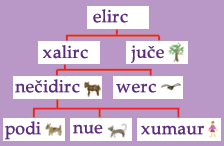
It’s worth noting that all cultures have categories; but not all emphasize them as we do. Premodern peoples—including the majority of Xurnese— tend to associate things by function, not category. Asked to find the subgroups within the set nue cat, red rabbit, teyp knife, the modern mind groups nue and red together as nečidircú mammals; the premodern groups red and teyp together on the grounds that knives are used to skin rabbits.
An obvious example is irony: a speaker says Yes susaur You’re brilliant to mean the opposite. Sometimes an ironical meaning is even lexicalized: e.g. the Mešaic term šuvičik ‘seek enlightenment’ was used ironically so often by the Endajué masters that šwečis now simply means ‘to be spiritually confused’.
Phatic communication is used to reinforce social bonds rather than convey information. For instance, English How do you do? is not a request for a medical diagnosis, it’s a greeting; the same is true of the Xurnese equivalent Maypayvú yunú?, literally Your parents are good?
We may also distinguish an utterance from a sentence. An utterance is a single speaker saying something, at a particular moment in time, in a particular context. This gets so messy that linguists and logicians prefer to deal with sentences, abstract statements without context. The optimist hopes that by getting the abstract sentence right, we’ll be in a better position to plunge into the grimy specifics of utterances. The pessimist may feel that focussing on ‘sentences’ is so artificial as to be counter-productive. If we want to learn how humans use language, we won’t get far by throwing out most of our subject matter.
We will focus on the interaction of language with the world under Pragmatics below.
It’s evident that words are much more complicated beasts than they look like in the dictionary. We deal seemingly effortlessly with a large mass of information about each word:
There are often idiosyncratic ways of referring to associated words: e.g. birds and sheep come in flocks, cows come in herds, fish in schools. In Xurnese domestic animals (e.g. cows or sheep) come in uykú, while small animals that move in unison (e.g. birds or fish) do so in ambrigas.
We can often find out more and more about a word’s meaning just by looking closer; George Lakoff wrote a 46-page analysis of the single word over. This gets into knowledge of the world; but there’s no firm boundary between knowledge about the word and knowledge about the world.
Another naive formulation is that all the members of a class have “something in common”, even if we are not sure what it is; Wittgenstein pointed out that this is not the case for many words, such as game, whose instances have family resemblances but do not all share a set of features. (This is even more true of šudo which also covers the ground of play, fun.)
Grammarians generally go farther; the morphology and syntax sections of a grammar are essentially the language’s operators, with the predicates and arguments left to the lexicon. But the lexicon is not merely a list; we know quite a bit about each word. (Foreign-language lexicons such as the one attached to this grammar are brief because they omit many complications, and because by providing glosses they leverage our own real-world knowledge.)
Syntacticians in the 1970s produced ‘semantic structures’ based on predicate calculus; e.g they would relate
Itep sukirc jeseji.to
Itep rapist kill-PERF.3s
Itep killed the rapist.
CAUSE(Itep, DIE(rapist))Some went on to treat nouns as predicates, leading to something like
EXISTS x, y SUCH THATPerhaps the same meaning underlies other sentences: e.g. The rapist was killed by Itep has the same semantic structure, but undergoes an additional transformation; Did Itep kill the rapist? has the same structure plus an element Q which queries truth value.NAMED(x, “Itep”) &
RAPES(y) &
CAUSE(x, DIE(y))
Many an ambitious grad student felt that, with just a few more semesters of work, the appropriate transformations could be modelled in LISP.
It’s worth playing with, just to see how far it can be taken. But as a model of either meaning or how the brain processes language, it’s at best very incomplete.
On Tuesday Itep caused the rapist to die on Thursday.
*On Tuesday Itep killed the rapist on Thursday.
amevati make one → ameac have sex +
ujivateč story → aujateč evidence +
pideč song → pídeč hymn (religious song)
revaudo newness → name of a religious awakening
šedirti sufferer → šedirc sick man
tibiki feel somewhat → civike pity
ewis world → wec milieu
yósuc tailored outfit → blouse
benki bless → beyk support
kezi command → kes govern
mexi mistress → mes woman
seješ clock → seješ machine
Šinkou the Xengi delta → šiyku any river delta
niwo grace → niwo gentleness
nugišik swallow → naušis suck
pavičik kiss → payčis embrace
puč stomach → puš abdomen +
rišidem lift → rešide get drunk
weš tail → weš buttocks
yaz cheek → yas mouth +
cue pour → host
miswen muscle → thug
rogu prison cell → rosik prison +
šuke color → tempera +
sagi sleep with → sas impregnate
kuzun a wonder → xuzu an attraction
makuri conquering → makri successful
wogi feel horror → weus regret
xul evil → xu bad
kokem knock → koke beat up +
suki pierce → saus rape +
sisikim annoy → sizike injure
zidi shudder → zic hate
baili amuse oneelf → bayl be dissipated
doumun domestic → dumu homely
meidemax peasantry → mídzex rabble
podei dog → podze rascal
ranaxun magical → ransu creepy
gi boy → xiu servant
us nose → up snout
zočuri different → zočaur heretical
dauxevi teacher → dzusey master, guruThere are also changes that simply reflect arbitrary changes in society:
demujidim await → denjidze hope
pojem drive animals → poje oversee
račazi whore → račaze entertainer
ewez a member of the third sex → intellectual → wes artistThe replacement of Mešaism by Endajué resulted in many Mešaic terms being reinterpreted negatively:
yaginari hunting preserve → yasinar retreat, spa
menalun of Mnau → mnalu outlandish
dzunan polytheist → bastard
nanudič child of two gods → nándzeš monster
šuvičik rise spiritually → šwečis be spiritually lost
duzočus rite → dzúčuc superstition +
čuzis fall apart → lose (a battle)One continuum may be likened to another; this provides terms for the extremes and sometimes points in between:
ejize poke → have sex
jisimel craven → tentative
kissu seedling → child
nudzis point → refer
orae leave → happen
peje stand → be (in a state)
šonuac spin thread → deduce
šwepusi fall short → disappoint
yucmel oily → cloying
Even more productive are metaphor systems, which can generate many expressions and be extended by speakers. Some examples common to Xurnese and English:
HEAVY IS IMPORTANT gisu heavy, important tegisu light, unimportant SHARP IS SMART isaur sharp, smart širi dull, dumb SOFT IS MERCIFUL mul soft, merciful dor hard, mean
LIGHT IS WISDOM
aul bright → clear
auliac brighten → explain
beriludo cloud-seeing → illusion
beyru cloudy → obscure
siluri brilliant
xorneac darken → make a mistake
HIGH IS IMPORTANT
bez low → humble
neymoro above → major
rešayc tall person → boss
šaumoro below → minor
SEX IS CONQUEST
mase conquer → seduce
nejasu soldier → ladies’ man
reuni besiege → pay court to
xauke skirmish → make a pass
ARGUMENT IS FIGHTING
šwedu mase win an argument
šwedu čuzis lose an argument
čaš opponent
ešinde counter, parry
A BUILDING IS A BODY
breš arm → wing
leš face → façade
dzuc back
teyš chest → main structure
mnórex clothes → decoration
giarji finery → rococo decoration
jiwe spine → main beam
tile rib → supporting beam
LARGE IS NUMEROUS
dari large → numerous
bip small → few in number
FEMALES ARE WATER
myun watery → effeminate
kagas dry → chaste (of males), impotent
rinari like a river → graceful
MALES ARE EARTH
sustri earthy → machoIn early Xurno, solidarity against the barbarians was an essential virtue; one of the key metaphors was THE EMPIRE IS A FAMILY. (This can be traced back to Axunai, but it was much more marginal; Axunemi absolutism was not very paternalistic.) The emperor referred to both cities and subjects as his children; he was called payp father and his policies approved as payvaur paternal. The Revaudo revolution countered this with a new metaphor THE EMPIRE IS A PREDATOR; this underlies the slang term ricayc royalist (= ‘wolfish’) as well as the verb riciac oppress = ‘act like a wolf’.
saumes earth-lady → lesbian
Other Xurnese metaphor systems which are not used in English, or used less extensively:
AN ARMY IS A BODY
newe brow → general
juysu head → commander
teyš chest → colonel
pučisu belly → major
reyxu thigh → lieutenant
xuc leg → sergeant
neja foot → infantryman
breš arm → vanguard
waysu nose → scoutThe movements of the body are also used for armies: neymore sleep = camp, jivi walk = march, etc.
The internal organs are used for nonce meanings, but these have not been lexicalized, except for the general xímex organs → support staff.
ARGUMENT IS ARCHITECTURE
Some of these derive at one remove from another metaphor system (A BUILDING IS A BODY).šwedu eši make an argument
dumu rickety → weak
gedzáysuš structurally sound
riykuirc bird’s nest builder → crackpot
cuystri leaky → full of holes
dax palace → proof
gij column → premise
šeyka roof → conclusion
puc floor → stage, step
teyš body of an argument
breš wing → side discussion
jiwe spine → crux of an argument
giarji rococo decoration → rhetorical excess
THE COSMOS IS A DANCE
cauč dance → cosmos
caučirc dancer → creature, spirit
bodeusis walk lamely → be foolish
reatudo movement → flux, fortune
rináric grace → acceptance of one’s fortune
WRITING IS DANCE
reátuc step, motion → action
reatudo motion → plot
brešísuc gesture → trope
MORALITY IS A PATH
ende path → morality
tegendi pathless → damned, depraved
jivirc walker → believer
pope drive (animals) → pastor (people)
misustri muddy → morally difficult
bem ga like a road → morally clear
WAR IS A PAINTING
nelima frame → context, casus belli
rímex sketch → strategy
šonasudo brushwork → tactics
ravom canvas → battlefield
šuke paint → blood
A SWORD IS AN ARM
uyk nail → edge
meyn hand → blade
xuba elbow → grip
néybreš upper arm → hilt
manyuma puff sleeve → basket hilt
SEX IS A RIVER
notanelu parched → lustful
ameatudo confluence → sex
ri flow → become excited
šiyku (imise) (reach the) delta → orgasm
xiaz ocean → post-coital happiness; sexual happiness in general
SEX IS A PAINTING
šónex brush → penisI’ve emphasized lexicalized metaphors here, but most of these metaphors are productive and can be used in phrases as well, e.g. ende pope lose the path → go wrong.
ravom canvas → vagina
šukeac paint → have sex
šuke paint → semen
He went further, identifying basic metaphors said to underlie our cognition, each based on direct bodily experience. E.g. the act of categorization itself is said to be a metaphor CATEGORIES ARE CONTAINERS.
We can zoom in to a smaller extent and treat the components of an object as entities: neywen o leš the front side of the bed. If an object’s plexity is changing, we can take the point of view either of the whole (Bumu ga paup čuzije The rock broke in two) or the pieces (Paup o teš čuzijuc The two halves of the rock broke apart).
An object may be treated as an extent (nelima o rumic buma meynú the box is 2 hands wide) or as a point (rónuc o nelima o dmuru bundeš meynú the box is 20 hands from the wall). Using the TIME IS SPACE metaphor system, events can be treated the same way: he lived for 70 years / he lived in the Age of Petty Kings.
An instance verb conceptualizes the action as occurring at a point in time:
But if you zoom in close enough to something pointlike, it becomes a perceptible extent— that is, a process:
Given an instance verb, we can zoom in to force a process reading:
With a process verb, we can zoom out till the process looks like a point again.
Sinde imišeji. He began to speak
Cu sindej na dzus pej. He’s just finished speaking

Sinde rap He keeps speaking.
Aycaur rap He’s always reading.
A moving perspective may be implied even if nothing is physically moving, e.g. in the following examples by the highlighted time expressions:
Rina neyo giesnar dzunyo jima.
river across castle afterwards hill
Across the river is a castle and then a hill.Rina rano kiras daumaur ga pejom.
river along villages times ADV stand-3p
There are villages now and then along the river.
kaym / kaynes buy / sellSimilarly, the choice of impersonal tas ‘us’ or ros ‘people’ depends on whether one pictures oneself inside or outside the group referred to:
rae / xame go / come
emurac / jireac marry a man / marry a woman
maypayvú / kissú parents / children
Bicikes ray dopalurač izom / ayzuc.
Academy in arrogant be-1p / be-3p
In the Academy we / people are rude.
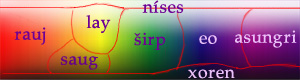
Color terms vary widely between languages in number and boundaries, but the focal or prototypical colors are nearly identical: Xurnese širp green has the same focal color as Verdurian verde, Kebreni kyr, Old Skourene -arṭ, Uytainese hur, Trêng šuda. However, it’s not the same as English focal green, because the eyes of Almean humans are not quite the same; ‘Almean green’ is slightly bluer than our green.
Languages may provide explicit ways of indicating how far a referent differs from the prototype:
The existence of basic categories answers Quine’s objection to ostension—e.g. that pointing to a rabbit cannot be used to define ‘rabbit’, since the speaker might be referring to rabbit noses, the act of running, or a miscellaneous collection of rabbit parts. Linguists studying language acquisition, such as Eve Clark, report that children apply some simple rules:
Of course, these categories are basic to humans. This is clearest with human-oriented words like sis chair, which are defined not so much by shape as by interaction with the body. But even the taxonomic categories are not ‘natural kinds’ pre-existing in the world. They are natural to human minds interacting with the world with human bodies.
Other slang terms are abbreviations or diminutives, or wordplay, or are borrowed from other languages:
Xurnese standard
meaningcolloquial
meaningaga baby newbie ejize poke have sex naušis suck drink heavily nulač ill messed up pidaup a drink alcoholic drink pucišu major gourmand tetiy chop off shut up weli old ones parents yas cheek mouth
As in English, there’s a continuum from colloquial to slang to obscene registers. Slang goes hand in hand with regionalism; if you’re departing from the standard, you’ll probably head in the direction of your native speech.
term gloss source bici Academy abbreviation of Bicikes endevu protegé abbreviation of endevugaup šara crap abbreviation of šaragú kurešiy girl, chick ‘trouser person’ nauziš eat Ṭeôši pečya boss Ṭeôši šuzir fabulous Ṭeôši galnu crazy Tžuro joir pal Tžuro nastuja whore Tžuro ingu booze Kebreni nabro captain Kebreni jusam stuff Verdurian
Words do not appear in their Axunašin forms. Xurnese script is partly logographic (with the consequence that logographs don’t reflect pronunciation at all) and partly syllabic; but the syllabary is highly archaizing. For instance, the script still distinguishes Axunašin e/ei and ou/o; in fact, this is the only way the script distinguishes c and t, or dz and d. Initial consonant clusters are still written with the ancient vowel; e.g. mnaur ‘wear’ is written minaur, while Mnau the peninsula is written Menau. Axunašin endings would be unusable in Xurnese. Thus the Axunašin spelling is generally unavailable, unusable morphologically, or not distinctive anyway.
Instead, Axunašin words are borrowed by meaning. Only if there is no clear cognate is the word borrowed by sound.
The worst offenders are books on magic and Mešaism, which use words in their classical meanings (e.g. mneušis ‘invite’ is used in its ancient sense of ‘gesture’, mes ‘woman’ in the sense of ‘mistress’, xu ‘bad’ as ‘evil’).
The earliest Endajué writings relate to a different stratum, the Old Xurnese of 1700 years ago. As these works are very familiar, the senses involve remain current, but may be restricted to religious contexts. For instance, dzaus ‘teach’ is still common, but for secular senses is replaced by zende, while xaleza ‘elite warrior’, like our ‘knight’, retains emotional resonance but is outmoded as a military term (cf. newe ‘general’, juysu ‘commander’).
Modern scientific terminology (including manufacturing and navigation) contains its share of Axunašin, but also heavily borrows from Tžuro (e.g. jeku ‘steel’), Kebreni (šenu ‘clock’), and Verdurian (e.g. resteko ‘telescope’).
Through the early Xurnese period the hours were sunrise to sunset, so they varied by the season. Astronomers and navigators preferred amuri (that is, equal-length) hours, and once good mechanical clocks existed (around the time of the Revaudo revolution), this became general.
Xurnese Axunašin time hours xora botino dawn 6 to 8 a.m. yeucino yoxino mid morning 8 to 10 a.m. šircino širtino late morning 10 a.m. to noon taucino tausetino early afternoon noon to 2 p.m. picino pinatino mid afternoon 2 to 4 p.m. baycino bantino late afternoon 4 to 6 p.m.
In ancient times the nighttime was not given hours; but kip ‘dusk’ was used for the first hours after sunset. By the Xurnese period the hour names were simply extended into the night, with the prefix nosuš ‘nocturnal’: e.g. nosuš yeucino mid-evening (8 to 10 p.m.). Now that lighting is better and evening events are common, the latter period is also known as kip dzus ‘after dusk’.
Xurnese prefers its more specific names for time periods, and has no terms for ‘morning’ and ‘afternoon’. However, two adjoining periods can be combined: yeušircino ‘2nd/3rd hours’ = 8 to 12 a.m., širtaucino ‘3rd/4th hours’ = 10 a.m. to 2 p.m., etc.
Few people recognize that the prefixes derive from the Wede:i numbers; their meanings are taken to be the times of the day, and can be used as abbreviations: e.g. taukéjuc ‘a meal eaten at noon’; baykejúcis ‘late afternoon snack’; pidéynduc ‘2:00 appointment’.
Hours are typically divided by fractions, e.g. taucino teč ‘taucino plus half a šaruc’ = 3 p.m. Astronomers divided the šarus into 100 deymisi ‘instants’, and clocks now have a déymis hand, so that city dwellers, at least, deal with times like picino li yumudeš deymisi ‘5 hours 80 instants’ = 4:36 p.m.
The hours can be used both to refer to the period of time, and to the instant that begins them. Thus taucino has increasingly displaced eudis ‘noon’, which however retains its metaphorical meanings such as ‘zenith, high point’.
(For simplicity’s sake I’ve treated the šaraup as exactly two hours; in fact it’s slightly longer, as the Almean day is about 24 1/2 hours long.)
day gloss indis first day pudis second day dzindis third day nimala market peykaudis fifth day seyčaudis sixth day šizaudis seventh day yusaudis eighth day tagri final (day)
Days are numbered within the season: e.g. dzayndešpayk kuludo ‘the 35th day of fall’. Each season has 82 days. (Because this doesn’t match our year, exact Earth equivalents can’t be given.)
season gloss Verdurian equivalent rough Earth equivalent eči summer 16 cuéndimar - 15 recoltë June / July / August kuludo fall 16 recoltë - 15 išire Sept / Oct / Nov raujic winter 16 išire - 15 bešana Dec / Jan / Feb sumbrey spring 16 bešana - 15 cuéndimar March / April / May
The numbering aligns with the calendar, not the movements of the planet; thus am eči ‘the 1st day of summer’ is New Year’s and precedes the solstice.
In ancient times the Axunemi emperors inserted a nonce leap day whenever the year wandered too far out of sync with the planet. This became chaotic in the Age of Petty Kings as a different schedule was followed in each kingdom. The Xurnese finally regularized the system by adding a leap day (an extra day in sumbrey) every five years.
Bezu ma-Veon Bezu son of BeonPatronymics appear after the name, a practice which dates back to Axunašin, where heavy modifiers could migrate after their head. The use of locatives is more recent and follows the standard modifier-head order.
Joraumiri Enirc Enirc of Joraumi
Jamimbri Xayu ne-Rilirc Xayu daughter of Rilirc of Jamim Colony
Naturally it wouldn’t do to have most of Inex surnamed Inegri; the locative may refer to the provenance of the parents or more remote ancestors.
In the cities, people are most commonly referred to using titles:
Aulic joraumirc Councillor AulicEveryone has a title—if nothing else róses ‘citizen’. If foreigners have a rank (e.g. dalonaysu ‘ambassador’, imimex ‘ship captain’) it’s used, otherwise they are neyosu ‘alien’, or empojaup if they are legal residents of Xurno. Other Thinking Kinds may be referred to using their species: Sulbelid gedzaysu ‘elcar Thulbelidd’.
Deru xairc Student Deru
Enirc jivirc Walker Enirc
Weneš bicikesiy Academician Weneš
Gašnue dzusey bicikesiy Master Academician Gašnue
Kaleon empojaup neyosu Permitted Alien Caleon
Raujic reyxu Lieutenant Raujic
Yute saus Cousin Yute
Within a family, kinship terms are preferred; elsewhere, religious, artistic, or military ranks. Titles of nobility are only used for foreigners (or in backwards areas like Bozan).
The title follows the name; this is not an exception to the rule that the head appears last in an NP, since the title is the head, as can be seen by the fact that on second reference the name, not the title, is dropped. That is, if you’re talking to Enirc you normally call him by his title, jivirc, not by his name. If you are talking to multiple jivircú, you use the full name and title.
Only close friends, lovers, and siblings use the name alone.
As Endajué disbelieves in gods and yet considers the Dance divine, you can insult someone both by calling them godless (nanač) or god-following (dzunan, nansu).
expletive gloss English equivalent tegendi pathless damned (very strong) nanač ungodly damned (less strong) tebengi (taboo-def.) darned, frigging berirri deluded godforsaken bodugri lame ignorant, irreligious end’ eš against path dammit! cuš eš against dance dammit! dzunan pagan infidel, bastard šwečirc striver fool nansu god-man pagan, priest-ridden i puide spit me damn me!
The Mešaic formula for making an oath was (god) leš sindú I speak before (a god), and this was transferred to the Path (ende), the dance (cuš), the Greater and Lesser Principles (šwerayjú), or the masters (dzuséy). Oaths are heightened with a little sacrilege; the difference between cuš leš and cus eš is similar to that between “dammit!” and “damn me!”
Similarly, to ask (say) Meša to curse someone, you said Meša toš puide! May Meša reject him! Endajué entities, abstract as they are, can be asked to do the cursing. (This construction is so ancient that it’s one of the few surviving uses of the subjunctive as an imperative.) As puide is now largely used literally (‘may it spit’), similar terms may be substituted, especially šauvide ‘may it vomit’ and mišide ‘may it piss’.
Bodily functions are a rich source of despectives, especially pija ‘shit’ and mišu ‘piss’ and their derivatives.
There are many vulgar terms related to sex, notably šim, jadzišis, dzaulišis, rijac ‘screw’, ri ‘be aroused’, zis ‘come’, naušis ‘suck’ There are two important differences from English, however.
term Subject Register ameac (anything but oral) formal dzaulišis uses the penis vulgar ejize (usually) penetrates colloquial jadzišis (anything but oral) obscene naušis uses the mouth colloquial reyxiš (anything but oral) neutral rijac is penetrated obscene šim penetrates vulgar zis orgasms colloquial
body part neutral colloquial vulgar euphemistic penis dzaul ejizirc ‘sticker’
ešis ‘tail’
jusu ‘spear’sausirc ‘stabber’
miširc ‘pisser’xumbri xim ‘male organ’
šónex ‘brush’testicles rízex šaup ‘eggs’ vagina xeje riyku ‘nest’
myunu ‘wet thing’
xeč ‘garden’bóneč ‘wound’
rijayc ‘open one’
kulum ‘clam’zimu xim ‘female organ’
ravom ‘canvas’vulva murayc moglu ‘oyster’ mišpay ‘piss-lips’ šaubri pay ‘lower lips’ genitals xim jad ‘butt’ (metonym) ameatri xim ‘sex organ’
reyk ‘thigh’
nar ‘place’buttocks weš jad ‘butt’ dzuc ‘back’ anus wéšeš jud jud ‘hole’ júcuy ‘big hole’
pijacirc ‘shitter’wéšeš ‘of the buttocks’ mouth bux yas ‘cheek’ jud ‘hole’
nauširc ‘sucker’
The boundary between semantics and pragmatics is vague and disputed, though as rough guide we may say that semantics deals with the meanings of words and sentences, while pragmatics deals with the way speakers use utterances in context. A short dialog may illustrate:
A: Yes muru kissu.Semantics seems to fully explain both sentences, and yet it is unable to explain even the basics of the exchange. A’s statement is evidently irony, the sentence’s meaning being interpreted as its opposite (aided by the deliberate choice of an expression that is insulting when applied to an adult). B’s question is logically a non sequitur, but we have no trouble taking it as an insulting rejoinder. Neither utterance is intended to convey or query a proposition, and thus truth conditions are irrelevant.
2s intelligent child
A: You’re an intelligent boy.B: Yes inar ray mneušije?
2s here inside invite-PAST.1s
B: Did I invite you here?
Yet these are not marginal examples; they’re typical of actual human conversation. Most broadly, pragmatics studies how language is actually used in the world.
They are not at all mysterious; they’re chiefly interesting to logicians because they so glaringly prevent abstract evaluation of the truth of sentences. For instance,
Cimai Aulirimes o payp zi.is the sort of sentence logicians love; we can easily decide whether it’s true, or with more sophistication, consider the set of possible worlds where it is true. But we can’t do the same with
Timai Uliromez of father be-PAST.3s
Timai was the father of Uliromez.
Aulirimes o payp zú.This can only be evaluated as an utterance: its truth depends on whether the person who speaks or writes it is in fact the father of Uliromez.
Uliromez of father be-PAST.1s
I am the father of Uliromez.
A related phenomenon is anaphora— expressions which refer to a previously cited entity or action.
Cimai Asunai o nyei zi. Toš Aulirimes o payp zi.Here the logician is on firmer ground, since toš ‘he/she’ refers back to Cimai. The rules for interpreting anaphora can be complex (e.g. determining their scope), but the problems are largely technical. Note however that anaphora can be used without an antecedent—for instance, pointing at someone— and thus reduce to deixis:
Timai Axunai of emperor be-PAST.3s / 3s Uliromez of father be-PAST.3s
Timai was emperor of Axunai. He was the father of Uliromez.
Toš Aulirimes o kissu ze.Extra points to readers who speculate that all words are in some sense deictic. For instance, Cimai in the first example might refer to my pal Cimai from dance class, and he’s not the father of anyone named Uliromez— he’s gay.
3s Uliromez of child be-3s
He [pointing] is a child of Uliromez.
Ordinary nouns like payp ‘father’ normally, like names, refer to single individuals rather than to a class. The difference from deictics is not binary; it’s a matter of how much additional informational content is provided. Yes ‘you’ provides only the information that the referent is singular and animate; compare Cuêzi lei which can only be used for females, or English you which is indeterminate as to number. A word like xumaur human provides little more information than these pronouns; a full noun phrase like Cimai o mul mau xursu Cimai’s fat bald neighbor offers quite a bit of information but still may be ambiguous.
A: Deru Bicikes eyka jam?If A were a logician, he would complain that B’s response is entirely irrelevant. Paul Grice pointed out that such replies make sense if we assume that speakers follow conversational maxims, and exploit apparent violations to convey subtle messages. The full maxims can be easily found elsewhere, but they can be summarized as follows:
Deru Academy for object
A: Is Deru Academy material?B: Deru. An, yu ze, plima lumaup.
Deru / well pleasant be-3s / very clean
B: Deru... well, he’s pleasant, very clean.
Often implicatures can be treated as adding unspoken propositions: the speakers can be taken as intending some specific statement (e.g. Deru šemilač Deru is incompetent) but not saying it. However, as Sperber and Wilson take pains to show in Relevance, there is no guarantee that all the implicatures of a statement are consciously present and intended. To take a simple case, B might have responded as follows to A’s query:
B: An... Yes Deru mwele.Like the first statement, this information is strictly irrelevant, and implicates that Deru is not a prime candidate; but unlike it, it does not commit to a simple proposition. It appeals to common knowledge without pinning it down— B may be referring to any number of known facts about Deru; B may not even be able to explain what Deru’s problem is; A’s impression of Deru need not be the same as B’s. (So much for the conduit metaphor of language: that the speaker has a fixed meaning in her head, dehydrates it into an utterance, and passes it to the hearer, who rehydrates it into a copy of her original meaning).
well / you Deru know-3s
B: Well... you know how Deru is.
Are the maxims culturally variable? Certainly what is relevant varies by culture. For instance, if B replied
B: Toš jue li kezaudo o zebiš, li čeiyu sinc.this is irrelevant to a career in art, and we might take it to implicate that he shouldn’t study it. But in artist-run Xurno, the Academy is effectively the government, so the implicature would be that Deru could be a valuable Academician, despite his lack of purely artistic skills.
3s war and government of expert and Ṭeôši speak-3s
B: He’s an expert in government and war, and he speaks Ṭeôši.
More subtly, the Xurnese differ in their expectations as to Quality and Manner. For instance, the Xurnese are famous for understatement; they seem to follow a maxim Do not tell all you know. This is said to derive from the ways of speaking of the early Endajué kešaup dzuséy, or from the need for secrecy during the Gelyet occupation.
For instance, in the statement
Tir ew šemil šukirc li reykeumar Jamim o raysu.the choice of adjective šemil ‘competent’ must be taken as high praise— we would probably say ‘outstanding’.
3s-GEN grandfather competent painter and settlement Jamim of member
Her grandfather was a competent painter and a member of the Jamim colony.
A famous example is the reply of a Xurnese diplomat to an indiscreet query from a Verdurian:
V: Oyes ros cu treše nowsuc na seješi ma?The claim that the country has one cannon is rather absurd; the implicature is that Xurno possesses many more such devices, but that the speaker won’t specify how many.
your country that black.powder burn-3p SUB machine-PL have-3s
Does your country have machines that burn black powder [i.e., cannons]?X: Am.
one
We have one.
Similarly, the Xurnese idea of sufficient clarity falls far short of our ideas (or the Verdurians’). The kešaup dzuséy relied frequently on indirection and parable, while Xurnese poets strove for suggestiveness, wit, and erudite allusion. The following dialog would be rather impolite in Verdurian:
A: Yes Inex ray neux?B is quoting a poet, who happened to be a native of Inex. If A happens to know the poet, he might take B as implicating that he also is a native. On the other hand, the Xurnese feel no need to fully answer an idle question; a polite response is to say something else about the invited topic. B’s implicature might be taken as ‘I won’t say, but I am listening and I do acknowledge that we’re talking about Inex.’
2s Inex in be.born-PERF.3s
Were you born in Inex?B: U Inex... Xurno o gopri melen.
oh Inex .. Xurno of beating heart
Ah, Inex... the beating heart of Xurno.
So is the meaning of ordinary-language bunji (as opposed to logical some) more than one but less than all? Not at all, because we can without contradiction say:
Bunji keprisú xudircú, zuryo ez.We can say that bunji has the meaning of logical ‘some’, but has the implicature that the quantity is more than one and less than all. (By the maxim of quantity, if the speaker knows that all Kebreni are cheaters she should say so.) Implicatures can be explicitly denied without contradiction.
some Kebreni-PL cheater-PL / truly every
Some Kebreni are cheaters, in fact all of them.
Due to the Xurnese predilection for understatement, we can’t say that the example implicates (as the English gloss does) that most Kebreni are not cheaters.
Similarly, Bicikesiy dzi endevugú ma The Academician has three protegés logically implies that he has two, but it implicates that he has no more than three. Again, the implicature can be explicitly overridden: Bicikesiy dzi endevugú ma, zuryo peyk The Academician has three protegés, in fact five.
(If the implicatures are features of a word rather than deduced by the maxims of converation, Grice called them conventional implicatures; I prefer lexical implicatures.)
Yes cu wu mes xaučij na zeneji.both presuppose that the old lady was dead. So does the interrogative: Yes cu wu mes xaučij na zeneji ma? Did you know that the old lady was dead? The presupposition is associated with a trigger, in this case the word zene ‘know’. Auxiliaries generally preserve the presupposition as well: Yes cu wu mes xaučij na zene šarasimiji You should have known that the old lady was dead.
2s that old woman die-PERF.3s SUB know-PAST.3s
You knew that the old lady was dead.Yes cu wu mes xaučij na zeynuči.
2s that old woman die-PERF.3s SUB not.know-PAST.3s
You didn’t know that the old lady was dead.
There is a bewildering range of presuppositions, as suggested by the following list. The symbol >> stands for ‘presupposes’. The highlighted expression is the presupposition trigger. For brevity, only the positive is supplied in Xurnese.
Deru Itep xwe tasej.Like lexical implicatures, presuppostions can be denied, though with restrictions. For instance, an outright denial following a positive statement is anomalous:
Deru Itep fight-INF stop-PERF.3s
Deru stopped / didn’t stop fighting with Itep.
>> Deru had been fighting with ItepMaysu puciga rile na jidzeji.
iliu again draw-INF SUB suffer-PAST.3s
The iliu was / wasn’t seen again.
>> The iliu had been seen beforeToš braup pej.
3s busy stand-3s
He’s (not) busy right now.
>> He is not always busyToš e Itep nokrebeji na Deru krendej.
3s against Itep cheat-PAST.3s SUB Deru accuse-PERF.3s
Deru accused / didn’t accuse Itep of cheating on him.
>> Deru believed that cheating was badCu oyes endevugaup ize na gesauliri zú.
that your protegé be-INF SUB proud be-1s
I’m proud / not proud to be your protegé.
>> I’m your protegéCu tas seyasú masejom na dzušši nauna mum.
that 1p Seia.PL conquer-PERF.1p since SUB peace have-1p
Since we conquered the Seia, we’ve had / haven’t had peace.
>> We conquered the SeiaNyew dzuséy aujimijeyc keno, jam pali još šu.
emperors masters listen-3p.PAST.SUBJ if / thing more good be-3s.SUBJ
If the emperors listened to the Masters, things would / wouldn’t be better.
>> The emperors didn’t listen to the MastersXamunar nao ir šu e gemaudo i tazdeju. (nominalization)
salon about my uncle to admission 1s.ACC shock-PAST.3s
The salon’s admission of my uncle shocked / didn’t shock me.
>> The salon admitted my uncleCu reykeumar Jamim nej na Xayu plima giarmel ze. (subordination)
that settlement Jamim born-PERF.3s SUB Xayu very condescending be-3s
Xayu, who was born in Jamim Colony, is / isn’t very condescending.
>> Xayu was born in Jamim Colony
??Yes cu wu mes xaučij na zeneji, li toš xaučis šuči.More precisely, then, there are contexts or special circumstances under which the presupposition can be removed. E.g. zene ‘know’ in the first person:
2s that old woman die-PERF.3s SUB know-PAST.3s and 3s die-INF not-PAST.3s
You knew that the old lady was dead, and she wasn’t dead.??Maysu puciga rile na jidzeji, pel toš pip ga rile na duoyo.
iliu again see-INF SUB suffer-PAST.3s / but 2s before ADV see-INF SUB never
The iliu was seen again, but she had never been seen before.
Cu wu mes xaučij na zeynauč, li toš xaučis zuryo šuči.(This sounds better with stress on zeynauč /know.)
that old woman die-PERF.3s SUB know-PAST.1s / and 3s die-INF truly not-PAST.3s
I didn’t know that the old lady was dead, and in fact she wasn’t.
Puciga ‘again’ takes a bit more context:
There were rumors that an iliu had been seen in the city. There was intense excitement, but nothing could be confirmed. In a few months the furor had died down. The iliu wasn’t seen again.
J.L. Austin challenged this view, first drawing attention to performatives, sentences which do not convey information, but actually accomplish a task:
Yes šukecudo xamunar o raysu eyka cuzasum.Performatives don’t have truth conditions, but they do have felicity conditions— e.g. one who utters the first example must have authority to admit members to the salon, must be speaking to a prospective member, must not have admitted the person already, etc.
you painting salon of member for select-1p
We accept you as a member of the Salon of Painting.Yes tom cu toš šwepusey na ej ximú
you DAT that 3s fail-FUT.3s SUB ej bet-1s
I bet you an ej that he’ll lose.
Expressions like imperatives can also be seen as performatives— Puxame! Go back!
It’s a small step now to maintain, not that performatives are an unusual subclass of utterances, but that informative utterances are just one subclass of speech acts. All utterances do something: inform, remind, disagree, complain, promise, warn, announce, propose, lie, flatter, persuade, mock, amuse, joke, threaten, praise, boast, show respect, kill time, show solidarity, express an aesthetic reaction, greet, apologize, and so on.
Speech acts should not be confused with syntactic or morphological categories. The imperative, for instance, is often an order, but it may just as well be advice, pleading, or a dare; in particular expressions it can be almost anything— e.g. empeuš ‘permit (it)’ is used to apologize for an interruption, and idiomatically marks the beginning of a lawyer’s plea. As well, orders can be expressed by questions (Would you please go back?) or declaratives (If you know what’s good for you, you’ll go back).
Adverbials may refer to the speech act rather than the content of the sentence.
Brumel ga joraumirc i šigosuac.Brumel ga ‘frankly’ doesn’t modify the verb šigosuac— it doesn’t tell how the Councillor bores me. It relates to the speech act, that of informing. Even more subtly:
honest ADV councillor 1s-ACC bore-3s
Frankly, the Councillor bores me.
Bunji misi, moz o busaum još ma?Here bunji misi ‘in brief’ doesn’t refer to the question itself, or to the speech act of asking, but to the addressee’s expected act of answering.
some word-PL / maiden of long.poem good or
In a few words— is the girl’s poem any good?
Yes seješ rano civike rile.
2s device through please look-INF
You will please look through the instrument.
This section is based on the methods of conversation analysis, and focusses on the prototypical case of two people conversing face to face. Extension to multiple speakers is not difficult. Obviously speech contexts such as lectures, court sessions, and meetings have different rules.
Xurnese culture, even after the egalitarianism of the Revaudo revolution, is more hierarchical than our own. The Xurnese are always conscious of relative status, and this affects turn-taking behavior.
It should be emphasized that the Xurnese are not (in general) overbearing; the above behaviors are nearly unconscious. Indeed, high-ranking speakers often speak with elaborate courtesy, and insist loudly that everyone should talk pešaycú dzu ‘as among friends’, an invitation that it is unwise to accept.
Generally multiple people are not to talk at once. However, women (of the same rank) may interrupt each other: if one feels that the other has gone on too long, she may simply start speaking. Usually the other will break off; if not, the interrupter will usually stop.
These are the building blocks of conversation, especially as they can be nested. For instance, a request may have one or more nested questions:
- greeting/greeting
- question/answer
- offer/acceptance
- apology/minimization
- request/fulfillment
- assessment/agreement
- complaint/apology
- objection/counter
- insult/riposte
- closing/closing.
REQUESTThere are preferred and dispreferred responses for each adjacency pair; dispreferreds are marked by pauses, longer replies, explanations, and pragmatic particles such as an ‘well’. Compare two responses to an invitation:
A: Šuema pic denidzú.
beer drink-INF hope-1s
I’d like a beer.QUESTIONFULFILLMENT
B: Saug ma ušu?
brown or gold
Dark or light?
RESPONSE
A: Civike saug.
please brown
Dark, please.
B: Cunde ma.
that.way have-3s
Here you are.
INVITATION/ACCEPTANCEPauses are indeed so characteristic of refusals that silence may be taken as a negative response:
A: I keumis picino?
me visit-INF late.afternoon
Come see me later this afternoon?B: Wéneš ga.
happy ADV
With pleasure.
INVITATION/REFUSAL
A: I keumis picino?
me visit-INF late.afternoon
Come see me later this afternoon?B: An... (térus) yes plima niun. (térus)
happy ADV / you very kind
Well... (pause) You’re very kind. (pause)B: Mojurači ze... koma ga cim šaragú; ir mayp cunde denjic...
impossible be.3s / home ADV sit must-1s / my mother that.way expect-3s
It’s not possible... I have to stay home, my mother is expecting it...
REQUEST/REFUSAL
A: Yes ir gejúpuy aycaur ruide ma?
you my novel read-INF want-SUBJ.3s or
Would you like to read my novel?B: (terudo)
(silence)A: Af... gerizagú; yes braup pej...
oops... understand-1s / you busy stand-3s
Ah... I understand; you are busy...
REQUEST PRE-SVery often the pre-s questions a felicity condition of the request. For instance, felicity conditions for accepting an invitation include not being busy, being in town, being willing to come, perhaps enjoying the type of event, etc. Any of these can be used in a pre-s, thus heading off a direct refusal.
A: Yes kip dzus braup ma?
you dusk after busy or
Are you busy tonight?B: Šač, ji xam?
not-1s / what come-3s
No, what’s up?REQUEST
A: Gašnue o dámis ray grijil zú, xaxau ambriga šonkiac šizenimom?
Gašnue of class in confused be-1s / anatomy together examine can-1p
I’m lost in Gašnue’s class, could we go over anatomy together?
INVITATION PRE-SPre-sequences are especially characteristic of a low-status person addressing a higher one— a nervous person may even have a pre-s for asking a question:
A: Yes cu Rorsus bicikesiy dzudis cuey na zen?
you that Rorsus Academician tomorrow host-FUT.3s SUB know-3s
Did you know that Academician Rorsus is throwing a party tomorrow?B: Cunde, tegendi cúeč e yes mu eraeyu.
that.way / pathless party to you with attend-FUT.1s
Yes, I’ll go to the damned party with you.
QUESTION PRE-SThe habit of issuing a pre-s is so ingrained that one may be given even for an insult:
A: Yes tom bunji zenise mojú?
you DAT something ask-INF may-1s
Can I ask you a question?
INSULT PRE-S
A: Cu yes tom naundú na zen?
that you DAT name-1s SUB know-3s
You know what I call you?B: Donde, i tom ji nauc?
no.way / 1s-ACC DAT what name-3s
No, what do you call me?
STORY PRE-SStories may be followed by a contentless statement which serves to indicate that the story is over, prompts for a response, and signals that ordinary shorter turn-taking can resume.
A: Deru xairc nao zen?
Deru student about know-3s
Did you hear about student Deru?B: Šači, ji oraeji?
not-3s / what happen-PAST.3s
No, what happened?
STORY WRAP-UP
A: Li cunde oraeji.
and that.way happen-PAST.3s
So that’s how it went.B: Oa... yu edum!
wow / fitting idiot
Wow, what an idiot!
GREETINGBetween peers only the first and third parts are necessary, and may be combined:
A: Yes payčú, Weneš bicikesiy.
2s greet-1s / Weneš academician
Greetings, Academician Weneš.B: Yes payčú.
2s greet-1s
Greetings.INSTITUTIONAL QUERY
A: Xamunar čiyče jic denjidzú?
salon prosper-INF Q hope-1s
The Salon is prospering, I hope?B: Još cu ende.
good that path
The Path is good.PERSONAL QUERY
A: Oyes kissú yunú?
your child-PL good-PL
Your children are well?B: Kyes yunú, kalordú.
3p good-PL / thank-1s
They are, thank you.
GREETING + PERSONAL QUERYNone of these queries actually seek knowledge, and it’s quite anomalous to answer with actual information. If Itep’s parents were ailing, there would be nothing unusual in the above exchange being immediately followed by a real inquiry after their health and an honest answer.
I: ’s payčú, Xayu, maypayvú yunú?
2s greet-1s Xayu / parent-PL good-PL
Hello, Xayu. Your parents are fine?X: ’s payčú, Itep, yunú.
2s greet-1s Itep / good-PL
Hello, Itep, yes, thanks.
Similarly, even a hostile conversation will begin with these ritualized preliminaries. No complaints or insults are allowed till after the greetings are executed. (Written letters have similar rules for polite greetings, which can lead to a comic transition from first to second paragraph in the case of an angry letter.)
Closings between peers require two adjacency pairs. The first, the pre-close, signals that the speaker thinks the conversation is over, but invites the other to bring up any new topics if any. If she is reassured, good wishes are exchanged.
PRE-CLOSEIf Xayu did not want to end the conversation, she would take the floor and bring up a new topic during the pre-close.
I: Cunde, još ga.
that.way / good ADV
OK, good.X: Cunde.
that.way
OK.GOOD WISHES
I: Oyes ende yu šu.
your path good be-SUBJ.3s
May your path be pleasant.X: Oyes mucauč.
yours also
Yours too.
With superiors, there is usually another pair after the pre-close, expressing thanks to the superior’s institution. The superior will also echo the final good wishes more exactly.
An, Zendey— árus zenday— yes oyes jam, oyes dámis u, dmoyo inar, dzaus ruide keno— u, rue cutun, čawke li sim... an čawke wes šaragú li sim čeji cunde.However, most of extra material is due to the repeated use of repairs, which go back and replace a portion of the ongoing sentence. For instance, the speaker began to use a keno ‘if’ construction, but changed it to a less tentative cutun ‘therefore’ construction; he simply supplies the new words rue cutun which are understood to replace ruide keno. If we show pragmatic markers in blue and repaired material in green—
well teacher / árus teacher / 2s your thing your class er really here teach-INF want-SUBJ.3s if / er want-3s therefore / table and chair-PL / well table move-INF must-1s and chair-PL carry-INF must-1s OK
Well, Instructor— Instructor árus—if you want.. er, since you want to hold your thing, your class, er, right here, the table and chairs have to— well, I have to move the table and get the chairs, OK?
An, Zendey— árus zenday— yes oyes jam, oyes dámis u, dmoyo inar, dzaus ruide keno— u, rue cutun, čawke li sim... an čawke wes šaragú li sim čeji cunde.we find that the material in black is now a clear, well-formed sentence: Instructor árus, since you really want to hold your class here, I must move the table and get the chairs.
well teacher árus teacher / 2s your thing your class er really here teach-INF want-SUBJ.3s if / er want-3s therefore / table and chair-PL / well table move-INF must-1s and chair-PL carry-INF must-1s OK
Self-repair is preferred to other-repair, which will be marked with hesitations and other indicators of a dispreferred response (at least among peers; brusque other-repairs are a privilege of authority).
A: Cutun, yes rindudo dzausí.Embedded repairs are a bit more polite:
therefore you drawing teach-FUT.3s
So, you’re teaching drawing.B: An... do geun ga... šukecudo dzausiye.
well / not correct ADV / painting teach-FUT.3s
Well, not exactly... I’m teaching painting.A: Af cunde, šukecudo, još ga.
oh that.way / painting / good ADV
Oh right, painting, very good.
A: Cutun, yes rindudo dzausí.
therefore you drawing teach-FUT.3s
So, you’re teaching drawing.B: Dzindex xaircú tom šukecudo dzausiye.
thirty student-PL DAT painting teach-FUT.3s
I’ll be teaching painting to thirty students.A: Oa, šukecudo o dzindex xaircú, toteus.
oh painting for thirty / too.much-3s
Oh, thirty for a painting class, that’s too much.
Pragmatics lets us be more specific: well, for instance, marks dispreferreds. Oh acknowledges new information; uh prolongs a turn or marks dispreferreds; by the way introduces a topic jump.
Some pragmatic markers and expressons in Xurnese:
Marker Usage an Marks dispreferreds. (If emphasized, prolong the n.) An... ir šonaup ci nox laumiye.
PT my hair-PL that night wash-FUT.1s
Well, I’m washing my hair that night.u Marks receipt of new information or a new topic. U zene šuč.
PT know-INF not-PAST.1s
Oh, I didn’t know.af Withdraws an offer. (Pronounced ingressively.) Af, yes mavirc ci idzum ma.
PT you lover this now have-3s
Ah, you aleady have a boyfriend.cunde Underlines a point of agreement (often recapitulated), or urges attention to a an important point. Cunde, li yes toš ešreac jende denjic?
PT and 2s 3s stop-INF how expect-FUT.3s
OK, and how will you stop him?oa Marks appreciation of a story, offer, or new fact. Oa, yes cu cunde sinc na niu.
PT you that that.way say-3s SUB kind
Aw, you are very sweet to say so.on Holds the floor, or marks dispreferreds. (If emphasized, prolong the n.) On... beč i de.
PT chicken me give-INF
Uh... I’ll have the chicken.keno Introduces a new topic. Keno... ir jire jinar?
if my wife where
Hey... where is my wife?još ga Ends a digression, or underlines an agreement. Još ga... dzunar ray xa nao...
good ADV / hallway in corpse about
Anyway, about that corpse in the hallway...nay Calls attention, or requests the floor. Nay, teris, dzutri izom!
PT / shut.up-INF / somewhat.late be-1p
Hey, shut up, we’re late!ma jende Marks tag questions, and as an extension, yields the floor even when not asking a question. Jidil, ir pudim xaulip reátuc zi, ma jende?
resultingly my week evil movement be-PAST.3s / or how
So my week was a disaster... how about you?zezin Acknowledges a point but suggests that it should be obvious. Zezin, joraumirc rinde zenači.
learn-3s / councillor draw-INF not.know-3s
Yeah, the Councillor can’t draw.ez Dismisses a series of objections or offers. Ez... yes toš mneušayp.
PT / 2s 3s invite-FUT.3s
Yeah yeah. (I tell you) you’re going to ask her out.
Let’s follow (part of) a conversation, adapted from A Diary of the Prose Wars (for more on this work, see the Examples). We’ll point out how the narrative focus changes, as well as other pragmatic phenomena. Two students— a couple, Deru and Itep— are talking.
Itep: Bicikesiy o cúeč e eraeyu.Though the word order here is unmarked, it’s clear that we’ve joined this conversation in medias res, because Itep would probably not introduce the idea of the party this way. It’s typical for new information to appear at the end of the sentence—in this case, Itep’s determination to attend.
Academician of party to attend-FUT.1s
Itep: I’m going to the Academician’s party.
Deru: I nao ji?This is an explicit, conventionalized way to raise a related topic— Deru himself. It’s an implicature (not a certain deduction) that he isn’t abandoning the previous topic (the party), but injecting himself in it, inasmuch as Itep didn’t include him in her first-person declaration.
1s-ACC about what
Deru: What about me?
Itep: Yes nao, cuš nao ji?A curious structure for something of a non-response. The formula X nao ji? asks “What about X?” Here X is stated, then replaced with the pronoun cuš, a form of topicalization, emphasizing X even more. But X is just an indirect quotation from Deru’s own utterance. Itep refuses to add a comment to this topic. If she’s following Grice’s maxims, her implicature could be that the new information is obvious. But perhaps she isn’t being cooperative at all— her refusal to supply the information is itself the message.
2s about / that about what
Itep: What about you?
Deru: I mneušis šučuc?Deru is forced to draw out the implication himself. He also makes it clear that the overall topic remains the party. The choice of impersonal 3p is intentional: Deru makes it clear that who’s issuing the invitation is of no importance; the focus is on his being left out.
1s-ACC invite-ACC not-PAST.3p
Deru: I’m not invited?
Itep: Yes mneušis šučuc.
2s-ACC invite-ACC not-PAST.3p
Itep: You’re not invited.
Itep confirms the implication; the absence of any mollifiers suggests either mockery or annoyance.
Deru: Syu je šenyu na denjic?Since syu is never required, its explicit use serves as a topicalizer: me, or by metonymy, my feelings. Deru’s tortured syntax corresponds to his frustration: the inner clause is all about what he should do (“Me, what will I do”) and yet is subordinated to a question about Itep’s intentions; the implicature is that Itep is responsible for him. The discussion has shifted from the party itself to its consequence— Deru being left alone.
1s what do-FUT.SUBJ.1s SUB 2s expect-3s
Deru: What am I supposed to do with myself then?
Itep: I puide jende zenimú? Braupač kip nej. Koma e moz murae.Itep belittles the question but answers it— on the surface. Taking things literally can be a form of mockery: she is disdainfully refusing to address the implicature (Deru feels left out). Or she simply refuses to take responsibility for amusing Deru.
me spit-SUBJ.3s how know-SUBJ.1s / unbusy dusk use-INF / home to girl bring-INF
Itep: How the fuck should I know? Take it as a night off. Invite a girl home.
Deru: Moz koma e murae xamač. Yes nulač tun zi? Bumasú cumoro gemimayc na rues xu zi ma?Again, Deru is forced to make his complaints more explicit... which underlines by contrast how often the ‘real subject’ of our conversations is kept implicit. He still uses some indirection, complaining that people (again, unnamed ones) won’t treat them as a couple; his real complaint is that Itep isn’t doing so.
girl home to bring-INF not.come-1s / 2s unwell why be.3s / couple like accept-SUBJ.3p SUB want-INF wrong be-3s or
Deru: I’m not going to invite a girl home. What’s the matter with you? Is it wrong to think we should be treated like a couple?
He doesn’t accurately quote Itep’s koma e moz murae, but switches ‘girl’ and ‘home’. Topicalizing moz makes the hypothetical girl more real. Itep’s phrasing is impersonal: “bring someone home— maybe a girl”. Deru focusses on the girl almost as an intruder: “Some girl, yeah, bring her home.” A subtle difference in syntax brings out their different attitudes toward infidelity, and thus toward their relationship.
Itep: Bicikesu ga bumasú šačum. Emu ize šarasum, mat endevugaup.Language includes meta-language: it’s always possible to go from use to mention, focussing on the forms or definitions of words. This can be done for play, to point out imprecise or incorrect assumptions, or as pedantic obstruction. Itep, more worldly than her boyfriend, points out that the artist class of the 3100s did not socially recognize mere romantic liaisons. From her point of view, Deru is making foolish objections and it’s sufficient to swat them down. By not addressing the real cause of complaint she denies it validity.
academic ADV couple not.be-1p / husband be-INF must-3p or protegé
Itep: In academic circles we aren’t a couple. You have to be married, or a mentor/protégé.
Deru: Yes tegendi Bicikes jideym xaušije? Bicikes yes cuš zic.In a failed argument, people behave like logicians: they focus on the surface meaning of the last utterance. Deru seizes on Itep’s Bicikesu ga Academically speaking, treating it not as a matter of social fact, but as an adherance to academic values. This allows him to point to a supposed contradiction with her oft-stated feelings about the Academy.
2s pathless academy when respect-PAST.3s / academy 2s that hate-3s
Deru: Since when did you ever give a fuck about academic circles? You hate the Academy.
The second sentence topicalizes its object. Bicikes ‘the Academy’; this has the effect of emphasizng the comment, namely Itep’s hatred.
Itep: Yes end’ eš je nao baus? Revaudo o tegendi xau yes cuš ukošim ma? Cuš nao šači. Yes cúeč e mneušis šačuc luk yes bodugri auris cumoro cauč, ceš nao jam.What in the name of the Path are we talking about? That is the question for narrative theory. By this time a lot is on the table: the Academician’s party, Deru, Deru’s empty evening, Deru’s feelings, the couple’s differing expectations, the Academy itself. Though we can juggle many topics at once, an orderly discussion focusses on one at a time, and closes out subtopics as they occur, returning to the larger points. A failed discussion leaves everything open, which probably underlies Itep’s frustrated question.
2s path against what about tell-3s / Revaudo of pathless study 2s that tend-SUBJ.3s or / that about not-3s / you party to invite-INF not-3p therefore 2s lame bear like dance-3s / this about thing
Itep: What the fuck are you talking about? Did you get interested in pathless Revaudo theory? I think not. I think it’s about you getting your precious nose out of joint because somebody didn’t invite you to a party.
Itep restates the topic as she sees it, addressing Deru’s feelings directly for the first time, but dismissively. To state a topic is in part to control the discussion. This being an argument, Deru will take this as an aggressive move and simply deny Itep’s formulation.
Her strong language derives from Endajué, still the spiritual touchstone of Xurnese culture. To be off the path and to “dance like a lame bear” are vivid images of depravity within Endajué, much more so than references to sex.
We’ve already encountered examples of politeness in Xurnese:
Negative face is threatened by orders, requests and threats (which limit freedom of action), offers (which may generate debts), and expressions of envy or anger. Positive face is threatened by disapproval and contradiction, inattention, or irreverence.
Oyes mnórex yeuš.
2s-GEN clothes strip-INF
Take off your clothes.
Mabri, cu eraom na cir dámis ray dmoyo šagú... yojaup ga toy rinde šarasum, ma jende?
Mabri / that attend-1p SUB 1p-GEN class in really fail-1s / nude ADV 1p-ACC draw may-1p / or how
Mabri, I’m doing so badly in this class of ours... maybe we could model nude for each other, you think?
Xirc ize rugač, pel i tom jujoš de yes civike rue... bunji yojaup ga rindudo mis šaragú.
lemon be-INF not.want-1s / but 1s-ACC DAT boon give-INF 2s please want-3s / some nude ADV drawing have-INF must-1s
I don’t want to be a bother, but if you could please do me a favor... there’s a little nude modelling I need done.
Yoyaup imisenyu na cinar zenač. Ezisu ruzenejú.
nude find-SUBJ.1s SUB there not.know-1s / everyone ask-PAST.1s
I don’t know where I can find a model to sketch. I’ve asked everyone.
The opposite vice (ezmavračudo) is not so much ill will toward all, as selective good will— i.e. prejudice, treating women worse than men, the poor worse than the rich.
The opposite vice (xaušmelačudo) is disrespect or impertinence.
This sort of humility became much easier for the nobles when the Gelyet invaded and took their lands, and then the new Xurnese state arose, which created new estates for its generals rather than restoring old ones. The old nobles largely became artists; both their aesthetics and their manners were suited to people with little money whose taste was formed when they had more.
The opposite vice would be dopaluračudo ‘immodesty, arrogance’.
From a Xurnese perspecctive, Deru and Itep’s discussion (under Narrative) is obviously an argument, but neither is particularly impolite. Neither is prejudiced, and since their rank is the same there is no real issue of deference or modesty. Deru’s naïveté about Academic norms would be less forgivable to Xurnese readers, but they would see little wrong in his making demands— or in Itep refusing them. They’d agree, however, that the couple shows little solidarity and would wonder if they’ll last together.
By Almean standards, the Xurnese are dismayingly egalitarian— in southern Eretald, horrified officials have gone so far as to ban discussion of Endajué, which seems to them to upend the natural order. Modern Americans will however dscover differences from their own ideas of politeness:
Rorsus bicikesiy, cuš edúmeč.
Rorsus academician / that.one idiocy
Academician Rorsus, that’s nonsense.
As a random example, here’s the beginning of a diary entry from Academician Rorsus in the Diary of the Prose Wars:
Cu čawke o xúdeč ji ze na zenisimayc cideym— li zenisayc denjitrač li teč ga orkaymaup izraudo mu— cu palači jam jad na ešindimú.Let’s enumerate some of the real-world knowledge the Xurnese reader needs to interpret this text.
that table of trick what be-3s SUB ask-SUBJ.3p then / and ask-3p hopeless and half ADV hidden envy with / that sole thing ass SUB reply-SUBJ.1s.
When they ask what is the secret of my table— and they do, with a desperate half-concealed envy— I answer that it’s all about the ass.Šišimimuc keno— li duoyo šišimuc— paundimú, palači jam jad li miruj o yu jíleč na
persist-SUBJ.3p if / and never persist-3p / SUB add-SUBJ.1s / sole thing ass and brain of suitable mixture SUB
If they persist— and they never do— I add that it’s about the proper mix of ass and brain.
It’s easy to show that almost any of the information in the script is relevant to language understanding; for instance, once a party is mentioned, all the participants and objects can be considered to be referenced. It would be odd, for instance, to say
Rorsus bicikesiy cúeš cuey. Cušrileuc bunji mneušú.because topicalization highlights new information, and once we know that there’s a party, we already know that there will be guests— this is not new information.
Rorsus Academician party host-FUT.3s / that.one some guests see-FUT.3p
Academician Rorsus is throwing a party. There will be some guests.
There are festivals commemorating the martyrdom of certain Hermit Masters; curiously we can’t refer to the festivals by the Master’s name (*Šika xam Šika is coming), but we must use a postpositional phrase: Šika o xam. The phrase, however, can refer to the time period of the festival: Šika o yes rileyu I’ll see you at Šika.
As we often say in linguistics, more research is needed...
Endajué rejected this hierarchy. Its heroes were not the petty kings who had torn Axunai into a patchwork of war-torn states, but the quiet Hermit Masters (kešaup dzuséy), who taught harmony, simplicity, mercy, and withdrawal from the world.
Several were women; this passage is attributed to one of them, Rúmeš (‘the Redhead’), who flourished around 1825. This is not an extract from a larger essay, but a dzusúis, a parable or short teaching; the Masters preferred to speak as briefly as possible, and if pressed to explain, responded only with a different dzusúis, often one counselling quiet reflection.
Rúmeš’s target was as much the first generation of dzuséy as the Mešaist elders. The equality of women did become Endajué doctrine, but like its pacifism, it remained largely an ideal, except among the clerical and intellectual class. When these took power, with the Revaudo revolution, Xurnese society was transformed.
The Hermit Masters taught by speaking; their dzusuisi were haphazardly written down by disciples, or disciples of disciples. It’s clear that the Masters spoke in the vernacular, in Old Xurnese, but the disciples often attempted to render them into classical Axunašin. Many dzusuisi, including this one, exist in multiple forms, widely varying in word choice, proportion of logographs to syllabic glyphs, and degree of archaism. The text here is taken from a standard text of 2855 and thus uses modern spelling. Its age is indicated by some lexical choices (notably dzaus for ‘teach’), the conservative question marker jic, and the Old Xurnese pronoun system.
Dzusey kírex o xumi xur ga kuluc.
teacher village of man-PL beside ADV bring-3p
A teacher takes the men of the village aside.Zimi orpwiduc, tošezič cuš sinc.
woman-PL leave-SUBJ.3p that.one say-3s
“Leave the women behind,” he says.Ci jisú mulú ayzuc na elircú cauč o orkaymaupi gerizas šučuc.
this weak-PL soft-PL be-3p SUB living.thing-PL cosmos of secret-PL understand-INF not-3p
“Weak, soft creatures, they will not understand the secrets of the universe.”Bezmoro ga zimi cu oraayc na kiezič rešayc.
sad ADV woman-PL that leave-3p SUB 3p watch-3p
Sadly, the women watch them go.Bunjisu dzuzočis xamen keno to lajú mu ešreac jidzenuc, cuš zenayc.
someone follow-INF intend-SUBJ.FUT.3s if 3s blow-PL with prevent-INF suffer-SUBJ.FUT.3s / that.one know-3p
If any tries to follow, they know, they will be prevented with blows.Rijivayjuc, li kiezič tom welayc je dzausyeyc?
enter-PERF.3s / and 3p DAT old.man what-ACC teach-FUT.3s
Once inside, what does the old man teach them?Još ameatudo ga elis, civike, kuvetudo ešinde, gesaulic li rumeludo brešrae.
good union ADV live-INF / pity--INF / violence reject-INF / pride and greed bypass-INF
To live in harmony, to be merciful, to reject violence, to avoid pride and greed.Tošezič cu denjidzirci zimi ci idzum zenayc na ez dzaus jic šači?
3s that waiting-PL woman-PL this now know-3s SUB everything teach-INF Q not-3s
Is he not teaching them what the women waiting already know?Cu xaleš na naumoro móreč, zimi ceš ez dis nej jic šačuc?
that preach-3s SUB peaceful world.level woman-PL this.one each day craft-INF Q not-3p
The peaceful ideal he preaches, is that not the daily achivement of women?Welayc na pali još ga wes zen; cauš mororiwde eyka tošezič niu li rinari moz rinc.
old.man SUB more good ADV artist know-3s / dance illustrate-INF for 3s kind and graceful young.woman draw-3s
The artist knows better than the old man; illustrating the Dance, he draws a sweet and graceful young woman.Xumi cauč zezine li xais li xauke šaraguc.
man-PL dance learn-INF and study-INF and struggle-INF must-3p
Men must study and struggle to learn the Dance.Zimi tom andes ze ayči cumoro.
woman-PL DAT easy be-3s wake-INF like
For women it is as easy as waking.Miezič aycaurri xumi, ir mis pucude šačuc!
2p reading men / my words 2p offend-INF not-3p
But men, do not take offense at my words!Cauč am kezirc mu nyešus šači; am masirc mu murutu šači.
dance one ruler with kingdom not-3s / one winner with race not-3s
The dance is not a kingdom with one ruler; it is not a race with one winner.
The Diary includes journals of several figures involved in the Prose Wars, some minor, some major— notably Enirc, a minor cleric and indefatigable promoter of northern science. His struggles won the day for Prose but not for himself; he was considered a popularizer, thus a journalist.
The work, published in 3226 in Inex, is anonymous, but assumed to be the work of one of the diarists, though critics dispute which one it might be. The diarists are all real people, and three of them at least are known to be real journals which have since been wholly or partially published. The editor is widely assumed to have invented some of the rest; again, it is unclear which.
This extract is from the diary of Deru, a student in the Academy of Drawing. Deru is the son of poor merchants who, by financing his artistic education, hope to make his fortune.
Rindudo mojurači.This is the same Deru whose relationship with Itep we considered earlier; a subsequent entry, in fact, adds that Itep is also mojurači.
drawing impossible
Drawing is impossible.Cunde, zendey bicikesiy tom šači.
that.way / teacher academician DAT not-3s
Not for the Academician Instructor, of course.Ezende andes rilauši cu toš bunji rim ribes na cideym, li rilayc šeri bibéseč.
every.way easy seem-3s that he some line-PL ooze-3s SUB then and see-3p elegant miniature
It looks so easy when he squirts out a few lines and there it is, an elegant miniature.Li ezende andes cu toš ez cuš nao sinc— reátuc o rim li ušu jataup li šic neymoro dmurú.
and every.way easy that he all that.thing about speak-3s / action of line-PL and golden proportion-PL and seven principle distance-PL
And it sounds so easy when he talks about lines of action and golden proportions and the seven key distances.Plaup dzu ximi eykraysú, li cu jam rindejú na pip xwenar dumoro rilauše.
paper on arrange-INF try-1s / and that thing draw-PERF.1s SUB before chicken-place like seem-3s
I try to lay all this out on the paper, and it looks like a chickenyard before I’ve drawn the thing itself.Cuš eykraysú, li toš cáunuc, xoren, jigaurataup mimic neyo do.
that.one try-1s / and 3s ruin / black tangled swamp beyond nothing
I try that, and it’s all a ruin, nothing but a dark, tangled swamp.Playnu ezisu o plu rešú li moreštes kyes silírceš réuric aušas muc.
other everyone of paper-PL look.at-1s / and turn without 3p celestial beautiful classic-PL have-3p
I look at everyone else’s paper and naturally, they all have ethereal, gorgeous masterpieces.
Many of his observations are true enough, though they are perhaps not as definitive as he believes. There is no ring of slums around Inex or Curau because they don’t have factories with an insatiable need for cheap labor. Absent an accurate census, Inex may or may not be larger than Verduria city; but Uvimel is correct that Xurnese has more cities of comparable size. And his information on sequestration of women is a few centuries out of date.
Worth noting is Uvimel’s use of the subjunctive to underline what he considers absurdities, such as the suggestion that the northern countries are more advanced.
A linguistic curiosity: much as medieval Europeans used ‘christians’ to mean ‘people’, Xurnese use wem ‘artists’.
Uvimel’s suggestion that the painters be asked to duplicate the northern clocks is less absurd than it appears: the Salon of Painting had oversight responsibility for the ministry of Engineering, which was responsible for the irrigation works and the ports.
Cu roc na dzudo ezič Berdura li Kebri na sindayc.
that nations SUB most great Verduria and Kebri SUB say-3p
It’s said that Verduria and Kebri are the greatest nations of Almea.Saur li mip ayzuc, li zuryo isaurisi seješi li šujisi mu.
powerful and rich be-3p and truly smart machine-PL and toys with
They are powerful, very rich, and certainly clever with machines and toys.Cu tir néjex gemi šačum keno brešraup šuenum na bunji wem sindayc.
that their methodology accept-INF not-1p if antiquated be-1p.FUT.SUBJ SUB some artists say-3p
Some people say that we should follow their ways or be left behind.Kyes tom cuš lusimú, tir rosuy pali wu— xumaur rosúy na dzudo wu.
3p DAT that.one remind-1s.SUBJ / 1p-GEN civilization more old / human civilizations SUB most old
I would remind them that our culture is older, the oldest of human civilizations.Xuač berdursú ceš zezinayc.
even Verdurians this.one recognize-3p
Even the Verdurians admit this.Kyes xuač corauši zezine ruuc, ciluk ediri súmex o zenaudo dzi.
3p even Xurnese learn-INF wish-3p / because Wede:i epoch of knowledge give-3s
They even wish to learn Xurnese as it gives insight into the most ancient epochs.Miuc nao— kyes bip ros, xir egusú o Kazinel o daruo xuač xauriac šačuc.
wealth about / 3p small country / 3p-GEN ancestors of Caďinas of size even attain-INF not-3p
As for riches, they are a small country, not even reaching the extent of the Caďinorians, their ancestors.Inex cir imaur runi Berdura na pali dari li pali mausixumu... li ci runi dzus kyes do muc cu Curau, Jinayzu, Lozauš, Lirau, Lij xauriac na.
Inex 1p-GEN principal city Verduria SUB more large and more magnificient / and this city after 3p nothing have-3p / that (proper names) attain-3s SUB
Our capital of Inex is larger and more magnificent than Verduria... and besides this city, they have nothing to compare to Curau, Jinayzu, Lozauš, Lirau, and Lij.Mucauč cir runú pali lumaup, li cu tekótuš jidzayc na cinar do edennari muc
also 1p-GEN cities more clean / and that poor suffer-3p SUB there no shantytown-PL have-3p
Our cities are cleaner as well, and have no ghettos where the poor suffer.Xir šukecudo nao imaur šuke li šudaudzu— cir yúseč bumeac peš ga imišačuc.
3p-GEN painting about / principal tempera and fresco / 1p-GEN oil.painting copy almost ADV not.begin-3p
Their chief visual arts are tempera and fresco— they have barely begun to imitate our oil painting.Myúnuc o kekelaudo ray myes xir kejisimeludo weunde mojuc... nimaléy o kissú o wemoxau.
watercolor of 3p-GEN enjoyment in 2p 3p-GEN refinement discover-INF may-3p / merchants of children of art
You may judge their refinement from their enjoyment of watercolor, the art of merchants’ children.Kyes aujikalur mis šačuc, mucauč aujikalu li cauč o xir gerizasudo ezende jis.
3p opera have-INF not-3p / also music and dance of 3p-GEN understanding wholly weak
They have no opera, and only the weakest understanding of music and dance.Xir rostri muešaudo giar— cuš kyes dmuna keyzum gié li ni; kyes dum e mesi dusrosuc, li šakusi li xalircú dmuna kapayc.
3p-GEN national organization feudal / that.one 3p still rule-3p lords and kings / 3p houses to woman-PL sequester / and idol-PL and animal-PL still worship-3p
Their social system is archaic— they are still ruled by nobles and kings; they restrict their women to their houses, and they still worship idols and animals.Mausu dari šomim xundayc, brešuatri li ransu zenaudo e nudzirc amende šuayc.
many,people 3p-GEN large ships admire-3p / advanced and occult knowledge DAT sign somehow be-SUBJ.3p
Many have admired their large ships, which are somehow supposed to be a sign of advanced, arcane knowledge.Peygam kyes brešuatri šuayc keno cir točim kaym tun ruiduc?
however 3p advanced be-SUBJ.3p / if our manufactures buy -INF why want-SUBJ.3p
But if they are advanced, why are they eager to buy our manufactures?Ez busaup wes cuš zen, treše nao Xurno pali seur, li cu kyes imprímeč xedejuc na pip pilaudo rumyo mijum.
all informed artist that.one know-3p / black.powder about Xurno more strong / and that they printing.press create-PAST.3p SUB before silkscreen longly have-PERF.1p
Any informed person knows that Xurno is far stronger in the use of gunpowder, and that we had silkscreening long before they created the printing press.Bunjisu tir šenú zuryo xundim, keno zezin, toš cuš kaym li tir dámuc nao ximi.
someone 3p-GEN clocks truly admire-SUBJ.3s / if learn-3s / 3s that.one buy-INF and 3s-GEN shelf on put-INF
If anyone truly admires their clocks, by all means let them buy one and place it on their shelf.Am sus dzus toš ci neyori mnáluc rešey ma?
one year after 3s this foreign oddity look-FUT.3s or
Will they still look at this foreign curiosity in a year?Cu šenú midum na gisu šu, šukecudo o xamunar tom cuš de, li bondu myum.
that clocks have-SUBJ.1p SUB important be-SUBJ.3s / sculpture of painting DAT that.one give-INF / and million have-FUT.1p
If it is important to have clocks, give them to the Salon of Painting and we shall have a million of them.
|
|
|
| ||||