


|
|
|
| ||||
The lexicon has been moved to a separate page for easier searching , and so has the information on its descendents Cuolese and Jeori.
--Mark Rosenfelder
Wede:i
Phonology
Grammar • Verbs Pronouns Nouns Adjectives Combinations
Word order Negatives, questions Clauses Adpositions Comparatives
Numbers Hours Calendar Time Kinship Names
Samples • Canon Parable Fox Multipliers
The Wede:i script * Origins The Old Syllabary Axunašin Later developments
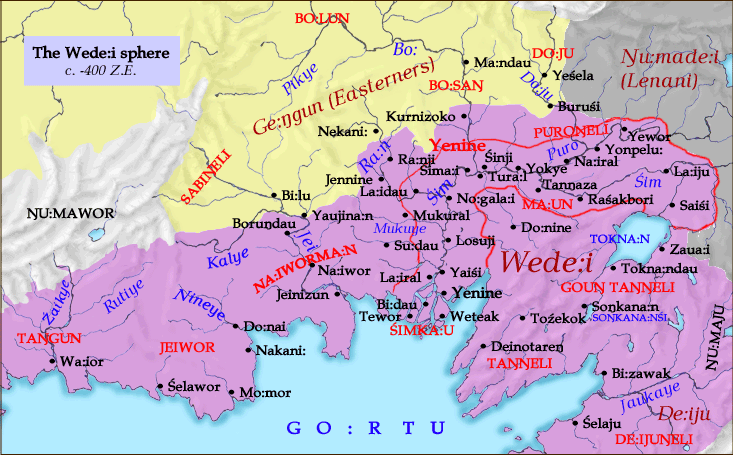 Speakers of the ancient Wede:i languages dominated the Xengi plain (Xengiman) and Čeiy, established the first states of men, and created the first human writing system (c. -1550).
Ancient members of this family include the languages spoken in Jeor, Do:ju, Puroŋeli , and pre-Axunaic Čeiy. All but the latter are well attested.
Starting in -350, the Ezičimi, a branch of the Easterners, conquered the Xengi plain; Wede:i languages gradually disappeared except in Jeor, Puroŋeli and Do:ju. The invaders’ language developed into Axunašin, not without being deeply modified by Wede:i, which affected its phonology and grammar, supplied hundreds of words, and provided the basis for the Axunašin writing system.
The language of Jeor, an offshoot of Wede:i, survived well into classical times. Jeor was finally conquered by the Gurdagor starting in 1950, and by the Xurnese c. 2600. It was replaced by Xurnese over the next few centuries, but survived among the local intellectuals as a badge of difference, somewhat like Irish Gaelic in Ireland; indeed, the official language of independent Tásuc Tag is (New) Jeori.
The other modern representatives of the family are Cuolese, spoken in Cuoli, to the northeast of Xurno, and Dowe, spoken in one canton of Belšai.
The Wede:i famiy has recently been shown to be related to Lenani-Littoral and Mei, the three families being grouped together as Southern. (Mei and Fei are both cognates of the morpheme de:i ‘people’ found in Wede:i; the Old Skourene cognate is mand- and the reconstructed Proto-Southern form is *nenanj.)
This grammatical sketch describes the ancient Wede:i language, in particular that of the delta in the centuries between Nanuŋitera’s unification of the Wede:i states (-625) and the Ezičimi conquest of the delta (-250). There was significant variety both geographical and temporal, though it was mostly hidden by the logographic writing system. Even within the delta, there were noticeable differences between cities, and evidently strong city accents
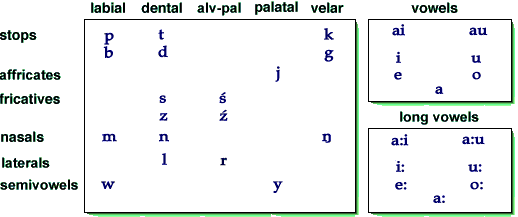
The ś sound is a lamino-prepalatal fricative, as in Kebreni or Polish ś or Mandarin x; ź is simply the voiced equivalent. (To be precise, this is our best reconstruction. Axunašin and Cuolese both have ś → š; Dowe has ç, which supports a more palatal original; Jeori retained ś and carefully distinguished it from š in Axunašin loanwords.) My mnemonic for pronouncing ś is “say sh while thinking [ç]”— that is, add more palatal hissing.
The only syllable patterns allowed are CV and CVC (where V includes long vowels and diphthongs); a V syllable can occur at the end of a word, as in liu ‘see’, and very occasionally at the beginning. Initial consonant clusters are prohibited, and the final consonant, if any, can only be one of l r n ŋ k. Syllables cannot begin with *yi- or *wu-.
Note that n+g can occur medially, though it was probably assimilated to [ŋg].
All syllables should be emphatically pronounced, with a slight stress on the first syllable of a word (but on the second, if the word begins with a vowel).
(Using : for long vowels is strict IPA, but doesn’t fit with the ā ē ī ō ū used for the Eastern languages. On the other hand the difference visually reinforces the fact that we’re dealing with a different language family— Wede:i words stand out from Eastern and Proto-Eastern ones.)
Affixation can cause doubling of vowels, e.g. yon+ki+i ‘if (you) say to him’ = yonkii. This would be pronounced identically to yonki:, but for ease of learning we do not respell it. The writing system was syllabic and did not consistently distinguish length.
VC affixes CV affixes Object suffixes ok past tense ro imperative no me ur remote ra passive ku thee en reflexive śi dative passive tu us iŋ I, we yu tentative we you (pl.) il you sa causative i him ta desiderative u her ju abilitative jau someone else yai inceptive pe repetitive ge durative mi reportative ze negative źu interrogative ki if ka conjunctive ne contrastive
As can be seen from the examples below, these suffixes can be combined in both simple and highly sophisticated ways.
yonu speak yoniŋ I speak yonilok you spoke yoniŋyui I may speak to him yonokźujau did he speak to someone else? yonuril you had spoken yonilokśi you were spoken to yonrono speak to me! yonoksa made to speak yonokgei you were speaking to him yonenze they are not speaking to each other yonpegeka and he keeps on speaking pamu listen pamiŋenta I want us to listen to each other pamźuku is he listening to you? pamilgekino if you are listening to me pamgeyuu he may be listening to her pamuraro may it be listened to! pamokźunewe but did he listen to you? ituri read ituriŋju I can read iturokpe he read it many times iturokge he was reading ituryuze he will not read it iturgemi he is said to be reading it iturilta I wish you would read it kudu break kudokra it broke kuduyai it’s beginning to break kudiŋok I broke it kudoksano he made me break it kudupera it is broken again
The final vowel of the root disappears, unless this would create an illegal syllable. Thus we see not *kudpera or *pamraru but kudupera and pamuraro.
Again, none of these suffixes is required, particularly when the meaning can be inferred from context. One can say Yoniŋok pamiŋokka ‘I spoke and I listened’, or simply Yoniŋok pamuka, or even (if the subject and time are obvious from the context) Yonu pamuka.
If you see an affixed verb in the Lexicon, the normal affix ordering still applies. E.g. go:źi is ‘eat’, and go:źisa is ‘feed’ (cause to eat). The 1s>3s past tentative ‘I might have fed him’ is go:źokiŋyusai, not *go:źisaokiŋyui.
The remote tense -ur is normally used within a past narrative to refer to events from an even earlier time: La:iŋok źenilurne ‘I came, but you had already gone’. By extension, the remote may be used to emphasize that something is already done: Gu:me kokurne! ‘But the man is already dead!’
It’s also used when referring to events in the mythical past: ŋu:mawo na:n ŋeur ‘the god raised up the mountain’.
Both subject and object are marked on the verb; however, there is no indication of whether either is singular or plural (except for ‘you’ objects). For convenience I offer a table of all possible combinations.
If no subject suffix is given anywhere in the sentence, third person can be assumed.
self me thee him her other us you I, we yoneniŋ yoniŋku yoniŋi yoniŋu yoniŋjau yoniŋwe you yonenil yonilno yonili yonilu yoniljau yoniltu 3s/3p yonen yonno yonku yoni yonu yonjau yontu yonwe
The self (reflexive) suffix -en should be used whenever the subject and obejct are the same; as a corollary there are some blank cells in the table, and e.g. yoni can only be used for someone speaking to someone else (almost always a previous referent).
The someone else suffix -jau (other in the table) can be used for clarity when introducing a new referent: using yonjau indicates that the object is a different person than whoever would be indicated with yonu or yoni.
There are two passive suffixes: ra is used for promoting direct objects to subjects; śi for indirect objects:
There is a set of modal suffixes, similar to our auxiliary verbs:
ŋok sela:ini ku:rokra. The jar was given to the general. Sela:i ŋoko ku:rokśi. The general was given the jar.
The imperative -ro, when used with the subject affixes, has a hortative sense: pamiŋro ‘I must listen’. Alone (or with object affixes), it’s a simple order: pamuro! ‘listen!’ pamurono! ‘listen to me!’
There is no future morpheme. It’s perfectly correct to use the ordinary present for future events:
The desiderative and the tentative also cover some of the ground of our future. The desiderative is used when reporting intentions of future action (Puliŋta ‘I intend to stay’); the tentative when the action is uncertain precisely because it belongs to the unknowable future (Ma:kilyui ‘You may defeat him’).
Tinti paźiwa pamuku. The king will hear you tomorrow.
There is also a set of aspect suffixes, which give details about the action’s placement in time:
The reportative suffix -mi is an evidential; it indicates that the speaker cannot vouch for the truth of his statement: Leźugu kalmi ‘The official is said to be good’. Like all Wede:i suffixes it is optional, but it’s very common-- especially in administrative writing, since officials rarely want to assume responsibility.
(If you don’t use –mi, evidentiality is unmarked. If you have direct knowledge, you should of course omit it. Some writers use –mi only when they want to convey some skepticism. Others use it more rigorously, and in that case its absence may be taken as an endorsement.)
The conjunctive -ka corresponds to our conjunction and. (There is no class of conjunctions in Wede:i.) It can be used for other parts of speech as well: go:źiŋok śaguka ‘we ate and drank’; gu:men ziminka ‘men and women’. Note that it appears on the last conjoint(s), not the first.
The contrastive -ne correspondes to our but; it has the same meaning as the conjunctive but expresses that the conjunction is unexpected: Yokak ŋereŋe nerneze ‘The two of them live together but do not sleep together.’
There is no disjunctive; instead, alternatives are simply concatenated: gu:me zimi ‘a man or a woman’; lauku:rok gojok ‘he paid for it or he stole it’.
The if affix -ki and the interrogative -źu will be discussed below.
A verb meaning may be intensified by reduplicating the first syllable, with insertion of -l-, -n- or -r- in between: kunkudu ‘break into pieces’; ma:ku ‘defeat’ → marma:ku ‘utterly vanquish’.
In court usage circumlocutions are sometimes used to refer to the speaker, e.g. lil gu:me ‘this man’, śaukraguku ‘your subject’.
There are a limited number of deictics and quantifiers:
Like most modifiers, these appear before the noun: lil gu:me ‘this man’; to:l daudo ‘at each city’.
lil this go that jok other, another ŋozi same, the same to:l each, every paun some ra:i none
There are not, strictly speaking, any indefinite pronouns; but there are indefinite expressions, built from the above modifiers plus words like boka ‘thing’, bogu ‘person’, jiro ‘hour’, tin ‘day’. Expressions like to:l bogu ‘every person’ may be taken as equivalent to ‘everyone, everybody’, but they are not different in kind from more specific expressions like to:l wa:igu ‘every sailor’ or more complex ones such as to:l pu:kokgegun ‘all of those who kept on sinning’.
Time expressions are no exception: ‘now’ corresponds to expressions like lil jiro ‘this hour’; ‘always’ to to:l tin ‘every day’; ‘sometimes’ to paun tin, etc. Choose the time period according to the meaning: you may swat flies away ‘every minute’, but kingdoms rise and fall ‘every epoch’.
See also Negatives and questions below.
Examples:
un plural (after vowels, -n) o object (after vowels, -wo) ni indirect object a:i place miŋ substance gu person zi woman ak collection of things wen tool ma augmentative iś diminutive (comes before a final vowel if any) a nominalization (ji and ka are others) ur gerundive śa which
Add -m- after the suffixes -gu and -zi before a vowel: Wede:izimo ‘Wede:i woman (acc.)’; but the plural is simply -n (Wede:izin).
nu:n tripod nu:nun tripods turak bundle of firewood (tur ‘stick’) turma branch turiśi twig paźiwiśa kinglet, small king itura:i scriptorium (ituri ‘read’) śabukmiŋ quicksilver (śabuk ‘fast’) paźiwaśa which king leźu trust (v.) leźa trust, responsibility leźur (act or process of) trusting leźugu trustee rukwen weapon (ruk ‘sharp’) neruwen bed (neru ‘lie down’] Wede:i Wede:i people Wede:igu a Wede:i individual Wede:izi a Wede:i woman
The case suffixes are generally used, even in unmarked SOV order; but the plural suffix is not at all required: do:n can mean ‘horse’ or ‘horses’, as necessary.
The same personal endings used with verbs-- no me, ku thou, i him, u her, tu we, we you-- can be used to indicate possession.
Kudokźu nu:no? Did he break the tripod? Leźegun dauwo ruŋu. The officials rule the city. Paźiwani yoniŋok. I said it to the king.
As a possessive, no: has a long vowel, distinct from the genitive –no: compare wa:ino ‘the boat’s’. By analogy this is sometimes applied to the 2s form: wa:iku: ‘your boat’.
wa:ino: my boat melenu her heart dautu our city komojau someone else’s house
In addition, adjectives can be intensified by reduplicating the first syllable, with insertion of -l-, -n- or -r- in between: bi: ‘white’ → binbi: ‘very white’; śabuk ‘fast’ → śarśabuk ‘very fast’.
ul past participle (e.g. leźul ‘trusted’) no genitive (do:nno ‘horse’s) uŋ adjectivization (nanuŋ ‘divine’) do locative (Yeninedo ‘in Yenine’) li possessing; instrumental (do:nli ‘having/using a horse’) sir without (do:nsir ‘without a horse’) ze negative (leźulze ‘untrustworthy’)
(Binbi: is pronounced bimbi: (as is made clear by Axunašin transcriptions, among other evidence.)
The causative -sa can be applied to adjectives: bi:sa ‘whiten’, śabuksa ‘quicken’.
With persons, -do implies ‘at the house of: Sekido ‘at Seki’s (place)’.
Adjectives normally precede the noun.
Before a verb, they turn into adverbs: śabuk rutok ‘he ran quickly’.
For instance, the gerundive -ur can be applied to verbs to which other suffixes have already been applied:
The gerundive is ‘more verby’ than other nominalizations; it’s best used to refer to a specific event, or when we would use the infinitive: ituri kalliiŋu ‘I like to read.’
yonilnour your speaking to me iturokur his having read it kudurapeur its constant breaking
Processes are named using the verbal suffix -ge plus the nominalization -a: iturgea ‘the process of reading’, teŋea ‘election’.
The –a nominalization is generally abstract; if you’re dealing with a physical object you probably want -wen (tool) or -miŋ (substance), or the general –ji, -ka. Compare ŋina ‘singing, music’, ŋingji ‘song’.
The ‘person’ nominalization -gu can be used not only with simple verbs (ruŋgu ‘governor’) but with more complex ones:
Likewise with the participle -ul:
yonpegu one who is always speaking iturzegu non-reader kojokgu one who has died
And the adjectival ending -uŋ can be used as an equivalent of the present participle:
pamuzeul not listened to takiŋul stopped by us la:ŋeŋul married to each other ze:nyuul possibly known
A future causative can be formed using the imperative suffix -ro and the adjectivization -uŋ:
pamugeuŋ listening yongekuuŋ speaking to you ruŋtauŋ who should be governiŋ
Adjectives (including those ending in uŋ) can be turned into causatives with the sa suffix (bi:sa ‘whiten’; nunuŋoksa ‘he was made divine’) and into nouns with the suffix a: kala ‘goodness’, su:a ‘newness’.
ma:krouŋ who must be defeated kudurouŋ to be broken
Adjectives can be used substantively-- we:un ‘the mighty’, kalni ‘to the good person’-- or as predicates, there being no verb ‘to be’:
Nouns can even be used verbally, with an existential meaning: raśak ‘fox’, raśakok ‘there was a fox‘.
Paźiwa kal. The king is good. Begoŋitera we:ok. Begoŋitera was mighty.
The unmarked order of a sentence is SOV, as in Axunašin. In more detail:
adverbials subject object-o indirect.object-ni other-objects-(li, do) adverb verbFor instance:
Raka Seki śino lilkomoguni bi:kali ka:imok.
autumn Seki cow-ACC neighbor-DAT silver-INS buy-PAST
During the autumn, Seki bought a cow from his neighbor, for silver.
“Adverbials” mostly means time and place expressions, or subclauses made with particles like la:uk ‘because’ and gau ‘that’, as well as rare special words like ŋauśa ‘how’.
Since the syntactic role is marked on every element (except raka), the constituents could, at least in theory, be freely moved. However, there were patterns:
Geographical names generally end with the noun: Puro ye ‘the Puro river’, Tokna:n śi ‘lake Van’. Note that some of these have become lexemes; do not duplicate the geographical noun: Kalye, not *Kalye ye ‘the Kalye river’.
Similarly, questions are formed using the źu suffix:
Liiŋokze de:iwo daudo. I didn’t see the people in the city. Liiŋok de:iwoze daudo. It wasn’t the people that I saw in the city. Liiŋok de:iwo daudoze. It wasn’t in the city that I saw the people.
There’s no word for ‘yes’; just repeat the verb (no inflections required): śubu ‘yes, he spit’. The negative response is dowo ‘no’ or śubuze ‘no, he didn’t spit’.
Sela:i paźiwawo śubokźu? Did the general spit on the king? Sela:iźu paźiwawo śubok? Was it the general who spit on the king? Sela:i paźiwaźuwo śubok? The general spit on the king?
These can be combined:
Other interrogatives are formed using the suffix śa ‘which’:
Sela:i paźiwawo śubokzeźu? Didn’t the general spit on the king?
Boguśa ‘which person’ can be translated ‘who’; but any nominal expression can be used: na:ŋguśa ‘which priest’, nijiśa ‘which animal’, juŋkuśa ‘which of your sons’, kokokmiguśa ‘which of those who are said to have died’.
Boguśa śebarulnowo iturta? Who wants to read my book? Pu:kok bokadośa? Where did the crime take place? Nitukśa mo:nzi ti:zige? Why is the maiden crying? Tinśa lauliilok? When did you arrive? (a matter of days) Jirośa lauliilok? When did you arrive? (a matter of hours)
For convenience, here’s a list of interrogatives. Note that these cannot be used as subordinators.
If you have a question with śa, you should not also add źu.
who boguśa or <noun>śa what bokośa or <noun>śa where bokadośa or <place>śa when jirośa or <time>śa why (purpose) nitukśa why (cause) ta:uno how ŋauśa how much paunśa using what bokaliśa
There are special negative words ra:i ‘not any’ and dowo ‘nothing’: ra:i gauji ‘no fruit’, ra:i jiro ‘at no hour (never)’, dowo ituriŋok ‘I read nothing’. (Dowo omits the accusative -(w)o.) Dowo can be freely suffixed, forming dowogu ‘no one’, dowoli ‘with nothing’, dowodo ‘nowhere’, etc. If you use these,-ze on the verb is optional.
Sentential clauses-- those which serve as a subject or object of the sentence-- are subordinated using a (postposed) particle gau:
śebarulo iturokuŋ gume:n the men who have read the book la:ŋtarauŋ na:nni zimi the woman who is to be married to a god nerokenuŋ mo:ngun youngsters who have lain together
[Gu:me paźiwano kamugunni ba:ilok gau] ze:niŋ.The constituent may be backed. With verbs of speaking or thinking, gau may be omitted.
We know [that the man escaped from the king’s guards]
Ze:niŋ [gu:me paźiwano kamugunni ba:ilok gau].A sentence can be subordinated to a noun or adjective as well:
We know [that the man escaped from the king’s guards]Yokiŋ [gu:me paźiwano kamugunni ba:ilok].
We said [that the man escaped from the king’s guards]
[Yak riŋul gala:ido ŋeru gau] śa:u.In the same way, sentences may serve as adverbials:
It’s a shame he lives in such a squalid neighborhood.
[Paźiwa ituri la:uk] ba:ilsamauŋ śebarul.
Because the king has read it, the book is condemned.
In English grammar we analyze these as conjunctions, but there is no class of conjunctions in Wede:i; the adverbial X lau:k formally occupies the same place as an adverb just as tinti ‘tomorrow’.
Conditional clauses are expressed using the verbal suffix ki:
Śebarul kalzeki, dowogu ituryu.The consequent generally uses the tentative -yu, the imperative -ro, or even desiderative -ta or abilitative -ju. If it’s absolutely certain, however, you can omit these suffixes:
If the book is not good, nobody will read it.Jukilokzeki ba:iliŋokyu.
If you had not sneezed, we would have escaped.Śebarul kalki, ka:imuro!
If the book is good, buy it!
Baŋ baŋka boyokki, la:uliu yokbaŋ.
If you add six and six, you get twelve.
As with other constituents, concatenating -ki clauses implies a disjunction:
Kalki yurki, la:ŋiltau.
(Lit.) If good, if bad, it’s desirable that you marry her.
Whether she is good or bad, you should marry her.
The adpositions that do exist (listed below for convenience) are mainly clarifiers, attached to a locative. Thus ŋokdo śen ‘above the jar’, ŋa:unado ta:i ‘on the right side of the street’; daudo go ‘away from the city’.
These can be appended to a noun to refer to a portion of an object (komora ‘the inside of a house’, jeŋo ‘the far side of the forest’, ŋa:iŋir ‘the left hand’) or to a geographical region (Jeiwor ‘west of the Jei’; Bo:lun ‘the northern Bo: valley’; Yesai ‘the middle river’). The same principle can be used for time words: sekibu ‘before night’ = ‘evening’, kokuti ‘after death’ = ‘mourning’.
ben under śen above ra inside rok outside lil near go away sai middle bu before ti after ta:i right ŋir left lun north saŋ south ju east wor west
The time suffixes can be attached to a verb: iturokbu ‘before he read it’, la:ilokti ‘after you came’.
A locative expression can of course be modified:
Gojugu kamuzeul komodo la:u.There are no headless ‘where’ clauses’; just supply a general locative word as the head:
steal-man guard-NEG-PP house-LOC come
The robber comes to the house which is not guarded.
Dowogu źenokpeuŋ ŋelido źeniŋro.
no-man go-PAST-REPET-ADJ land-LOC go-1s-IMPER
Let us go where no man has gone.
Aukoni śin ŋorma.You can also use these forms when making an implied comparison, e.g.
dog-DAT cow big-AUG
A cow is bigger than a dog. (Lit., to a dog, a cow is very big.)Daukani rukŋa:iji śiyiša.
whale-DAT crab small-DIM
A crab is smaller than a whale.
Ŋorma źalkiśawo zu:rtaiŋu.
I want a bigger plate.


 ).
).
The numbers from 1 to 36 are:
1 bo 13 yokbaŋ boka 25 tausebaŋ boka 2 yok 14 yokbaŋ yokka 26 tausebaŋ yokka 3 śir 15 yokbaŋ śirka 27 tausebaŋ śirka 4 tause 16 yokbaŋ tauseka 28 tausebaŋ tauseka 5 pina 17 yokbaŋ pinaka 29 tausebaŋ pinaka 6 baŋ 18 śirbaŋ 30 pinabaŋ 7 baŋ boka 19 śirbaŋ boka 31 pinabaŋ boka 8 baŋ yokka 20 śirbaŋ yokka 32 pinabaŋ yokka 9 baŋ śirka 21 śirbaŋ śirka 33 pinabaŋ śirka 10 baŋ tauseka 22 śirbaŋ tauseka 34 pinabaŋ tauseka 11 baŋ pinaka 23 śirbaŋ pinaka 35 pinabaŋ pinaka 12 yokbaŋ 24 tausebaŋ 36 taŋ
Numbers are named digit by digit in base 6: for each digit, one gives the multiple of the power of six, plus the name of the power (baŋ 6, taŋ 36, ke:ta 216, eze:r 1296), plus (for all but the first digit) -ka ‘and’. Examples:
śirbaŋ tauseka ‘three sixes and four’ = 22
tausetaŋ pinabaŋka boka ‘4 · 36 and 5 · 6 and 1’ = 175
eze:r śirke:taka yokbaŋka pinaka ‘1296 and 3 · 216 and 1 · 36 and 2 · 6 and 5’ = 1997
yokeze:r tauseke:taka tausebaŋka ‘2 · 1296 and 4 · 216 and 4 · 6’ = 3480
There are words for the next powers of six (ja:u 7776, bo:ndo 46656), but these are used only to name orders of magnitude, and not for constructing names of precise quantities. Wede:i arithmetic became cumbersome with such high numbers, and approximations were used instead.
Numbers are modifiers, thus pina do:n ‘five horses’. (With an explict number, plural –un is unnecessary.) A measure word can intervene: pina da:ur rintuka ‘five skins of wine’.
Ordinals can be formed with the genitive -no: śirno gu:me ‘the third man’.
A collection of n objects can be named using the collective suffix -ak: yokak ‘a pair, a couple’; pinak ‘a group of five’. A fraction is named by combining the cardinal and the collective: bo pinakra ‘one in a set of five’, i.e. 1/5; pina yokbaŋakra ‘5 in a set of 12’, i.e. 5/12. There are suppletive forms ba ½, śira 1/3, and taur ¼.
The period was a jiro, but the times are named ‘one of the day’ etc. Compare our hour vs. o’clock.
bo tinno early morning / dawn yok tinno mid morning śir tinno later morning tause tinno early afternoon / noon pina tinno mid afternoon baŋ tinno late afternoon / dusk
In the city, the jiron were announced with water clocks (jirowen). To match the varying length of the day, one filled the basins to a mark for the appropriate month (see below). Precise timekeeping only really mattered in the cities. The outflow slows as the level in the basin drops, so a really fancy jirowen had two basins, the time being read from the bottom basin.
The evening was sekibu ‘before-night’; the night was seki.
A basin emptying out (bu:na) was a powerful metaphor, applied to tasks, lifetimes, and the cycles of the cosmos.
The Wede:i division of the hours was adopted by the Ezičimi and still persists in Xurno, with the Wede:i names— e.g. mid-morning is yeucino.
Recording dates, the formula is <number> <month>no, e.g. pina Tokna:nno, the 5th day of Tokna:n.
watasu: spring Tokna:n Wila:r giźoma summer Akśim Akru: raka autumn Begoŋ Yaujina:n re:tema winter Jaukaroda Birbi:
The full formula for a year was
<ordinal> <king>ben <state>no watae.g.
śirno Begoŋiteraben Yenineno wataOr more informally 3no Begoŋiteraben, or even 3no Begoŋ. (That is, it was customary to write only the first character of the king’s name.) The Wede:i never used a year reckoning, though the Jeori did, in imitation of the Ezičimi.
the third year under Begoŋitera of Yenine
A subclause can be subordinated to a time word, e.g.
Sekini la:uliŋokuŋ tin (ti)This is how you’d translate ‘when I met Seki’. You can only use tinśa ‘when’ in questions:
(since) the day I met Seki
Tinśa Sekini la:uliŋok?
When did I meet Seki?
The system obviously produced close-knit clans. An extended family lived together.
A woman moved to her husband’s clan’s home, but retained ties to her family of origin— especially to her possibly multiple papan and bedan. (Not infrequently a clan was joined by multiple marriages, so she might bring some of her bedan with her.) She addressed her in-laws using the same terms her husband would. However, he addressed his in-laws with the prefix kal, e.g. kaldata ‘father-in-law’. (This was short for kalzino data ‘wife’s father’.)
They can be divided into unisex, male, and female. A sampling:
There are no family names nor patronymics. In larger towns, people often had nicknames to distinguish between people of the same name. In “The Multipliers”, Bokugo (‘turnip’) is a nickname rather than a given name.
Unisex Masculine Feminine Anda ash tree Bika fir Bi:po: fair hair Ba:un storm Bukuro owl Bi:zi fair woman Bi:ka silver Do:ngu horseman Buka deer Da:iul favored Guśa honor Go:rtuzi sea woman Itera radiance Naugu ox man Jenka forest Iterul shining La:igu glorious man Joŋpo: dark hair Ka:yomul wondrous Jauka wolf Joŋzi dark woman Kala goodness Kalte:du good mind Kunu rain Ku:rul given Kaltoa good sword Loda peace Ma:un leopard Kenur oak Ma:in star Miriŋ snake Lu:gu water man Maŋayuma type of flower Muna holiness Ma:nka greatness Mogau peach Nanno of the god Mo:mo young No:zi red woman No:bi: copper Muku bull Ŋeka flower Ŋa:ila:ul invited No:gu red man Ŋina music Ŋegeul enlightened Ŋo:dugu hunter Ŋiyan linen Ŋota high Ŋol fire Paira pool Paudu worship Ŋor big Pirzi harpist Pikji green one Ŋorźuko big nose Reja sky Raka autumn Ŋu:ma mountain Re:tema winter Raśak fox Puŋan wood Soŋmiŋ jade Ruk sharp Rakugu bear man Śaki rouge Ruźi spotted Ru:gu sun man Śali:l lovely eyes Seki night Saijuŋ middle son Śabukka swallow Su:wata good year Saŋgu south man Śabukma Naunai (moon) Śabuk quick Simul literate Sekibu twilight Śal beautiful Soŋka bear Śeya soft Śelul protected Śojo pride Śi lake Śukzau crystal Śuk stone Śiya small Tokka blue one Telgu manly man Taŋzi fertile woman Wedaŋ vigilant Tikma eldest Teldi:n tomboy Wen luck To:gu clever man Watasu: spring Worgu westerner To:rogu thunder Wete birch Ye:bi: gold We:a might Yai jewel Źaikka yellow one Ye:bi:li rich Ya:li rose Zaupo: sandy hair Źeba hawk Yoru dance Źe:tur laughter Zaitoa lightning sword Źaiji bee
To:l gu:me źegusir kalzimili pulro ŋera:ino komozinlika; jok komono ma:rzimo ni:guno kalzinkawo źeguzero.
each MAN LUST-without WIFE-his-with STAY-imper HOUSEHOLD-gen SERVANT-pl-with-and / another HOUSE-gen FEMALE-acc FARMER-gen WIFE-pl-and-acc LUST-neg-imper
Gu:me lil sa:uno guśuzeki, la:ŋulaujiwo lauku:ruro; zimi la:ŋokki la:ŋzekika; gu:me kalzimili zu:rzeroneu.
MAN this LAW-acc RESPECT-not-if MARRY-MONEY-acc pay-imper / WOMAN MARRY-past-if MARRY-not-if-and / MAN WIFE-his-instr TAKE-neg-imper-but-her
Zimi ŋa:ila:okkii, gu:me bali lauku:rro.
WOMAN INVITE-past-if-him MAN HALF-instr PAY-imper
Lauku:rujuzeki, koksararo.
PAY-can-not-if DIE-caus-passive-imper
Papaiwo di:niwo śendi:niwo dataino kalzimo zu:rokki, koksararo.
MOTHER-his-acc DAUGHTER-his-acc GRANDDAUGHTER-his-acc FATHER-his-gen WIFE-acc TAKE-past-if DIE-caus-passive-imper
zimijauwo zu:rok nituk joko kokoksaki, koksararo.
WOMAN-other-acc TAKE-past for OTHER-acc DIE-past-caus-if DIE-caus-passive-imper
Gu:me pu:kpeki, lauku:rupero ŋosuraroka.
MAN EVIL-repeat-if PAY-repeat-imper FLOG-passive-imper-and
Lil sa:un ma:nguni na:ŋguni de:igunika zotiŋsage.
this LAW NOBLE-dat PRIEST-dat COMMONER-dat-and BELONG-we-caus-durative
Let each man be content with his wife and the servants of his household; let him not lust after a female of another house, or after the wives of the peasants. If any man disrespects this rule, let him pay the bride-price, whether or not the woman is married; but he may not take the woman to be his own. If the woman invited him, he may pay half. If he cannot pay, let him be put to death. If he takes his own mother or daughter or granddaughter or his father’s wife, let him be put to death. If he kills a man in order to take his woman, let him be put to death. If an offense is repeated, it may be paid again, but let the man be flogged. This law applies to noble, priest, and commoner.
Notes:
The protagonist is a duzulno komogu, the servant of a slave-- obviously a low and poor condition, but perhaps not as low as it sounds. Slavery was a legal condition, and trusted slaves could become powerful and wealthy people.
The Wede:i had skin and hair coloration similar to northern Europeans. Fair skin and blonde hair were valued among them, but came to be disdained by the Ezičimi invaders; it took more than a milennium for this prejudice to die out.
Zimi la:ok muna:ido lumenokka pairadouŋ źi:a:ido, mo:ngu zu:roktayaikau.
WOMAN COME-past TEMPLE-loc BATHE-refl-past-and POOL-loc-adj GARDEN-loc / YOUTH TAKE-past-want-incept-and-her
Bi: zauuŋka rilsirguni zu:roktajusa.
FAIR SAND-adj-and EUNUCH-dat TAKE-past-want-can-cause
Da:izeyuno gau mo:ngu yedokne muna:ido duzulno komogumiŋge la:uk.
VALUE-not-tentative-me that YOUTH THINK-past-but TEMPLE-loc SLAVE-gen SERVANT-I-durative because
Śigamali na:nunni na:nku:runi yebi:liokyai zimini da:iraju nituk.
WORK-augment-instr GOD-pl-dat SACRIFICE-pl-instr RICH-past-incept WOMAN-dat VALUE-passive-can for
Kamugunili la:ok komoudo yonka kalzino:li zu:riŋwe gau.
GUARD-pl-his-with COME-past HOUSE-her-loc SAY-and WIFE-my-instr TAKE-I-you that
Woŋoksaiuŋ zimi sukwenli melendo ra sukenok.
HORROR-past-cause-him-adj WOMAN DAGGER-instr HEART-loc in STAB-refl-past
Muna:ino na:ŋgu lioksai, dauudo ma:ngu lila:uru ŋozi śojoli.
TEMPLE-gen PRIEST SEE-past-caus-him / CITY-her-loc NOBLE APPROACH-remote-her SAME PRIDE-instr
Muna:ido bamba:iluruŋ zimi benuŋo la:ŋokta yebi:ligumo paijuryai la:uk.
TEMPLE-loc FLEE-remote-adj WOMAN LOW-acc MARRY-past-want RICH-person-pl-acc FEAR-remote-incept because
A woman came to a temple and bathed in a pool in its garden, and a boy fell in love with her. Fair and blonde, the woman could cause desire in a eunuch. But he thought, she may disdain me, because I am only the servant of a slave of the temple. By means of great work and sacrifices to the gods, however, he became a rich man, in order to be worthy of the woman. He came with his retainers to the house where she lived, and said, I take you as my wife. To his horror, she took a dagger and plunged it into her heart. A priest of the temple had to explain: a nobleman of her city had approached her in the same arrogant way. She had fled to the temple, hoping to marry a base commoner because she had come to fear rich men.
Notes:
My translation of Aesop’s fable.
Raśakokmi. Nitugeuŋ raśak yumaido śen doluŋ ŋununo la:uliok. Ponok ponpeka, ŋuno zu:rokzene. Melenokudawoi digugeuŋ raśak yonok, ŋunun zanzaranyuge! Zu:rrataze.
FOX-past-reportative. WALK-progressive-adj FOX HEAD-his-locative ABOVE HANG-adj GRAPE-plural-acc FIND-past. JUMP-past JUMP-repetitive-and, GRAPE-acc TAKE-past-not-contrastive. HEART-BREAK-acc-his HIDE-progressive-adj FOX SPEAK-past, GRAPE-plural SOUR-tentative-progressive. TAKE-passive-desiderative-not.
There was once a fox. While walking, the fox found some grapes hanging above his head. He jumped up again and again, but he could not reach the grapes. Hiding his disappointment, the fox said, "The grapes are probably sour, I don’t want them anyway."
Some things to note:
A memoir set in Bi:dau, before the empire, sometime in the -600s Z.E. See the full story (translated) here.
For help with the text I am grateful to Mornche Geddick and Pedant.
That is, the 2nd day of Tokna:n; see Calendar.
Bokugoni baŋ tinno go:źok. Goŋze guśulze to:magu.
Bokugo-DAT one day-GEN eat-PAST / false-NEG honor-PP-NEG clever-AUG-man
Dined with Bokugo tonight. Truly an unsung genius.Normally you’d say go:źiŋok ‘I dined’, but this is a diary style where the 1s is implied.
Yak riŋul gala:ido ŋeru gau śa:u: Lu:sir La:wa:indo, Aklu:marauno joŋkani liluŋ.
such rot-PP neighborhood-LOC live SUB shame / water-WITHOUT well-PL-LOC / Aklu:ma-door-GEN shadow-DAT near
It’s a shame he has to live in such a squalid quarter: the Dry Wells section, virtually in the shadow of the Aklu:ma Gate.
To:l jiro ba:nsirgun zusokpetu, Bokugo toawo jalnoksaibu.
every moment beggar-PL buzz-PAST-REPET-US / Bokugo sword-ACC wave-PAST-CAUS-3s.obj-before
We were bothered by beggars all evening, till Bokugo brandished a sword at them.Note -bu ‘after’ applied to a verb, forming a time adverbial.
Munśukno tiźengunni Moganopaźiwa Naurodano sa:uno yonok.
Munśuk-GEN follow-person-DAT minister Nauroda-GEN law talk-PAST
Discussed King’s Ear Nauroda’s decree against the followers of Munśuk.The decree is simply tiźengunni ‘to the followers’; there is no adversative preposition ‘against’.Moganopaźiwa ‘King’s Ear’ is a vivid name for the king’s counselors or ministers. In this story the position is singular, so it can be taken as ‘prime minister’ or ‘vizier’.
Munśukni śai liraju gau Bokugo paijokge, dowogu ze:npe gau liiŋoksanei.
Munśuk-DAT support see-PASS-ABIL SUB Bokugo fear-PAST-DUR / no-man know-REPET SUB see-1s-PAST-CAUS-BUT-3sm.obj
Bokugo was worried that his own support for Munśuk would come out, but I assured him that no one would ever knowThat last verb needs some unpacking. Lisa = explain, liiŋsai = I explain to him, liiŋoksai past tense, liiŋoksanei = but I explained to him.
Goŋzeka, boguśa nizdo Bokugono simo ze:nyu?
truth who palace-LOC Bokugo-GEN word-ACC know-TENT
The truth is, I doubt anyone in the palace even knows Bokugo’s name.Literally: “Truth: who in the palace could know Bokugo’s name?”
Lil bokanra Bauŋaujima gau kaltane.
this thing-PL-in quiet-tongue-AUGM SUB good-DESIR-BUT
Still, I wish he would be more discreet about these things.X gau kalta is a wayof expressing a mild wish.
Paźiwa zu:rtauŋo zu:rtaro ŋeka gau kalsim yonu.
king love-ADJ-OBJ love-IMPER rise-AND SUB proverb say
Love what the king loves and prosper, as the proverb says.Paźiwa zu:rtau would be a sentence ‘the king loves’; adding gerundive -ur makes it a relative clause: ‘that the king loves’. As no noun is supplied, read it as an NP ‘what the king loves’. Finally this whole expression is the object (thus taking final -o) of the imperative zu:rtaro ‘love’.
Bokugo bo su: buśigani dondo:te:duokge.
Bokugo one new project-DAT INTENSIVE-breezy-mind-PAST-DUR
Bokugo seemed unusually excited about one of his projects.
Boyokakdo paun boka. Soźokśino.
counting-LOC some thing / lose-PAST-DAT.PASS-1s.obj
Something about addition. It was lost on me.
Gobokani yumawo duziŋze, nanuŋ boyokak.
that-thing-DAT head-ACC have-1s-NOT / god-ADJ counting
I have no head for higher mathematics.The author emphasizes the final phrase by backing it, leaving a demonstrative expression goboka in its place.Boyok, from ‘one-two’, is the word for a sum or count. As a secular discipline— counting or addition, it’s boyokak ‘sums’. Scholarship in Wede:i society was indistinguishable from religion, so mathematics as a discipline was nanuŋ ‘divine’ boyokak.
All those who supported Munśuk in the late rebellion are to be skinned alive.By now a relative clause formed with –uŋ should be familiar. Note however that the overall sentence is copulative, using the ‘future causative’ -rouŋ.
Yok tinno paun pu:kgumo bu:niśokge nizido bu.
one day-GEN some sinner-PL torture-PAST-DUR palace-LOC before
A few prisoners were being tortured in the square in front of the palace this morning.
Goŋze, gobokawo kalliiŋjuze.
false-NEG / that-thing-ACC approve-1s-ABIL-NEG
I can’t really approve of that.
Bono jiron śigurouŋ; dowojok tause tinno yak źe:tisarouŋ.
one-GEN hour-PL work-IMPER-ADJ / not-other four day-GEN such laugh-CAUS- IMPER-ADJ
The morning is for work; such entertainment should be saved for lunchtime.See the “Hours” section— lunch is normally taken at noon, that is, the 4th hour.
Bokugowo la:uliok Paźiwanno Ŋa:unamado.
Bokugo-OBJ meet-PAST king-PL-GEN street-AUGM-LOC
Met Bokugo on the Avenue of Kings.
Te:duno: Saiśiguni lilti ka:imujiwo yediŋokpe; ze:nokyai ŋegeamado lila:okyai dowojok gau.
mind-1s.obj Saiśi-man-DAT pending sell-NOM-ACC think-1s-PAST-REPET / know-PAST-INCEP revelation-AUGM-LOC approach-PAST-INCEP only SUB
My mind was on a big deal that’s pending with the Saiśigu; I only gathered that he was on the verge of a great discovery.Dowojok ‘only’ is applied to the subordinator gau— what the author learned was only [the contents of the subclause].
Yoniŋoki to:magumok na:ŋgu weyutayaika gau, dowojok źe:tok
Speak-1s-PAST-3s.obj clever-AUG-man-PAST god-man serve-DESID-INCEP-AND SUB / only laugh-past
I told him that he was a genius and ought to go into the priesthood, but he only laughed.The –ok on to:magumok isn’t really needed for tense (as the main clause indicates the time), but it clarifies that to:magu is being used as a verb ‘to be a genius’.
The Saiśigu deal fell through.
Yunyur, te:dusir joŋgun kalkal No:gala:ino ŋiyano da:izeneki, ŋauśa źeniŋju?
bad-bad / brain-LACK dark-man-PL good-good No:gala:ino-GEN linen-ACC value-NEG-BUT-IF / way-WHICH go-1s-ABIL
It’s too bad, but if the stupid barbarians don’t appreciate fine No:gala:i linen, what can I do?The term translated ‘barbarian’ is really a racial term: people dark in hair and skin. It was chiefly applied to the Ezičimi, the pesky neighbors to the north who would eventually conquer Xengiman. The De:iju were more primitive, but the Wede:i recognized their kinship with them.There is no general term for ‘do’, but ‘go’ serves for ‘do things, proceed.’
No:bi:wo zu:rtauŋ paun Gotakgun pulenno; Na:iworgu Sekiwo ŋa:ili zu:riŋro.
copper-ACC desire-ADJ some ktuvok-man-PL stand-REFL-1s.obj / Na:iwor-man Seki-ACC hand-INS get-1s-IMPER
I’ve got a few Munkhashi interested in copper; I’ve got to get hold of Seki the Na:iworgu.To say “there is X” you can say X pulenu, literally X is standing itself. X pulenno is ‘X exists for me’, which expresses that I don’t own X, but I have access to it.
Went to Śakipeś Street to dine with Bokugo, who was burning to show me his latest findings.
Ŋazawo zu:rok ze:nkano śir śirka śirka boyokuro gau.
clay-OBJ take-PAST ask-AND-1s.obj three three-AND three-AND count-IMPER SUB
He took out a clay tablet and asked me to add three and three and three.
La:uiŋok baŋ śirka la:ulika.
follow-1s-PAST six three-AND find-AND
I complied, and got nine.
Yonokka liluŋ to:lze:nu gau: śirakuŋ śir bokano zu:rki, to:l tin baŋ śirkano boyoko la:ulipe gau.
say-PAST-AND near-ADJ certain SUB / three-COLL-ADJ three thing-PL-ACC take-IF / every day six three-AND-GEN sum-ACC find-REPET SUB
Then he said that he was almost certain that, taking three quantities of three each, one would always find the sum to be nine.Śirak is a collection of three things, so śirakuŋ is ‘made of three parts’.The overall structure of the sentence is a double subordination “said that (certain that X))”. With proper modifier-first order this should be X gau certain gau said, but it’s almost the reverse: said [certain gau]: X gau. This can be seen as moving the heavier elements to the end of the sentence, a common operation with reported speech.
To: boyokakuŋ ka:yomuliś gau yediŋyu, paunśa la:ne?
clever arithmetic-ADJ wonder-DIM that think-1s-TENT / few-which come-BUT
It’s a cute mathematical curiosity, I suppose, but how often does it come up?
Seki the Na:iworgu is out of town.
Gotakgunni ja:iok bono śirabataur no:bi:wo kaimśiur Akśim da:ize gau.
ktuvok-man-PL-DAT tell-PAST / one-ORD third-month copper-ACC sell-GERUND Akśim approve-NEG SUB
I had to tell the Munkhâshi that Akśim does not favor those who sell copper in the first half of the month.More literally, what Akśim doesn’t approve of is “the selling”— that is, this is a use of the gerund.
Jok niŋmaguni yonki, na:nun a:inrono, tik ka:imugunpe tikokpe gau wennone.
other trade-man-DAT speak-IF / god-PL help-IMPER-1s.obj / old buy-man-PL-REPET SUB luck-1s.obj-BUT
The gods help me if they talk to another trader, but thankfully they are old customers.
Ŋozi tin śiya ka:imujiwo śigok, menśu:lu:i joŋzauno:.
same day small sale-OBJ work-PAST / resin-3s.obj tin-1s.obj
In the meantime we negotiated a minor deal, tin for resin.Literally, “his resin my tin”, these being the states before the deal. (That is, the author had resin and now has tin.)
Tause tinno Miriŋi:ldo, tik bi:kali niŋmaguma.
four day-GEN Miriŋi:l-LOC / old silver-INS trader-AUGM
Middle-day-LOC eat-I-past Miriŋil-and old silver-GEN sell-augment-man
Lunched with Miriŋi:l, the old silver magnate.Normally we’d expect go:źok ‘ate’, but in a diary style it can be assumed, given the noon hour.
Yebi:wo ŋe:dupezeki, joŋkawo ŋa:ryujuzeno, kalliyuneno.
gold-ACC sweat-REPET-NEG-IF / shadow-ACC touch-TENT-ABIL-NEG-1s.obj / like-TENT-BUT-1s.obj
I wouldn’t be caught dead with him if he wasn’t dripping with gold, but he seems to like me.Two idioms here: yebi:wo ŋe:dupe ‘to sweat gold’ is obvious enough; the second clause has ‘(his) shadow couldn’t touch me’.
Yonpe, —Liyonuŋ mo:nguno da:iiŋpe, yak paun pulenpe la:uk.
say-REPET / honest young-man-PL-ACC value-1s-REPET / such some stand-REFL-REPET because
“I appreciate honest young men,” he says, “there’s so few of them.”Loyonuŋ ‘honest’ is simply ‘saying (what you) see’.
Goŋe boyokun la:uk śir śebarguno ba:iloksa, ka:imuguno ŋa:inika.
false sum-PL because three write-man-PL-ACC remove-PAST-CAUS / buy-man-GEN hand-DAT-AND
He had to fire three clerks recently for false addition (and moreover in the customer’s favor).Lil watanno ze:nsaguno śa:uliu— nanuŋ ja:iano iturur kalmi, boyokakno yokboakno lijupeze.‘In X’s favor’ is literally ‘to X’s hand’.
He blames modern education: It’s all very well to read the great epics, but you can’t ignore addition and subtraction.Iturur here turns an event (‘read’) into an abstract noun (‘reading’).Kalmi shows off the skeptical tone you can achieve with the reportative: “They say that it’s good— I can’t vouch for it myself.”
Goŋze yonyu, śukyumane.
false-NEG say-TENT / stubborn-BUT
He’s right, I suppose, but terribly rigid;
Rokuŋ do: zu:rtau, yoniur jiro ti.
out-ADJ breeze want / speak-3sm.obj-GER hour after
You want a breath of fresh air after talking with him.
Went to Kaltoa at the Palace, to see about lessening my merchandise tax.
Kaltoa ze:npeno la:uk, dowojok śiya ra:boakiśi tensirokra.
Kaltoa know-REPET-1s.obj because / only small bribe necessary-PAST-PASS
Kaltoa knows me, so it took only a small bribe.
Su:ma nizno śa:uwo ja:iyokno—
new-AUGM palace-GEN shame-ACC tell-PAST-1.obj
He told me the latest Palace scandal:
Yok śir paudurouŋ lu:juŋun paźiwano benzinni paudurozeuŋ benśentino peŋokmi.
two three worship-IMPER-ADJ prince-PL king-GEN concubine-PL-DAT worship-IMPER-NEG-ADJ down-up-day-ACC play-PAST-REPORT
Two or three of their Eminences the Princes seem to have taken some un-princely liberties with the King’s concubines.Lu:juŋ ‘prince’ is literally ‘son of water’— meaning the water god Akśim, patron god of Bi:dau.Benśentin is ‘topsy-turvy day’, a religious festival where hierarchical roles are reversed. To ‘play benśentin’ is to flout those roles at other times— thus the translation ‘to take liberties’.
Recall that there’s no ‘or’; yok śir is interpreted as a disjunction ‘two or three’. (This is why you see all those –ka suffixes in number names: yok śirka would be five.)
This passage uses the reportative -mi, as the author cannot vouch for these things.
Munśuk źerźengemi benuŋ Akśimno yeni:ndo digugemika.
Munśuk INTENS-go-DUR-REPORT low-ADJ Xengi-GEN marsh-PL-LOC hide-DUR-REPORT-AND
It is rumored that Munśuk is still at large, hiding in the marshes of the lower Xengi.
Paźiwa bokado toako źenuryusami, da:iulma lu:juŋ Muku sela:iwo weyuryuge, goŋzekane zimisindo ragojokuŋ lu:juŋundo Muku pulenokmi gau.
king thing-LOC army-ACC go-REMOTE-TENT-CAUS-REPORT / favor-ADJ-AUGM prince Muku general-ACC serve-REMOTE-TENT-DUR / true-NOM-BUT harem-LOC in-steal-PAST-ADJ prince-PL-LOC Muku stand-REFL-PAST-REPORT SUB
The King was going to send an expedition there led by his favorite prince Muku, but in fact Muku was one of the princes of the harem infiltration.The first two verbs include both the reportative -mi (as we’re still retelling rumors) and the tentative -yu (as we’re describing a hypothetical). Two levels of irrealis! Also note the use of the remote tense (with -ur) to place the story of the expedition planning before the time of the harem escapade.Note the useful idiom Y-do X pulenu, literally X stands itself in the location Y— X is part of the group Y.
Ŋa:u tu:buzege.
path smooth-NEG-DUR
It’s a tricky situation.Literally, ‘the path is rough’.
Bokugo came over to my house uninvited: he was anxious to show off his latest ruminations.
Bokawo la:uliok, ŋozi boyok bokan ŋozi boyok bogunni ku:rraki, ŋazan zarangaun to:l bokan gau goŋzemi, boyokma boyokrayuju, buśigugeuŋ tu:buzeka ŋazanli.
thing-ACC find-PAST / same sum thing-PL-GEN person-PL-DAT give-PASS-IF / tablet-PL citrus-PL every thing SUB true-REPORT / sum-AUGM count-PASS-TENT-ABIL / work.out-DUR-ADJ difficult-AND tablet-PL-INS
He has found that whenever a given number of objects–tablets, oranges, it doesn’t matter what kind of objects–are distributed among the same number of people, the total quantity of objects can be calculated with complicated tables which he is working out.The construction X gau la:uliok ‘he found X’ becomes very cumbersome when X is a long sentence; thus it’s replaced with ‘he found a thing: X’.That X is quite a mouthful, but its basic structure is a conditional statement: Y-ki, Z-yu. It’s complicated by the parenthetical in the middle and by backing an instrumental at the end.
For the first part (Y), compare a simpler version like Zarangauwo zimini ku:rki ‘if he gave the orange to the woman’. First passivize: Zaranau zimini ku:rraki. Now add numbers: Pina zaranaun tause zimini ku:rraki ‘5 oranges were given to 4 women’. Finally replace the numbers with ŋozi boyok ‘the same sum’.
Te:dun bu:nanka, Bokugo yedune losuwo ŋo:duge gau.
soul-PL cycle-PL-AND / Bokugo think-BUT moose-ACC hunt-DUR SUB
It’s all very abstract, but Bokugo seems to think he’s on to something.The author complains that it’s “souls and cycles”— that is, it’s like abstract Mešaist cosmology.The idiom losuwo ŋo:duge, literally ‘be hunting a moose’, means to be after something big.
Ze:noki, riŋtukano da:uruno jok bokawo ku:rtauŋ bogun lil ŋazano ŋaikaźu gau, pamokyuzeneno.
ask-PAST-3s.obj / beer-GEN skin-PL-ACC other thing-ACC give-DESID-ADJ someone-PL this table-PL-ACC carry-Q SUB / hear-PAST-TENT-NEG-BUT-1s.obj
I asked him if people were really going to lug these tables around when they wanted to distribute skins of beer or whatever, but he didn’t pay any attention.If you’ve read this far, a word pamokyuzeneno ‘but it seems (he) didn’t hear me’ should no longer cause palpitations.
To:l śe:i murando ŋerupe.
Nitwensir leźuŋ beśara.
He doesn’t have a practical bone in his body.Literally, his bones all live in the muran (Ax. mureši), the planes above and below the physical world.
Second half of the month: the Munkhâshi were back.
Na:iworgu Seki daudo go źenokgene.
Na:iwor-man Seki city-LOC away go-PAST-DUR-BUT
Yet Seki the Na:iworgu is still out of town.
To:l śirabataur no:bi:wo kaimśiuro Akśim da:ize gau yokiŋjuze, yok tindo ti no:biwo buku:roki.
all third-month copper-ACC sell-GERUND-ACC Akśim approve-NEG SUB say-1s-ABIL-NEG / two day-LOC after copper-ACC promise-PAST-3s.obj
I could hardly have Akśim forbid copper selling all month, so I promised them that I’d have the copper within two days.
Ŋauśa źeniŋju?
way-WHICH go-1s-ABIL
What am I going to do?
Seki the Na:iworgu finally got back today.
Ka:ima:iido rutiŋok, baŋ tauseka pasur no:bi:wo yunyur boyokli kaimśika, komodo rutokla, gotakguno ŋaikokka.
shop-3s.obj-LOC hurry-1s-PAST / six four-AND donkey copper-ACC awful price-INS buy-PAST-AND / home-LOC hurry-PAST-AND ktuvok-man-PL-ACC fetch-PAST-AND
I dashed over to his shop and bought ten asses’ loads of copper at an exorbitant price, then hurried home and ferreted out the Munkhâshi.
Yatusimino yuriturur gau lioksayai, dowojok baŋ pasuruno tensirokka.
order-word-3s.obj-ACC bad-read-REMOTE SUB see-PAST-CAUS-INCEP / only six donkey-PL-ACC need-PAST-AND
They revealed that they had misread their orders and only needed six loads.Note the use of the two past tenses to order the two events.
Boyoko yokiŋoksa, tause pasur no:bi: pulneno.
price-ACC two-1s-PAST-CAUS / four donkey copper remain-BUT-1s.obj
I charged them double, but I’m still stuck with four asses’ loads of copper.
Tareŋ tisika.
blood urine-AND
Botheration.The full, stronger oath is tareŋ tisika radaka— blood, urine, and semen— the three liquid besamiŋun or bodily substances of Mešaist medicine. The phrase was familiar from physicians and priests and had an air of occult wisdom.
The next task to be tackled, suggested perhaps by the fact that rulers’ names were often taken from animals and planets anyway, was the writing of elementary chronicles (some of which still survive), on the level of "King Ramarm defeats King Lionbrow year 452." The new symbols devised for this purpose were rather fluid, as if scribes were improvising as they worked.
do:n ‘horse’
nu:n ‘tripod’
mai ‘wheat’
Wila:r ‘Išira’
śir ‘three’
The earliest symbols were all pictographic or ideographic. The symbol for ma:k ‘defeat’, for instance, showed a sword threatening a stylized human figure:  Eventually, however, it occurred to some bright soul that the same symbol could be used to represent mak ‘cousin’, which was not otherwise easy to represent. Similarly,
  wada ‘stool’ was pressed into service to represent wata ‘year’.
Proper names composed of two or more words, such as 
 Wila:ri:l ‘Išira’s eye’, had long been in use; with the invention of phonograms it now became evident that polysyllabic words could be represented as a sequence of glyphs: e.g. ruŋokur ‘governing’ could be represented

 , using the signs for ru: ‘sun’, ŋok ‘jar’, kur ‘ram’. (Such usages were facilitated by the simple phonologic structure of Wede:i, in which all syllables have a CV(C) structure, with the number of final consonants being severely limited.)
These discoveries greatly multiplied what could be represented using the script. By perhaps -1100 it had developed to the point where any sound in the language could be represented; it was now a true written language. There were about 1400 glyphs in use at this time.
There was still a wide range of variation in the use of the script. Many syllables could be written in multiple ways, and many glyphs had multiple meanings; there was wide variation in the style of writing and level of stylization; there was still some leeway for the invention of signs; and there were quite a few two- or three-syllable glyphs, names of cities or deities.
The script was written somewhat differently in the three Wede:i kingdoms, Yenine, Na:nyanok, and Saiśi; and this variation was complicated by minor dialectal differences: two words that sounded the same in Yenine, leading to the use of a phonogram, might not sound the same in Na:nyanok, but the phonogram might be borrowed anyway.
The use of the script now extended to the writing of monumental inscriptions, religious poetry, diplomatic correspondence, and books of proverbs.
The Old Syllabary is actually a mixed syllabic and logographic script; it consists of 655 signs corresponding to the possible syllables of Wede:i, plus an additional 440 signs representing particular words of one or more syllables.
 for both do and don.
Actually, rather more than 440 words could be represented using single glyphs: the word-specific glyphs could be used for other words pronounced the same way (and the phonemic ambiguities mentioned above put a little wiggle room into that ‘same’); and the majority of the syllabic glyphs also served as logographs for one-syllable words (e.g.  lu: ‘water’).
The scholars were careful to retain the traditional signs for nanuŋ ‘divine’ and itera ‘radiance’, in order, it is said, that the king could continue to make use of the only two signs he knew. This story is most likely a calumny; Nanuŋitera’s line was somewhat disrespected among the Wede:i for choosing conquest over culture, but this does not mean he was an illiterate.
The reader should not imagine the scribes struggling to learn 1095 completely distinct glyphs. There were systematic resemblances between glyphs; many of them could be easily recognized as combinations of simpler elements. For instance,  la:ŋu ‘marry’ was drawn using the glyphs
  gu:me ‘man’ and
  zimi ‘woman’;
  za:uni ‘family’ simply incorporated a drawing of a child as well.
Similarly,
za:uni ‘family’ simply incorporated a drawing of a child as well.
Similarly,  digu ‘hide’ depicts a man hiding between two trees.
Nanuŋitera’s scholars also disambiguated many of the homonymous glyphs by including another glyph to suggest the meaning. For instance,  ko:u ‘mouth’ was also used for yonu ‘speak’; the latter was now designated
  , incorporating the glyph
  moga ‘ear’.
As most inflections were simply additional syllables, they were easily represented in the script. When the syllabic signs were used, strict syllabic separations were respected: e.g. makun ‘cousins’ was represented as 
 ma + kun (using glyphs meaning ‘star’, ‘rain’). When word-specific signs were used with suffixes, however, the final consonant of the root could be represented (redundantly) by the suffix syllable, or skipped: do:nun ‘horses’ was represented
  do:n + un or
  do:n + nun.
The Axunašin script was reformed around 650, under the patronage of the kings of Axuna and Gotanel, forming the Classical script. By this time the glyphs had become highly stylized; the Classical script systematized this tendency, writing every glyph as a combination of lines and circles:
There was a canonical order of glyphs, based on the number of lines, topographical order, the number of circles, and orientation. This allowed,for the first times, dictionaries to be consulted to look up an unknown glyph.
old form new form 
‘defeat’ 
‘Meša’ 
‘eye’ 

ni 
lu
Axunašin had a more complicated syllable structure than Wede:i, with the result that (say) a word like lič ‘face’ had to be written with two glyphs,  <li><či>. The classical reform introduced diacritics representing final consonants; lič could now be written
  , using the <li> glyph plus a = diacritic representing final -č. This change greatly reduced the number of syllabic glyphs.
(However, quite a few of the old syllabic glyphs were still used to represent entire words.)
, using the <li> glyph plus a = diacritic representing final -č. This change greatly reduced the number of syllabic glyphs.
(However, quite a few of the old syllabic glyphs were still used to represent entire words.)
Modern Xurno and Čeiy have each developed cursive forms of the classical script:
A number of other languages have adapted the Xurnese script for their own languages, notably Sevisor, Qey, Lelm, and several cantons of Belšai.
old form new form 

‘Axunai’
The modern Cuolese have simplified the glyphs still further, and adapted them to an even more developed phonology, including even more consonant clusters and a range of new vowels. Unlike the Axunašin, the Jeori and Cuolese have never moved in the direction of characters representing single phonemes; the Cuolese system relies heavily on two- or three-glyph combinations that represent a single phonologically complex syllable.
|
|
|
| ||||
