


|
|
|
| ||||
 |
Old Skourene |
The first invasion took place around -50 Z.E., displacing the Mei peoples. The invaders gave the country its name, Skouras, and spread first to the littoral, then to the Mnau peninsula, and then across the southern sea to Gurdago.
(All the letters in Skouras have their IPA values; so the first syllable rhymes with stow, not with scow or sue.)
For more on the history and culture of the Skourenes, see the Historical Atlas of Skouras, or on a lighter note, the Skourene Culture Test.
The second invasion was that of the Tžuro, who originally lived in the eastern half of the Lenani plateau. On fire with the new religion of Jippirasti, they invaded Skouras in the 1600s. Around 3000, the Tžuro state of Jaešim colonized the southwestern portion of Arcél, creating the nation of Fananak.
The invasions serve to classify the languages of the family:
The exiles also called themselves the Uṭandal (‘the Strong’), and it’s convenient to use this name rather than Skourenes for the post-Jippirasti Littoral peoples.
The major languages in the family are these; there are also half a dozen minor languages.
LENANI
Old Lenani+, Lenani, Karimi, Lumbani
TŽURO
Babureni+, Šureni, Jaešeni, Fananaki
LITTORAL
Old Skourene+
EASTERN
Gelihurendi, Šijinti, Uṭandal, Barmundi
WESTERN
Gurdagor, Didburir
Skouras and the littoral were never united under one government— though this was the aspiration of one group or another throughout the period— and the language was thus subject to great regional variation. This document describes the most prestigious variety, the language spoken in the great cities of the Šinour delta— Engidori, Iṭili, and Imuṭeli— in the classical period, Z.E. 300-900.
(The names and areas of the major OS dialects are the same as those of the variants of the writing system, and can be seen on map 827 in the Historical Atlas of Skouras.)
It can be taken as the ancestor of all the modern Littoral languages, east and west, including Gurdagor— though the remoter areas (Rudeŋ, Jecuor, Šiji) preserve some oddities and vocabulary that must date back to sister languages. An example is the name Barmund; it was the equivalent of OS Ṭarmand ‘southern people’.)
Old Skourene has several distinctive features:
Phonology |
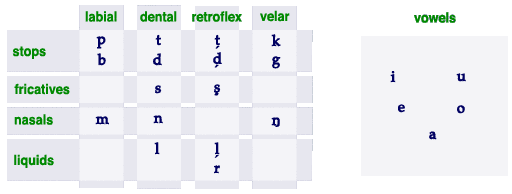
The phonology is somewhat idealized, being based on reconstruction from modern dialects, borrowing behavior, infuriatingly vague comments from OS grammarians, and the OS writing system. The only really problematic aspect is the exact nature of the third column of consonants. Retroflex is the best guess, but palatal and even aspirated stops are remoter possibilities.
To produce retroflex stops, start with the tongue on the alveolar ridge behind the teeth, and slip it upwards. The tip may end up curled backwards (which is what ‘retroflex’ means). However, it shouldn’t end up on the top of the palate (that’s the place for palatals). If you’re American, your r may be retroflex. If your tongue points upward from its rest position, you’re in business— just move it forward a bit and you’ve got OS ṭ and ḍ. If your tongue points downward and is pulled into the back of the mouth, you have a bunched r instead.
OS r in the delta dialect was an approximant, but seems to have been a flap in other areas (e.g., it ended up as a flap in Gurdagor).
English t/d/n/s/l are alveolar, with the tongue touching the ridge behind the teeth; make sure you pronounce the OS t/d/n/s/l as dental, with the tongue touching the teeth, for maximum contrast with the retroflexes.
OS had some formidable clusters (e.g. kpasriukka, ŋoknlun). Some of these were subject to assimilation consistently enough that it can be assigned to the OS period:
There is no phonemic retroflex nasal, but n next to a retroflex consonant was very likely retroflexed.
N before g was not velarized; don’t pronounce Engidori as *Eŋgidori.
Any two distinct vowels can be concatenated; but two identical vowels are separated by an inserted r— e.g. a + a = ara.
The general stress rule is that it comes after the first consonant in the root. As this requires identifying what the root is, this will be discussed in more detail below.
Verbal Morphology |
The system is complicated enough that a conjugation utility can be useful.
There are also nominal derivations; indeed, the vast majority of OS nouns are derived from verbs; the non-derived nouns are a small closed class.
OS doesn’t have lexical gender, as in French or Verdurian; it has natural gender, like English. That is, gender isn’t a fact about words, but a fact about referents.
There are four genders, which can be divided into two overall categories, sentients and non-sentients.
By our standards, the Skourenes were fairly generous about assigning sentiency or animacy. From their perspective, of course, we are extremely narrow about these things!
Gender is not always expressed; when it is, the distinction made is not always fourfold. Sometimes only sentients and non-sentients are distinguished; sometimes masculine/feminine/non-sentient.
Though these look and sound very different to us, they are all standard derivations, easily recognized by an OS speaker as belonging to a single root, and in fact they are all written using the same glyph.
ṭelpum it was written ṭelup I wrote ṭuloup we will write aiṭlope they made me write ṭeilop he was always writing inṭulup I may try to write ṭlepa document aṭelop writer ṭilap pen uṭalpas the art of writing aṭalpi written gauṭulip you write clumsily nilṭulrap she can write
For ease in discussion, it’s convenient to name the positions within the root; we will refer to the three consonants as C1, C2, C3, and the positions adjacent to them as P0, P12, P23, P4. Thus instead of saying “an -a- inserted between the second and third consonants signals a noun” we can say “an -a- in P23 signals a noun”.
Some examples:
Though Skourene grammarians consider the root to consist of the consonants only, each verb has a characteristic vowel or stem vowel which usually appears in P12— for instance e in ṭ-l-p- ‘write’ or i in k-s-n- ‘hear’. The stem vowel is always one of i e a. It doesn’t always appear, but when it does it’s not predictable from the consonants; it must be learned along with them and is thus best considered part of the root. The citation form of ‘write’ is thus ṭelp-, and ‘hear’ is kisn-.
P0 C1 P12 C2 P23 C3 P4 ṭ e l p u ai ṭ l o p e ṭ l e p a ṭ i l a p u ṭ a l p as
There are a small number of biconsonantal roots, which will be discussed later.
Now that we’ve defined the positions we can state the stress rule:
The window broke.Syntactically, we say that the first sentence is intransitive, meaning that it has a subject and no object, and the second is transitive, meaning that it has both. Semantically, we can talk about three possible case roles:
The boys broke the window.
So aknó brisre.In an ergative/absolutive language like OS:
Soî sefoi brisrü so aknám.
Some sample OS sentences:
Bakşu tostim. The window broke.
Bakoşu tostim immolnimi. The boys broke the window.
Bakoş immolnimi. The boys broke something.
Often, though, we have a pair of verbs where OS has one: rise / raise; fall / drop; die / kill, come / fetch. These will be one verb and one concept in OS; this may take some getting used to. The transitive generally has a causative meaning, though as we’ll see OS has a causative as well.
We also have verb pairs which have about the same meaning, but differ in transitivity: I listened vs. I heard the sound; I studied vs. I learned algebra. These pairs are also single verbs in OS, with our subject expressed in the ergative; if a patient is present it’s as usual placed in the absolutive.
If we have no separate intransitive verb, we use the passive. For instance, we can say The mother nurtures the child but there’s no simple verb for what the child is doing; we have to say The child is nurtured. In OS there is; the child melnu, which has none of the indirectness of our passive.
The absolutive can always be used alone, with no ergative ‘subject’, even for transitive verbs. E.g. Ṭelpum ṭlepa, which we have to translate more verbosely as ‘The document was written’ or ‘Someone wrote the document’.
(This is the most basic verb tense in OS, but the glosses are past tense. Technically this is the perfect mood. We’ll see how to refer to present events later on.)
be heard break fall be lit up I -e kisne bakşe targe şebre I-f -et kisnet bakşet target şebret you-m -a kisna bakşa targa şebra you-f -at kisnat bakşat targat şebrat you-du -as kisnas bakşas targas şebras he -u kisnu bakşu targu şebru she -ut kisnut bakşut targut şebrut it -um kisnum bakşum targum şebrum we-excl -ep kisnep bakşep targep şebrep we-incl -eg kisneg bakşeg targeg şebreg you-pl -ag kisnag bakşag targag şebrag they -i kisni bakşi targi şebri they-f -it kisnit bakşit targit şebrit they-ns -im kisnim bakşim targim şebrim
listen break drop light up I -u- kisun bakuş tarug şebur you-m -i- kisin bakiş tarig şebir you-f -ri- kisrin bakriş tarrig şebrir he -- kisn bakş targ şebr she -ra- kisran bakraş tarrag şebrar it -ḷa- kislan bakḷaş tarḷag sebḷar we-excl -obu- kisobun bakobuş tarobug şebobur we-incl -ou- kisoun bakouş taroug şebour you-pl -oi- kisoin bakoiş taroig şeboir they-mf -o- kison bakoş tarog şebor they-an -ḷo- kislon bakḷoş tarḷog şebḷor
subject object I you-m you-f he she we-excl we-incl you-pl they me kisine kisrine kisne kisrane kisobune kisoune kisoine kisone me-f kisinet kisrinet kisnet kisranet kisobunet kisounet kisoinet kisonet you-m kisuna kisrina kisna kisrana kisobuna kisouna kisoina kisona you-f kisunat kisinat kisnat kisranat kisobunat kisounat kisoinat kisonat you-du kisunas kisinas kisrinas kisnas kisranas kisobunas kisounas kisoinas kisonas him kisunu kisinu kisrinu kisnu kisranu kisobunu kisounu kisoinu kisonu her kisunut kisinut kisrinut kisnut kisranut kisobunut kisounut kisoinut kisonut us-excl kisunep kisinep kisrinep kisnep kisranep kisobunep kisounep kisoinep kisonep us-incl kisuneg kisineg kisrineg kisneg kisraneg kisouneg kisoineg kisoneg you-pl kisunag kisinag kisrinag kisnag kisranag kisobunag kisonag them kisuni kisini kisrini kisni kisrani kisobuni kisouni kisoini kisoni them-f kisunit kisinit kisrinit kisnit kisranit kisobunit kisounit kisoinit kisonit
kisuna I listened to you (m). kisobunas We (excl) listened to the two of you. bakşum He broke it. şebḷareg It lit us (incl). terilet You (m) touched me (f). dirobuşi We (excl) allied with them. geşorag They ruled you people.
hear oneself break oneself drop oneself light oneself up I -ei kisnei bakşei targei şebrei I-f -eṭ kisneṭ bakşeṭ targeṭ şebreṭ you-m -ai kisnai bakşai targai şebrai you-f -aṭ kisnaṭ bakşaṭ targaṭ şebraṭ you-du -aş kisnaş bakşaş targaş şebraş he -ui kisnui bakşui targui şebrui she -uṭ kisnuṭ bakşuṭ targuṭ şebruṭ it -uim kisnuim bakşuim targuim şebuim they-du -uş kisnuş bakşuş targuş şebruş we-excl -eip kisneip bakşeip targeip şebreip we-incl -eḍ kisneḍ bakşeḍ targeḍ şebreḍ you-pl -aḍ kisnaḍ bakşaḍ targaḍ şebraḍ they -iri kisniri bakşiri targiri şebriri they-f -irit kisnirit bakşirit targirit şebririt they-ns -irim kisnirim bakşirim targirim şebririm
kisnei I heard myself. kisnai You (m) heard yourself. kisnuṭ She heard herself. kisnaş The two of you listened to each other. kisneip We (excl) listened to each other. kisneḍ We (incl) listened to each other. kisnaḍ You all listened to each other. kisniri They listened to each other.
There are four other moods. The descriptions below are simply a first approximation; the full usage of the verb is best explained after all the forms have been presented, and I therefore discuss it farther on, under Syntax.
kusne I intend to be heard kusun I intend to listen turga You intend to fall bukş He intends to break (something)
kasne I want to be heard kasun I want to listen taurga You want to fall baukş He wants to break (it)
kosne I’m afraid of being heard kosun I’m afraid to listen torga You’re afraid to fall bokş He’s afraid of breaking (it)
ksne I don’t/didn’t/won’t hear ksun I don’t/didn’t/won’t listen trga You don’t/didn’t/won’t fall obkşu He doesn’t/didn’t/won’t break it
A negative imperative is formed using the particle gba: gba uksinut ‘don’t listen to her!’
uksne hear me! uksinut listen to her! uturga Fall! ubukş Let him break it!
kiasne I was heard for a long time kiasun I listened for a long time tararga You kept falling
kiusne I began to be heard kiusun I began to listen tauga You began to fall baukş He began to break (it) şeubru It was lit (e.g. set aflame)
kirisne I was heard over and over kirisun I listened many times tairga You fell several times baikş He kept breaking it şeibru It was illuminated again and again
mood aspect example gloss perfect unmarked ṭelup I wrote durative ṭealup I wrote and wrote inceptive ṭeulup I began to write cyclical ṭeilup I often wrote intentive unmarked ṭulup I intend to write durative ṭualup I intend to keep writing inceptive ṭurulup I intend to start writing cyclical ṭuilup I intend to write over and over desiderative unmarked ṭalup I want to write durative ṭaralup I want to keep writing inceptive ṭaulup I want to start writing cyclical ṭailup I want to write over and over metutive unmarked ṭolup I’m afraid I’ll write durative ṭoalup I’m afraid I’ll keep writing inceptive ṭoulup I’m afraid I’ll start writing cyclical ṭoilup I’m afraid I’ll write over and over imperative unmarked uṭlip write! durative uṭalip keep writing! inceptive uṭulip start writing! cyclical uṭilip write over and over!
These can be divided into several classes.
Note the chain of demotions: the boys go from ergative to absolutive; the window goes from absolutive to genitive (and no longer triggers any verb agreement).
bakşum It broke bakuşum I broke it aibakşe He made me break (it)
Aibakşi tostimi molnimil ŋagetorul.
caus-break-3s-3p window-gen-def boys-def potter-def
The potter made the boys break the window.
Inanimates can never cause anything.
If the prefix ends in -m, this changes to -u before a non-labial stop: ḍautispum ‘they ripped it entirely up’.
prefix meaning example me- pretense; doubt mekisun I pretended to listen nil- knowledge, ability nilseatre I know how to swim in- attempt inkisun I tried to listen gam- clumsiness gammendu he walked clumsily, he stumbled ŋre- falsity ŋrenulin he spoke wrongly, he lied kpa- wrongness kpaguaşreg
kpanulinWe are misruled
he spoke wrongly, he was mistakenbun- neglect to do, almost do bunḍişinu you overlooked it ukḷu- despective ukḷuṭiarku he was lurking (ṭirk- ‘stand’) kus- in a superior way kussemritu she outran him ru- quickly, urgently rurugnda! come quickly! ṭis- into pieces ṭisbakşum it broke into pieces ḍam- completely, wholly ḍamşeabrum it was entirely lit up ŋok- stop ŋokmende I stopped walking piŋ- undo piŋgitrum it was destroyed pum- help pumsaulrat she wants to help clean min- back mindanteg we went back mek- here mekuḍriḍum! bring it to me here! ḍim- there ḍimmenidut? did she walk there?
Me- indicates doubtfulness in the absolutive paradigm (mekisne ‘I may not have been heard’), but falseness or fakery in the ergative (mekisun ‘I pretended to listen’).
prefix meaning example mne- walk mnemoirmeg we’re walking in a circle tim- cut tiuḍeḍugu I cut it in half bau- speech baugime he insulted me (= bit with words)
Some other nouns may be used as prefixes, especially in nouns or in single lexical items. Derived nouns (see next section) can never be used as a verb prefix.
prefix meaning example les- water leskeşgut
leskuşugashe drowned
I greet you (= bring you water)ksa- heat, light ksaşodme
ksaḍeskeI’m dizzy from the heat
it’s faded (= whitened by light)ŋol- food ŋolburusug I’m hungry (= lack food) una- clothing unatisipe he tore my clothes nos- money nosḍaraḍum I paid for it (= money-took it) ḍoŋ- baby ḍoŋuslritu! wash the baby! um- head or face umboŋke I have a headache bol- hair bolbuldei I’m going to comb my hair teḷ- by hand teḷgenudum I made it by hand gan- by foot gantarasgut she was barefoot
That we can form all these nominalizations doesn’t mean that we should. Proper OS style prefers verbs wherever possible— e.g. “I fight and they cannot stop me” rather than “My fighting technique is unstoppable”. See Avoiding copulation below.
ekusena listening, hearing eṭulepa the writing process egutera creation ekureka fighting, combat eguşera government, rule emulena nurture, mothering emuŋela speaking, (the facility of) speech emusepa thinking; concern, worry
ksiunna an act of listening ṭliuppa a writing session gdiurra the formation of a single object kriukka a fight gşiurra a governmental act mliunna a nurturing action ŋiulla utterance msiuppa thought, idea
ukasnas listening skills uṭalpas writing ugatrasa pottery ukarkas the art of war ugaşras a ‘gubernatorial’ (vs. a senatorial) state umalnas the art of nurturance, parenting skills umaŋlas oratory umaspas logic
ṭlepa document, essay gdira pot, vessel mŋela a speech, a discourse msepa subject, topic gşera regime, administration
kosnim a sound ṭolpim text gotrim the form or shape of something korkim opponent goşrim subject (of a ruler) molnim child moŋlim addressee, audience mospim ward, protégé
akeson listener aṭelop writer agetor potter, creator akerok fighter ageşor ruler amelon mother ameŋol speaker amesop thinker
kessen a recording device, perhaps magical ṭellep a writing device getter mold kerrek a recalcitrant or dangerous machine meŋŋel a speaking device messep robot
kisan ear ṭilap pen gitar potter’s wheel kirak weapon gişar staff (Skourene symbol of authority) milan breast miŋal mouth misap heart (for Skourenes, the organ of thought)
ṭlapali scriptorium gdarali pottery shop krakali arena gşarali throne room, court mlanali foster home, orphanage mŋalali auditorium msapali study, a thinker’s private room
akasni heard aṭalpi written agatri formed, shaped akarki fought agaşri ruled amalni nurtured amaŋli spoken to amaspi thought about or cared for
If the verb has a verb prefix, form the nominalization, then precede it with the verb prefix. However, the initial u- of the art nominalization, and the initial a- of the actor nominalization, normally migrate before the prefix: uŋremaspas ‘illogic’, amnekerok ‘one who fights by hand’.
ikksen listening iṭṭlep writing iggter forming ikkrek fighting iggşer ruling immlen nurturing immŋel speaking immsep thinking
This type of derivation remained extremely productive for names, as well as for nonce descriptions: kşigu umḍişnu ‘don’t kill a man who has surrendered’, where umḍişnu is used as a noun, but simply means ‘he surrendered’.
ḍairḷoḍ they keep bringing it amber gitra you were formed wax guṭḷi they will be glad good omen kusni they will be heard language Miligenḍi they were summoned; they came (city name) ḍadnim they are inside intestines guşouri we rule them hinterland ṭailuadni they want to keep living in the sea iliu goşpa it tires you far nuilmim they will cyclically shine moons mianum it is always below floor gairoukum we cyclically sprinkle it cumin muḍureg we will be whole federation gidori they protected them military honors raḍḍoug we have finished harvesting harvest festival usṭişum (you) solve it! puzzle
There are also irregular derivations:
Or perhaps the process of derivation went the other way. Some linguists suggest that e.g. ḍod came first, and was turned into a verb.
maŋ- fear → moŋ coward dem- go upward → idma more ḍed- be a brother → ḍod brother meld- be a sister → mald sister pasn- be a man → pisan ten sirm- crawl → surm reptile
For biconsonantal verbs, the positions are named P0 C1 P12 C2 P3.
kisn- listen ḍer- rot gim- bite riŋ- sing ŋeḍ- recline abs (1s) kisne ḍere gime riŋe ŋeḍe erg (1s) kisun ḍur gum ruŋ ŋud abs/erg (1s/2s) kisuna ḍura guma ruŋa ŋuda refl (1s) kisnei ḍerei gimei riŋei ŋeḍei erg (3s) kisn der gim riŋ ŋeḍ
kisn- listen ḍer- rot gim- bite riŋ- sing ŋeḍ- recline Absolutive (1s) intentive kusne uḍre ugme urŋe uŋde desiderative kasne aḍre agme arŋe aŋḍe metutive kosne oḍre ogme orŋe oŋḍe negative ksne ḍoḍre gogme rorŋe ŋoŋḍe Ergative (1s) intentive kusun uḍur ugum uruŋ uŋuḍ desiderative kasun aḍur agum aruŋ aŋuḍ metutive kosun oḍur ogum oruŋ oŋuḍ negative ksun ḍoḍur gogum roruŋ ŋoŋuḍ
kisn- listen ḍer- rot gim- bite riŋ- sing ŋeḍ- recline Absolutive (1s) durative kiasne ḍeare giame riaŋe ŋeaḍe inceptive kiusne ḍeure giume riuŋe ŋeuḍe cyclical kirisne ḍeire girime ririŋe ŋeiḍe Ergative (1s) durative kiasun ḍuar guam ruaŋ ŋuad inceptive kiusun ḍurur gurum ruruŋ ŋurud cyclical kirisun ḍuir guim ruiŋ ŋuid With aspects (1s) Absolutive (1s) dur + int kuasne uaḍre uagme uarŋe uaŋḍe incep + desid kausne auḍre augme aurŋe auŋḍe cycl + metut koisne oiḍre oigme oirŋe oiŋḍe Ergative (1s) dur + int kuasun uaḍur uagum uaruŋ uaŋuḍ incep + desid kausun auḍur augum auruŋ auŋuḍ cycl + metut koisun oiḍur oigum oiruŋ oiŋuḍ
kisn- listen ḍer- rot gim- bite riŋ- sing ŋeḍ- recline Process ekusena eḍera egema ereŋa eŋeḍa Instance ksiunna ḍiurra giumma riuŋŋa ŋiuḍḍa Art ukasnas uḍaras ugamas uraŋas uŋaḍas Resulting object ksena ḍrera gmema reŋa ŋeḍa Patient kosnim ḍorim gomim roŋim ŋodim Actor akeson aḍeroṭ agemoṭ areŋoṭ aŋeḍoṭ Device kessen ḍerreḍ gemmeg reŋŋer ŋeḍḍeŋ Tool kisan ḍiraḍ gimag riŋar ŋiḍaŋ Place ksanali ḍarali gamali riŋali ŋaḍali Abs. participle akasni aḍari agami araŋi aŋaḍi Erg. participle ikksen iḍḍer iggem irreŋ iŋŋeḍ
Nominal morphology |
The citation form— the form you’ll find in the lexicon, and the one the other forms are all built from— is the absolutive singular indefinite.
Noun stress:
‘realm’ ‘mother’ ‘wax’ ‘arena’ ‘writing’ sing. abs tebbeḍ amelon gitra krakali ukasnas erg ittebbeḍ ŋamelon iggitra ikrakali ŋukasna gen tebbeḍi ameloni gitrai krakaliri ukasnai pl. abs tebbeḍe amelono gitrar krakalir ukasnara erg ittebbeḍe ŋamelono iggitrar ikrakalir ŋukasnara gen tebbeḍu amelonu gitrau krakaliu ukasnau
(We can reconcile these two rules by supposing that in the ancestral language, a final vowel was doubled, with the usual -r- insertion between identical vowels: *gitrara; the final vowel was then lost.)
‘document’ ‘ear’ ‘sea’ ‘temple’ ‘city’ sing. abs ṭlepa kisan ṭal ṭisu eŋ erg iṭṭlepa ikkisan iṭṭal iṭṭisu ŋeŋ gen ṭleipa kisain ṭail ṭirisu eŋi pl. abs ṭlopa kison ṭol ṭusu oŋ erg iṭṭlopa ikkison iṭṭol iṭṭusu ŋoŋ gen ṭleupa kisaun ṭaul ṭiusu eŋu
‘writing’ ‘wax’ ‘document’ ‘ear’ base ukasnas gitra ṭlepa kisan sing. abs ukasnatul gitral ṭlepal kisanul erg ŋukasnal iggitral iṭṭlepal ikkisanul gen ukasnail gitrail ṭleipal kirisanul pl. abs ukasnaral gitraḷ ṭlopal kisonul erg ŋukasnaral iggitraḷ iṭṭlopal ikkisonul gen ukasnaul gitraul ṭleupal kiusanul
The close definite form is very similar to our definite article— that is, we can say that ṭlepa = ‘a document’, ṭlepal = ‘the document’.
‘writing’ ‘wax’ ‘document’ ‘ear’ base ukasnas gitra ṭlepa kisan sing. abs ukasnask gitraŋ ṭlepaŋ kisanaŋ erg ŋukasnaŋ iggitraŋ iṭṭlepaŋ ikkisanaŋ gen ukasnaiŋ gitraiŋ ṭleipaŋ kirisanaŋ pl. abs ukasnaraŋ gitraŋ ṭlopaŋ kisonaŋ erg ŋukasnaraŋ iggitraŋ iṭṭlopaŋ ikkisonaŋ gen ukasnauŋ gitrauŋ ṭleupaŋ kiusanaŋ
The remote definite can be seen as an obviative: ṭlepaŋ ‘the other document’.
These can be also seen as demonstratives, and in fact historically that’s what they are: ‘this document / that document’. If you have no specific noun in mind, you can use the generic mam ‘thing, item’— e.g. mamul ‘this one, mamaŋ ‘that one’.
The precise manner of using the definite forms varied by region:
ḍel river → ḍeṭil brookThe other diminutive expresses affection, and is mainly used for family members, lovers, children’s names and body parts, and small animals. In most cases, one applies the following rules:
konşim galley → koṭinsim rowboat
misan grass → misaṭin stubble
surm reptile → suṭirm insect
greḍa house → greṭiḍa hut
aŋesom father → meşe daddy
amelon mother → meḷe mommy
ḍod brother → ḍoḍo
mald sister → meḍe
adenom male lover → ḍene
domim female lover → ḍomo
biraḍ buttocks → biri tushie
Other word types |
The suffix is added to the citation form of the noun, with these exceptions:
suffix miŋal
harborḍel
rivernorşis
maidenṭisu
templedreşa
alliancekrakali
arena-ram great miŋarram ḍerram norşisram ṭisuram dreşaram krakaliram -sok white miŋalsok ḍelsok norşissok ṭisusok dreşasok krakalisok -eli good miŋaleli ḍeleli norşiseli ṭisueli dreşeli krakaleli -naku new miŋalnaku ḍelnaku norşisnaku ṭisunaku dreşanaku krakalinaku
For standalone nouns like ḍel and ṭisu, the infix is added after the last consonant.
suffix miŋal
harborḍel
rivernorşis
maidenṭisu
templedreşa
alliancekrakali
arena-iḷt beautiful miŋaliḷt ḍeliḷt norşiḷtis ṭisiḷtu dreşiḷta krakiḷtali -urg dark miŋalurg ḍelurg norşurgis ṭisurgu dreşurgi krakurgali -ikt cold miŋalikt ḍelikt norşiktis ṭisiktu dreşikta krakiktali -arṭ green miŋalarṭ ḍerarṭ norşarṭis ṭisarṭu dreşarṭa krakarṭali
For nouns derived from triconsonantal verbs, the infix is added after C3. When C3 is the last consonant, as in miŋal and dreşa, this looks like the last rule; but compare norşis and krakali. The -is and -ali are sufixes, so the infix must precede them.
Descriptive affixes are applied after case changes and pluralization, but before the definite suffixes. Thus ṭisurram ‘great temples’, tebbeḍiram ‘of a great realm’, but ṭisurramul ‘the great temples’, tebbeḍiramul ‘of the great realm’.
ḍemn- blacken
ḍegr- darken, make evil
ḍeḷt- beautify
ḍenk- renew, renovateḌunku Skouras ŋageşor. The ruler will renew Skouras.
Ḍeltut norşis. The girl has become beautiful.
Skouras → skourand SkoureneAs substantives, they decline and behave exactly like any noun:
Ṭisutra → ṭisutrand
Guṭḍaku → guṭḍakuro Gurdagor
Aksun Axunai → aksunaro Axunemi
Ḍabriŋ Jeor → ḍabriŋik Jeori
Namal → namalasp
boḍ west → boḍand westerner
isskourand the Skourene (sg. erg.)They can be used to modify a noun, in which case they look to us more like adjectives, especially as in this usage they are not declined by case or number. They appear after the noun:
ḍabriŋiki a Jeori’s (sg. gen.)
skouranda the Skourenes (sg. abs.)
ŋortim ḍabriŋik Jeori merchandise
eŋ komand an eastern city
ameşodol aksunaro the Xurnese women
(The patient and actor nominalizations (goşrim ‘subject’ and ageşor ‘ruler’) are similar, but imply a more permanent or inherent state, which is why they’re often lexicalized as names of titles and classes of people. An iggşer might be someone who finds themselves leading in a temporary or abnormal situation.)
As substantives, the participles are declined normally:
ipplen kind one (sg. abs.)And like the associative nouns, the participles can be used as apppositives, without declension:
ipplene the kind ones (pl. abs.)
ŋaḍaltir the beautiful ones (pl. erg.)
ageşor ipplen kind ruler (lit., a ruler, a kind one)The descriptive affixes can be turned into standalone substantives or appositives by taking the absolutive participle of the causative: e.g.
-iḷt beautiful → ḍeḷt- beautify → aḍaḷti beautiful oneŋaḍalti a beautiful person (erg.)
norşis aḍaḷti a beautiful girl
kennek aḍaski whitewashed wall
Şolpe. I’m fat. (metutive)These verbs can only have absolutive forms. However, they have regular causatives, e.g. aişolrape ŋameloŋŋop ‘My mother is making me fat’.
Şulpa. You’re fat. (intentive)
Şiulpu. He started to get fat. (inceptive)
Inanimates can’t possess anything, so -lek and -lim apply to animates only.
suffix gloss example -ŋop my (m.) greḍaŋop ‘my house’ -ŋot my (f.) atesoŋŋot ‘my husband’ -goş your (s. m.) aŋesomgoş ‘your father’ -goṭ your (s. f.) nriuddagoṭ ‘your dance’ -san his eŋsan ‘his city’ -sat her teralsat ‘her hand’ -lek its msanalilek ‘its pasture’ -dor our ṭretador ‘our country’ -beş your smepabeş ‘your law’ -sir their sortimşin ‘their clothes’ -lim their (an.) gimagşam ‘their teeth’
A noun with possessive is considered definite; the definite and remote suffixes can’t be added to it.
As with any descriptive suffix, these can be turned into causatives, e.g. ḍedr- ‘make or become ours’. Compare:
Ḍedru eŋul. The city became ours.These verbs have a special nominalization CeCCiCa which functions as a standalone pronoun. These are used for emphasis or for a sense of formality.
Dedouru eŋul. We made the city ours.
The patient nominalization produces the generalized pronominals ḍosrim ‘they’ and ḍodrim ‘we’. These are used to express common judgments or behavior; the second, of course, when the speaker approves of them, or wants to contrast Our People (the family, or Skouras) with outsiders or foreigners.
s. pl. 1 ḍeŋŋipa I (m.) ḍeddira we ḍeŋŋita I (f.) 2 ḍeggişa you (m.) ḍebbişa you ḍeggiṭa you (f.) 3 ḍessina he ḍessira they (m/f) ḍessita she ḍellika it ḍellima they (an.)
As usual, the absolutive participle can be used as a substantive or appositive: aḍaŋti ‘my (f.)’, aḍabşi ‘your (pl.), etc. These have an emphatic force, so we might think of them as meaning ‘mine, my own’, ‘yours, your own’, etc.
In general, if you find yourself wanting to say that something “is” something, you’re not thinking in OS. Think about how to express the thought using a verb, instead— even if the nouns you want to use exist in the lexicon. Using English examples and sometimes stretching the language:
It is possible to use an appositive construction without a verb: Eŋŋuloşum aŋelot Meŋelandi ‘Eŋŋuloşum is the dictator of Meŋeland’; nilam dlena ‘gold is a metal’. But most nouns are derivatives of verbs and thus can be replaced with verbal expressions: ŋualtu Meŋeland Ŋeŋŋuloşum ‘Eŋŋuloşum commands Meŋeland’.
English style OS style This is amusing This amuses me He’s rich He has become rich My house is here I live here He is the ruler He rules I’m happy I rejoice That’s a lie! You’re lying! He’s dead, Jim He just died, Jim We are at war We have begun to fight My son is worthy I praise my son She’s ready for marriage She has matured I’m a storyteller I habitually tell stories I have orders They ordered me I am a parent I’m raising children He’s the Lord’s advisor He advises the Lord He is naked He undressed She’s a hottie She attracts me This is my father Meet my father I am 24 years old I lived 24 years That’s a great idea I admire your idea This is a ‘saddle’ We call this a ‘saddle’ You are a wonder I marvel at you This is my answer I reply thusly
There is an existential verb tirṭ-, so that one can say e.g. tiarṭu eŋ koimdaraŋu ‘there existed a city in the east’. Gand- ‘come’ is also used existentially. Generally, however, it’s better to use a locative for this; see below.
In negative expressions, -moṭ can be translated ‘any’: gşutut moṭim ‘I don’t love anyone.’
Root Forms Meaning -ṭas no, not ṭosim no one, nothing ḍusṭas never -moṭ one moṭim someone, an individual -gog other, another gega another thing, something else gogim another thing or person ḍusgog another day, some other time -bab some, a few beba something bobim someone ḍusbab some day, sometime -kuş much, many koşim many people ḍuskuş many days, often -doḷ each, every doḷim everyone, everything ḍusdoḷ always
The pronouns in -im must be inflected by case: e.g. ibbobim ‘someone (erg.)’.
Other useful expressions of time include aṭi ‘now’ and sas ‘already’.
The numbers from 1 to 6 are unanalyzable roots; pisan ‘10’ is a variation of pasn- ‘to be a man’, and 7 to 9 and 11 are formed by subtraction— e.g. 9 = 1 [from] 10. Morg ‘12’ seems to be a contraction of mar + ḍog ‘six-two’.
unit x12 x144 12x 1/x 1 moṭ morg geld morg ḍmeṭa 2 ḍog morḍog geldog geld ḍega 3 ded morḍed gelded ruŋ ḍneḍa 4 darṭ morḍart geldarṭ demum ḍreṭa 5 bim morbim gelbim tolkim ḍbema 6 mar mormar gelmar geldroḍ ḍmera 7 depsan morḍeps geldeps ruŋroḍ 8 darg mordarg geldarg demumroḍ 9 mopsan mormops gelmops tolkimroḍ 10 pisan morpisn gelpisn geldram 11 momug mugeld geldruŋ ruŋram 12 morg geld ruŋ demumram
A multidigit number can be expressed, majestically, by concatenating the full forms of each digit: e.g. 5293 (base 12) = ruŋbim ḷa-geldog ḷa-mormops ḷa-ded.
There are verbs for the first three ordinals: nikt- ‘be first’, nişp- ‘be second’, nind- ‘be third’. The participles anakti, anaşpi, anandi ‘first one, second one, third one’ are useful. Past this the idiom ‘to come n’ can be used, e.g. gendu bim ‘he came fifth’.
5 + 2 bim idma ḍog 5 - 2 bim imna ḍog 5 * 2 bim diliri ḍog 5 / 2 bim kunkiri ḍog
For the first six numbers, there are verbs ‘to make n; divide into n parts’: ḍemṭ-, ḍeḍg-, ḍenḍ-, ḍerṭ-, ḍebm-, ḍemr-. The first six fractions are nominalizations of these verbs.
Further fractions are made by numbering the word tniussa ‘fraction’. e.g. tniussa depsan ‘1/7’, tniussa momug ‘1/11’. A ratio is expressed as e.g. tniussa ded kunkiri darg ‘3/8’.
The Skourenes were well trained for arithmetic; in trading they had to deal not only with currency conversions but different bases, since the Jeori used base 6 and the Axunemi used base 10. They learned the Jeori and Axunašin numbers in order to calculate using these bases.
Some names (e.g. Mandaŋoḍu and Sinatşugla above) use verbal prefixes which are rare or nonexistent in the rest of the lexicon.
Name Meaning Baulunrada she will calm you with speech Bolbsgu he will not lack hair Doḷsurriki you (f.) will please them all Ḍamnualmu he will shine wholly Ḍodsians he counselled (his) brother Ḍolbunodu they all will marvel at him Ḍuaptai you will always make yourself strong Ḍurunsu he will become rich Gangşpu his foot does not tire Geŋmunda you will walk in the forest Kamopa we expected you Krolakurilim they will not weaken you, you will weaken them Kurran she will attract Kuskurki he will outfight them Mandaŋoḍu the people want to obey him Menidep you accompanied us Mianṭep we are rejoicing Mneutiḍe you will walk alongside me Nilşugla you know how to be great Nosḍururiḍ he will acquire money Nuiktui he will win many times Nusrinep you (f.) will take care of us Pgomu they won’t defeat him Pilobus we sacrificed Pualran She will always be kind Sianisep you continually advised us Sinatşugla you will be great with the sword Suŋka you will succeed Tuşurat we are attached to you (f.) Ṭalḍaga you were born by the sea Ṭelpulgag his hand will support you Umḍultat her face will be beautiful Uruŋḍep we will begin to rest
Noun phrases can also be used as names; these are less likely to be unique.
Name Meaning Anakti first one Anesodram great hunter Apelog sustainer Bika silver Greḍakos fine house Guṭḷi good omen Ikkren beautiful one Ksenilam like gold Ḷordis dancer Maḍaṭiŋ jewel Nreşuşta rose Riuŋŋa song Teralepṭ strong hand Ḍişaneli good eye Ḍodeli good brother Ḍonsim rich man
Syntax |
The default sentence order is VAE (verb-absolutive-ergative):
Kisni asenoso ŋageşorul.Pragmatically, placing a constituent earlier than its accustomed position expresses surprise, hearsay, or distance: Asenoso kisni ŋageşorul, for instance, could be translated “I hear that the governor listened to his advisors.” A complete reversal (Ŋageşorul asenoso kisni ) could be interpreted, “His advisors— take it as you will, I’m just sayin’— the governor listens to them.”
listened-3s-3p advisor-pl governor-def
The governor listened to his advisors.
Modifiers to a noun (e.g. numbers, genitives, appositives) follow it.
As a slightly jocular summary, we might say that OS asks three questions of any action in order to assign the tense:
Kirouki. We fought them.By a slight exaggeration the perfect can refer to events which the speaker assures us are nearly complete: gendut ‘she’s coming’, ṭelpe ‘I’m just finishing writing.’
Gauşte I fell in love.
Melrane ŋameşodul. This woman raised me.
Meŋlut tosgitul. Someone spoke to the naked woman.
Its prototypical meaning is to express what someone is trying to do right now, or intends to do in the future: dunte ‘I’m going, I will go’; kurouk ‘we mean to fight’.
Combined with the perfect, it expresses the actors’ state of mind, and thus corresponds to our past progressive:
Gendi durki, lit. ‘They came, they will cry’ = They came crying.
It’s the vaguest of the imperfect moods— after all, most actions are intended by someone. As such it can be used for most present actions, much like our present progressive.
Surutu degarṭa. I’m wearing a green dress.
They may be used literally to refer to desire or fear: dante ‘I want(ed) to go’, donta ‘I’m afraid you’ll go’.
Normally the feelings are those of the speaker; but speaking to someone one may take their point of view (torga ‘you could fall!’); and in a narrative they refer to the viewpoint character (torgu ‘he was afraid of falling’).
By extension, they’re used for uncertain or future events that no one is responsible for (i.e., they’re no one’s intent). If the effect is positive or neutral the desiderative is used (paltu ‘it will rain (if all goes well)’, otherwise the metutive (soḷgu ‘it may get dark’).
(It could also be argued that the connectors are all subordinators. Since they include simple concatenation and all have the same syntactic form, it’s simpler to consider them akin to conjunctions.)
The simplest case is where two or more verbs share the exact same arguments. They can simply be concatenated, using the clitic ḷa- (aḷ- before a vowel):
Nemratut ḷa-lenradut ḍogimsat ŋamelonul.The conjoined verb can also be moved after the object:
lift-3sf-3sf and-comfort-3sf-3sf baby-her mother-DEF
The mother picked up and comforted her baby.
Nemratut ḍogimsat ŋamelonul ḷa-lenradut.
lift-3sf-3sf baby-her mother-DEF and-comfort-3sf-3sf
The mother picked up her baby and comforted it.
Lenradut ḍogimsat ŋamelonul ḷa-naḷraşu atesonsat.In the first example, we know that the second verb should have an ergative argument and none is supplied: it’s assumed to be the same as the first verb’s (i.e. ‘mother’). The same goes for the second example and its understood absolutive argument (i.e. ‘baby’).
comfort-3sf-3sf baby-her mother-DEF and-praise-3sf-3s husband-her
The mother comforted her baby and praised her husband.Nemratut ḍogimsat ŋamelonul ḷa-naḷşut ŋatesonsat.
lift-3sf-3sf baby-her mother-DEF and-praise-3s-3sf husband-her
The mother picked up her baby and her husband praised it.
What if the a referent’s role changes between sentences? First and second person arguments cause no confusion, of course; one can string together almost any number of predicates with no confusion:
Guşutat ḷa-guşrite ḷa-nuḷuşat ḷa-daunumat.Referents of differing genders are also clear:
love-INT-2sf-1sm and-love-INT-1sm-2sf and-praise-INT-2sf-1sm and-sex-DESID-2sf-1sm
I love you and you love me and I praise you and I want to sleep with you.
Meŋralu ḷa-kisnut ḷa-dantu ḷa-benkut.Ergativity leads to some unexpected implications, if you’re used to a nominative-accusative language. For instance:
speak-INT-3sf-3s and-listen-INT-3s-3sf and-go-3s and-stay--3sf
She spoke to him and he listened to her and he went and she stayed.
Serḍu aŋeşoṭul ŋanesonul ḷa-sepu.The person who left is understood to be the thief, not the watchman. Sepu requires an absolutive argument, and there’s nothing to indicate that case roles changed, so it gets the first verb’s absolutive.
hit-3s-3s thief-DEF watchman-DEF and-go-3s
The watchman hit the thief and he left.
Aiserḍu aŋeşoṭil anesonul ḷa-sepu.Again, the unstated argument of the second verb is assumed to be the absolutive of the first verb, but now this is the watchman.
CAUS-hit-3s thief-GEN watchman-DEF and-go-3s
The watchman hit the thief and left.
Serḍu aŋeşoṭul ŋanesonul aḷ-aiŋiriştu romimil.Aiŋiriştu lacks an explicit absolutive, so it’s understood as referring to the most recent absolutive, the thief. (Without the antipassive, the thief would be the one robbed!)
hit-3s-3s thief-DEF boy-DEF and-CAUS-steal-CYC-3s noble-GEN-DEF
The boy hit the thief who was robbing the noble.
Ŋişṭum ŋiraşul ŋaŋeşoṭul ḷa-sepu.As usual sepu requires an absolutive argument; but it can’t be ŋiraşul ‘the money’, because that’s inanimate. Its argument is therefore taken to be the thief, demoted from ergative to absolutive.
steal-3sin-3s money-DEF thief-DEF and-go-3s
The thief stole the money and left.
If it’s not possible or not desired to change case roles to make everyone match up, the clitic ge- (g- before a vowel) can be used instead; this has the same meaning as ḷa- but explicitly suspends case role expectations. E.g::
Serḍu aŋeşoṭul anesonul ge-sepu.There’s nothing explicit that tells us that the boy is the absolutive of sepu; but we can deduce it from the fact that no other argument was supplied, and ge- was used.
hit-3s-3s thief-DEF watchman-DEF plus-go-A3s
The boy hit the thief and he (the boy) left.
Often we want to introduce a referent in one clause, typically as an absolutive, and focus on it in the next, typically as an ergative. This is done using the topicalizer kau- (kam- before a vowel).
Bilobutu Ṭisutrand kau-nankep.The pragmatic effects of kau- and ge- are similar— both revise the case matching process— but kau- is more specific; its referent is always one explicitly present in the preceding clause.
find-1p-3s Ṭisutran topic-cheat-3s-1p
(Lit.) We found the Ṭisutran; as for him, he cheated us. We found the Ṭisutran who had cheated us.
In both cases, the most natural English translation is with a relative clause; the ge- example above might also be translated The boy hit the thief, who left. Still, in OS there is no formal process of relativization— that is, the use of a pronominal element referring explicitly to a preceding referent.
Some examples:
prefix before vowels meaning ḷa- aḷ- and (concatenation) kla- kaḷ- or (disjunction) ŋa- aŋ- but (contrast, surprise) nsul- nsul- therefore (logical effect) kru- krum- because (logical cause) ṭou- ṭom- for (purpose) gre- grel- for (exchange) aṭi- aṭiḷ- when, while (at the same time as the main action) mur- mur- until, before (end time of the main action) de- nd- since, after (beginning of the main action) aḷde- ḷand- then, next (sequence in time) nen- nen- as (metaphor) şiu- şim- only, except (limitation on main action) ṭas- ṭas- except; (after negatives) not even, including laŋ- laŋ- there (introduces an event at a mentioned location) kau- kam- topicalizer (promotes previous absolutive) ge- g- case reset
Gauşrutu kru-paralnet.The difference between ‘since’ and ‘after’ (and ‘until’ and ‘before’) is expressed by verbal aspect (perfect vs. durative). Compare:
incep-love-1sf-3s because-dur-kind-3s-1sf
I fell in love with him because he was kind to me.Ḷilirde mur-nemtut aşebort.
cycl-dance-1px until-rise-3sf sun
We often danced until the sun rose.Dirinmet şiu-tesnet.
cycl-sex--3s-1sf only-marry-3s-1sf
(Lit.) He had sex with me only (when) he married me.
We had sex only once we were married.Ŋa-bakşeip ṭou-ḍelnum sekketsan.
but-break-refl-1px purpose-assist-3s-3sin taxes-his
However, we divorced for tax reasons.
Bedre de-sepat. / Beadre de-seapat.A more sophisticated sentence, from the examples:
wake-1s after-leave-2sf / dur-wake-1s after-dur-leave-2sf
I woke after you left. / I’ve been awake since you left.Ḷiardeg mur-ḍusnemtu. / Ḷirdeg mur-ḍusmentu.
dur-dance-1p before-sunrise / dance-1p before-sunrise
We danced until dawn. / We danced before dawn.
Saŋkum psiukkasan nsul-mindntu aŋ-inbuştu boiḍunru nen-bşti ḍodrim.This way of putting sentences takes some mental adjustment; but on its own terms, it’s as simple and expressive as English. It’s something like pointillistic painting: there are more and shorter brushstrokes, but the resulting picture is no less complicated.
successful-3sns expedition-his therefore-back-go-neg-3s but-attempt--int-travel-3s westward as-dur-go-neg-3p us-people
(Lit.) His expedition was successful / therefore he did not return / but tried to travel westward / as people do not go
His expedition was so successful that he did not return, but decided to travel farther west than anyone had gone.
Korlu molnimul kau-nulnum.The two conjoints can just as well be reversed:
metu-sicken-3s boy-def topic-tell-3s-3sin
Lit. The boy sickened / he said it
The boy says that he is sick.
Nulnum immolnimul ḷa-korlu.The case roles must be handled according to the usual rules. Here, for example, the boy is the absolutive of kirl- ‘be sick’ but the ergative of neln- ‘tell’. In the first sentence kau- is used to promote him from absolutive to ergative; in the second the demotion is automatic since no other argument is possible.
tell-3s-3sin boy-def and-sick-3s
Direct speech can be handled the same way—
“Korle,” ge-nulnum immolnimul.—but it may be explicitly signalled using the pronouns mamul (if the verb of speaking comes first) or mamaŋ:
metu-sicken-1s and-tell-3s-3sin boy-def
Lit. I sickened / the boy said it
“I’m sick,” the boy said.
“Korle,” ḷa-nulnum mamaŋ immolnimul.The case-resetting connector ge- is no longer needed, because both arguments to neln- are now explicit.
metu-sicken-1s and-tell-3s-3sin that boy-def
Lit. I sickened / the boy said it
“I’m sick,” the boy said.
Nuasni goşrimi ŋageşorram nen-mualranit molnimi ŋamelon.If the verbs and arguments are identical (or can be made so), the conjoined verb can be omitted, and nen- attached to the noun instead:
dur-care-3s-3p subject-pl ruler-great as-dur-nurture-3s-3p child-pl mother
A great ruler cares for his subjects as a mother nourishes her children.
Nuasdi goşrimi ŋageşordor nen-ikkuḷiŋ.The same connector is used for comparisons of equality:
dur-hunt-3s-3p subject-pl ruler-our as-lion
Our ruler preys on his subjects like a lion.
Şulpu ageşordor nen-gerrek.Inequalities are indicated with the adverbs idma ‘more’ and imna ‘less’: e.g. Şulpu ageşordor idma nen-gerrek ‘Our ruler is fatter than a pig’.
int-fat-3s ruler-our as-pig
Our ruler is as fat as a pig.
Superlatives are expressed the same way, with the addition of -doḷ ‘every’:
Ḍoansum Engidori idma nen-eŋdoḷ.
dur-be.rich-3sin Engidori more as-city-every
Engidori is the richest of cities.
Daraŋum ḍeilul eŋul.For present, temporary situations, the intentive is the most appropriate form:
located-dur-3sin river-gen-def city-def
The city is on the river.
Udnu msapalirisan aŋesom.The locative expression may simply be dropped into another sentence, normally after the nominal arguments:
located-int-3s study-GEN-his father
Father is (presently) in his study.
Ŋulsum roz ŋaŋesom udaŋ msapalirisan.Locatives are essentially sequenced verbs without an explicit connector. The case roles must match the main verb— here, for instance, udaŋ takes an ergative 3s subject, matching ‘father’. Locative verbs have the peculiarity that they may take either absolutive or ergative arguments, without a change of meaning. (If you’re not sure what verb form to use, it’s always safe to have it match the main verb.)
eat-int-3s-3sin apple father located-int-3s study-GEN-his
Father is eating an apple in his study.
(It wouldn’t be incorrect to say udnum msapalirisan with an absolutive 3s-in subject; this would match ‘apple’. This would focus attention on the apple; we might translate the sentence Father is eating the apple (that’s) in his study.)
Directions and short common geographical terms are prefixed to the verb; in effect the combined verb becomes an adverbial. E.g. koimdaraŋu ‘in the east’, geiŋdaraŋu ‘in the forest’, ṭaildaraŋu ‘at sea’. (I’ve used the durative 3s form for these to emphasize the commonality; but they must agree with their subject in case and person.)
Motion toward is expressed using the verb ner- ‘move (toward)’; motion away using sep- ‘depart’, using the same rules as daŋ-.
Unrep eŋil. Uspep şoḷmimil.Again, short words can be prefixed: koimnearu ‘eastward’, soupseapu ‘from the mountains’.
move-int-1px city-gen-def / leave-int-1px ship-gen-def
We’re going to the city. We’re leaving the ship.
There are no prepositions in OS; instead, there is a set of more specific locative verbs, such as:
Deictic locatives include:
dem- be above men- be below telk- be on top of ḍadŋ- be inside kart- be before sipt- be after dird- be in front of taḍ- be next to didm- be far from gerd- be between saln- be in the middle marm- be around geḍl- be beside
If you have (in our terms) a pronominal object, it can be expressed using the absolutive suffixes— e.g. utuḍat ‘I am next to you (f.)’,
luḷ here ḍumak there
Suruḍu ṭeḷḷeki ukḷuṭorkimul.Some verb prefixes can be instrumental— e.g. teḷ- ‘by hand’. If an appropriate prefix exists, use it in preference to the above construction: teḷsuruḍu ‘I’ll hit him using my hand’.
intent-hit-1s-3s shovel-gen lurker-def
I’ll hit the villain with a shovel.
It’s bad form to use an instrumental derived from the main verb— e.g. ṭiḷuk ṭeḷḷeki ‘I dug using the shovel’, utnisum tennesi ‘cut it using the knife’. Though these sentences are fine in English, they sound redundant in OS; the instrumental can simply be omitted.
A measurement is a type of instrumental:
Siatmum mneida darg greḍal.
dur-measure-3sin pace-gen eight house-def
The house is 8 paces long.
Benkep ḍuis darṭ daŋep eŋi.(For time clauses (‘after’, ‘before’, etc.), see Logical connectors above.)
stay-1pex day-gen four located-1pex city-gen
We stayed in the city for four days.
Ḍariḍum-si rilar?A specific item that’s being questioned is often fronted: Koṭinşim-si ŋurşum? This expresses a certain skepticism: “Is it really a boat he wants to buy? / He wants to buy a boat, are you sure?”
bring-2s-3sin Q kindling
Did you bring kindling?Ŋurşum koṭinşim-si?
int-buy-3s-3sin rowboat Q
He wants to buy a boat?
The verb sepk- asks what someone is doing: Supik? ‘What are you doing?’ It can be very usefully expanded with the logical connectors:
abs erg. gen. masc. abeg ŋabeg abegi fem. abegis ŋabegis abegiri non-sentient bogim ibbogim bogimi Ŋalsum şresa ŋabeg?
desid-eat-3s-3sin cake who
Who wants cake?Guşitut abegis?
int-love-2s-3sf who-f
Which girl are you in love with?Ḍerḷagu aŋetotul ibbogim?
make.evil-3sin-3s trader-def what
What made the trader evil?Şagḷaḍ rark abegi tellak riummai?
shit-3sns dog who-gen on-3sns carpet-gen
Whose dog shit on the carpet?Salitum bogimi mianum?
clean-2s-3sin what-gen floor
What did you clean the floor with?
Ukḷubunriku ḍodgoṭ tou-supriku?There are two special locative verbs: sadŋ- for questioning location, and senr- for questioning direction or destination:
intent-annoy-2sf-3s brother-your.sf for-intent-what-2sf-3s
(Lit.) You’re annoying your brother because of what-are-you-doing?
Why are you annoying your brother?
Ḍişinu ṭailuadnil sadiŋu? Senru?One can ask about times with the connectors mur-/de-; but the usual method is to question a possible time: Dunta ḍustaḍ-si? ‘Are you going tomorrow?’ Danta pastdim-si? ‘Did you go last year?’ (From a query about whether something happened at a particular time, it’s not a long jump to a request that the correct information be supplied.)
see-2s-3s iliu-def where-2s-3s / whither-3s
Where did you see the iliu? Where was it going?
The verb sakş- asks about the quantity or extent of something: Sukşum koṭinsimul? ‘How much is the boat?’
As manner is not grammaticalized in OS, there is no standard way of asking how something was done. If you want to ask (say) ‘how did the prisoner escape?’, you will have to rephrase: where is the prisoner? why is he not here? who allowed it, the prisoner escaping?
Şbourum riullal.To negate an imperative, however, the particle gba is used with the ordinary imperative: gba ukḍibe ‘don't lie to me!’
neg-light-1p-3sin fire-def
We didn’t light the fire.
Or, I won't light the fire. Or, I don't want to. Or, I fear to.
The negative words listed under Quantifiers, including the negative suffix -ṭas, must be used with the negative mood:
Gndu ṭosim. Klte ḍusṭas. Ŋlisum ṭagṭas.Negative questions are formed according to the standard rules for questions:
neg-come-3s nobody / neg-sleep-1s never / neg-eat-2s-3sin fish-none
No one is coming. I never sleep. I won’t eat any fish.
Gnidum-si unaŋellemgoş? Aḷde-bsigum-si?Ṭas- is also used as a logical connector. If the preceding verb is positive, it excludes a case from the main action; we can translate it ‘except’:
neg-bring-2s-3sin Q blanket-your / then-neg-lack-2s-3sin Q
You’re not bringing your blanket? You won’t miss it?
Guḍobuli ageşorodor ṭas-aŋeloto.If the preceding clause is negative, however, ṭas- simply gives a more specific case, and we can translate it ‘not even’:
support-1pex-3p ruler-pl-our / not-dictator-pl
We support our rulers, except dictators.
Nnobuki skouranda ṭas-Guṭḷeliki.
neg-cheat-1pex-3p Skourenes / not-Guṭḷeliki We do not cheat Skourenes, not even people from Guṭḷeli.
Examples |
However, it was felt that puzzles and games developed the mind, and there were many collections of these. This one, unsigned, dates from Engidori from about Z.E. 650.
Paurṭut means ‘lazy (child)’, and is a nickname rather than a given name. We find him in other anecdotes and stories as well; he is something of a folkloric character. Though usually disdained for his laziness, he is sometimes admired for finding clever ways to avoid work.
Looking at the numbers, remember that OS uses base 12, not base 10.
Ṭou-piraṭ naurranim Ippaurṭut giurra morḍog ḷa-ded, ḷa-satramim diḷaig moṭ.The answer to the puzzle is morg ḷa-ded.
for-game / incep-desid-want-3sf-3pin cube 24 and-3 Lazybones / and-desid-measure-3sf-3pin finger-gen one
Feminine forms are used, implying that Paurṭut is a child (of either sex).
For a game, Paurṭut wanted 27 cubes one finger’s width each.Nirranum giurra ḷa-satmum diḷaig ded ḷa-ḍetşum.
have-3sf-3sin cube / and-measure-3sin finger-gen three / and-make.blue-3sin
OS resists reifying colors and other qualities. ‘Blue’ exists only as a suffix -toş and a verb detş- ‘be(come) blue’.
He had a cube measuring 3 fingers, which was painted blue.Tinrasum giurral aḷde-niurranim giuṭirra morḍog ḷa-ded; ḷa-nulidum daŋum goḍlimi babtoş kla-babburn.
cut-3sf-3sin cube-def / then-have-3sf-3pin cube-dim 24 and-3 / and-know-2s-3s exist-3pin side-pl- some-blue or-some-wooden
The idiom noun-pl quant-x kla-quant-y, where quant is a quantifier, gives the composition of a group in terms of qualities x and y. We’ll see this again below with ḍega ‘half’.
He cut the cube into 27 cubes; but of course some sides were blue, some were wood color.Ḍeutraşim giuṭirraḷ şiu-goḍlimmoṭ giurraudoḷ.
incep-make.blue-3sf-3sin cube-dim-pl-def / only-side-one cube-pl-gen
He began painting the cubelets blue, one side of one cube at a time.De-ḍetraşim goḍlim morg ŋa-delrad ḷa-nilaukşim goḍlimi giurraudoḷ ḍegatoş kla-ḍegaburn.
after-make.blue-3sf-3sin side twelve / but-decide-3sf desid-suffice-3pin side-dim-pl cube-pl-gen-each half-blue or-half-wooden
But after painting 12 sides, he decided that it was sufficient if each cube was half blue and half not.Saukşim goḍlimi ḷa-ḍtraşim?
how.many-3pin side-pl / and-neg-make.blue-3sf-3sin
How many sides does he still have to paint?
The first woman is obviously an iliu (ṭailuadni). These were fairly well known to the Skourenes— it was easier to get to the iliu enclave north of Feináe than to Axunai. However, this area was not exotic enough to form the basis of a cautionary fantasy; Ḍodsians therefore places her far to the west, past where the known world ended in Luduyn. There actually is an iliu enclave on the southern coast of Ereláe, in Jagai, though it’s unlikely that Ḍodsians actually knew this.
Syntactic notes are placed after the glosses and before the translation. If a mood is not named, it’s perfect; e.g. “and-bring-3s-3pns” should be taken as the perfect “and he brought them”.
Şuḷm boiḍudaŋ iṭṭisutrand ḷa-ḍarḍim kirok ḍiran ḷa-şketa ḷa-sortimikos ḷa-ŋartim ḷa-ḍaurḍim reller ḷa-bika ḷa-ḍairḷoḍ.
int-sail-3s west-gen-locate-3s Ṭisutran and-bring-3s-3pns weapon-pl and-tin and-wine and-clothes-pl-fine and-trade-3s-3pns and-bring-incep-3s-3pns spice and-silver and-amber
OS does not have double accusatives; it can’t directly say ‘he traded X for Y’, but ‘he traded X and brought Y.’
A man from Ṭisutra sailed to the west, bringing weapons, tin, wine, and fine clothing, which he traded for spices, silver, and amber.Saŋkum psiukkasan nsul-dntu unru Ṭisutrai aŋ-inbuştu boiḍunru nen-bşti ḍodrim.
successful-3sns expedition-his therefore-return-neg-3s int-go-3s Ṭisutra-gen but-attempt--int-travel-3s west-go-3s as-dur-go-neg-3p us-people
The generalized ḍodrim ‘people’ can be taken here as meaning ‘we Skourenes’.
His expedition was so successful that instead of returning to Ṭisutra he decided to travel farther west, beyond the lands that anyone knows.Neru ṭretai mirḍok aḷ-ekurenairam ŋa-barasgi mandimi— ŋa-maraspum mur-girput ameşod, kau-kuarran nen-illenis ḷa-şuagluṭ nen-ikkuḷiŋ, ḷa-karaḷraşim tişaptoş ḷa-bul kau-şeabrim nen-riulla.
come-3s land-gen remote and-beauty-gen-great / but-dur-lack-3p people/ but-dur-think-3s-3sin / until-encounter-3s-3sf woman / topic-dur-int-attract-3sf as-goddess / and-proud-3sf-refl as-lion / and-had.inalienably-3sf-3pin skin-blue and-hair / topic-dur-glow-3pin as-fire
The woman does not possess her skin and hair like she does her house; she enjoys the use of them. These are two different verbs in OS, nirn- and kalş-.
“Without people” is— like almost everything else— a subclause, literally “though it continually lacked people.”
He came to a remote land of great beauty, yet empty of people, or so he thought till he encountered a woman, lovely as a goddess, proud as a lion, with blue skin and hair the color of fire.Srratim sortimi şiu-sirat ḷa-maḍaṭiŋ.
wore-neg-3sf-3sns clothes except-belt and-jewel-pl
She wore no clothing except a belt and jewelry.Gauştut ogpu ḷa-ŋirimput ṭou-tasnut.
incep-love-3s-3sf wait-neg-3s / and-cyc-beg-3s-3sf / for-desid-marry-3s-3sf
Ogpu is literally ‘he didn’t wait’; without a connector, it’s an adverbial— “at once”.
He fell in love with her at once, and begged her to become his wife.Şmrapu ŋa-inmindaintu ḍusdoḷ inneirum luiṭ laŋ-daraŋut ḍaradnut greiḍaḍarkos ḷa-ŋirimput.
neg-consent-3sf-3s / but-back-attempt-cycl-go-3s day-every go-3s meadow-gen / there-dur-reside-3sf dur-inside-3sf house-gen-stone-fine / and-cyc-beg-3s-3sf
She refused, but every day he returned to the meadow where she lived in a fine stone house, and pleaded with her.Oŋlsu ŋiraş ḷa-ḍeandum ŋiraşul ḷa-ḍaurḍum kru-garaştut.
eat-neg-3s / and-dur-scorn-3s-3sin money and-acquire-3s-3sin / because-dur-love-3s-3sf
He did not eat, and he scorned the riches he had won, he was so enamored of her.Dedimu ḍaḍḍut, ŋa-nelranum aḷ-udni ṭreitasat ḷa-gba utrlum nilam ḷa-gba unuşṭ ḷa-gba udunmut ameşod şiu-tosnissan.
after-long soften-3sf but-say-3sin-3sf / and-imper-reside-3p land-gen-her / and-not imper-touch-3s-3sin gold / and-not steal-3s / and-not sex-3s-3sf woman except-wife-his
The reported commands are simply expressed as imperatives.
Finally she relented, but she said that they must live in her land, and that he must never touch gold, nor steal, nor make love to any woman but his wife.Şamput agaṭḷi kru-ḍadŋ ṭreital ḍuşnum nilammoṭ, aḷ-adaŋimoṭ şim-ameşodtoşul, aḷ-greḍamoṭ şim-aḍasni.
agree-3s-3f glad-part / because-inside-3s land-gen-def neg-see-3s-3sin gold-one / and-resident-one except-woman-blue-def / and-house-one except-hers
He gladly assented, for in this land he had seen no gold, nor any inhabitant but the blue woman, nor any house but hers.Aḷde-dinmut, ḷa-ŋaraktim molmsat idma nen-ameşoddoḷ ṭaildoḷ, ḷa-deanḍim milonsat idma, ḷa-niadpum medsat idma.
then-sex-3s-3f / and-dur-warm-3pin lip-pl-her more as-woman-every world-gen / and-dur-soft-3pin breast-pl-her more / and-dur-active-3s body-her more
The particle idma stands in for the whole repeated nen- clause in the last two comparisons.
Then she made love to him, and her lips were the warmest of any woman in the world, her breasts the softest, her body the liveliest.Daraŋi taraḍi past geld ḷa-ḍspi ḍusṭas kau-ŋsomi molnimi.
live-dur-3p together-dur-3p year 144 / and-age-neg-3p never / topic-sire-neg-3p-3p child-pl
They lived together for one hundred years, never aging, and having no children.
De-past geld ḷa-ḍus baurukpu ṭisutrandul.
after-year 144 and-day incep-desid-wander-3s Ṭisutran
After a hundred years and a day, the man from Ṭisutra felt the urge to wander.Mendu goşpa sepu greiḍasan, de-bakpu ḍus mar aḷ-aibiltum greṭiḍitsai kau-telkum saip.
walk-3s far leave-3s house-gen-his / after-wander-3s day six / and-caus-find-3s hut-small-gen / topic-on.top-3sin mountain-gen
He walked far from his house, and after a week’s travel he came to a small hut on a mountain peak.Diardut greṭiḍai bararḍut ameşod taraḍut riullai.
dur-front-3sf hut-gen / dur-sit-3sf woman / dur-next.to-3sf fire-gen
Before the hut a woman sat before a burning fire.Karalraşum buldimşalg ḷa-ḍug nilaim ḷa-tişap ḷa-şeabrum nen-maki; ḷa-tirṭum degasat reḍirimuşt; ḷa-ḍamkearnut.
dur-have.inalienable-3sf-3sin hair-long-brown and-eye-pl gold-gen / and-skin and-glow-3sin as-wheat / and-made-3sin robe-her linen-gen-red / and-wholly-dur-attract-3sf
She had long brown hair and golden eyes, and skin the color of wheat; her robe was red linen; she was altogether lovely.Serratim merrem nilaim, ḷa-moŋa ḷa-merreme miḍaim nilaim, ḷa-serratum bolḍellet nilaim ḍadnim burul.
wear-3sf-3pin circlet gold-gen and-earring-pl and-circlet-pl wrist-gen gold-gen / and-wear-3sf-3sin crown dur-in-3sin hair-pl-gen-her
She wore a gold necklace, golden earrings and bracelets, and a gold crown in her hair.Nelnum, “Ḷa-nuarrinum nilam nen-mukrişum, nsul-ḍuansat!”
say-3s-3sin / and-desid-have-2sf-3sin gold as-int-that.extent-2sf-3sin / therefore-int-rich-2sf
Makş- ‘to be to an extent’, when it qualifies another verb, takes the same verb form. We may translate ‘...to have gold to the extent you do.’
“You must be a rich woman indeed to have so much gold,” he told her.“Şuş!” ḷa-nelranum. “Mekoakşum nilam nen-ukḷumisan.
pff / and-say-3sf-3sin / here-metut-dur-spread-3s gold as-weed
“Pff! It is as common as weeds in these parts,” she told him.Surrutum nilamdoḷul kla-piŋurrunum naurinum, şiu-nd-uḍriḍum dlenal nuilmimi nen-searitum mneṭa-gre-mneṭa.”
int-wear-1sf-3sin gold-all-def / but-int-un-have-1sf-3sin int-incep-have-2s-3sin / only-after-imper-bring-2s-3sin metal-def moon-gen / as-dur-wear-2s-3sin weight-for-weight
Literally, “I wear all this gold, I give it / you take it, after you bring metal of the moons, as you wear it, weight for weight.”
“I will give all I wear for its weight in the moon-metal you are wearing.”Bika gre-nilam— dildum ḷa-mnegḍlum!
silver for-gold cheap-3sin / and-neg-pass-3s-3sin
Silver for gold— this was a bargain he could not pass up!“Ukmripe,” ḷa-delnum.
imper-wait-2sf-1s / and-say-3s-3sin
“Wait here,” he said.Minbiştu şolmimisan ḷa-teḷḍarḍum bikakuş ḷa-patku ḷa-teḷḍarḍim ḍairḷoḍsanbab ḷa-reller.
back-travel-3s ship-gen-his / and-gather-3s-3sin silver-much / and-whim-3s / and-gather-3s-3pin amber-gis-some and-spice
He travelled back to his ship, gathered much silver, and on a whim gathered some of his amber and spices as well.Aḷde-mnebiştu ḍuis mar neru greṭiḍitsai ameşodi.
then-walk-travel-3s day-gen six / move-3s hut-small-gen woman-gen
Then he walked the week’s journey back to the woman’s hut.Ḍimgendu ḷa-suanrar uatraḍ riullai.
there-come-3s and-intent-dur-cook-3sf / intent-dur-next.to-3sf fire-gen
When he approached, the woman was cooking on her fire.Pirsut aṭi-ḍişranu, ḷa-paurragim mombik giṭḷut ḷa-ḍarḍim.
smile-3sf / when-see-3sf-3s / and-incep-inspect-3sf-3pin thing-pl-silver / delight-3sf / and-bring-3s-3pin
She smiled when she saw him, and looked with delight at the silver items he had brought.“Kearnim nsul-bundu atesoŋŋot,” ḷa-nelranum.
beauty-3pin / therefore-intent-marvel-3s husband-my.f / and-say-3sf-3sin
“My husband will be amazed at their beauty,” she said.“Sunrurum aṭi ŋliussasan, kla-kumpu.”
intent-cook-1sf-3sin meal-his / but-int-delay-3s
“I am cooking his dinner now; but he is delayed.”Sigum plesa ṭisutrandul ḷa-saranrum ḷa-ḍeskum şliuppai ḷa-sigum nen-punspiutta, nsul-ḍamŋolbausig.
smell-3s-3sin beef Ṭisutran-def / and-cook-3sin / and-white-3sin fat-gen / and-smell-3sin / as-procession / therefore-wholly-incep-hunger-3s
The man smelled the cooking beef, white with fat, fragrant as a temple festival, and was overcome with hunger.Nelnum, “Aḷ-uḍşinim, ḷa-ḍauruḍim riullamna aḷ-gneka aḷ-şreta aḷ-gairoukum.”
say-3s-3sin / and-imper-see-2sf-3pin / and-bring-1s-3pin pepper and-salt and-coriander and-cumin
“Look, I’ve brought pepper and salt and coriander and cumin,” said the man.“Uḍbriḍim udriŋim ŋolḍreinagoṭ, aḷ-uŋlrus utuḍat.”
imper-add-2sf-3p imper-inside-2sf-3p stew-gen-your.f / and-imper-eat-1s imper-next.to-1s-2sf
“Add some of them to your stew and let me eat with you.”Şamrapu, ḷa-ḍamsanrar rellerisan, ḷa-ŋelos toḍ.
agree-3sf-3s / and-wholly-cook-3sf spice-gen-his / and-eat-3p together-3p
The instrumental is expressed as a genitive immediately following the verb.
The woman agreed, and finished cooking with his condiments, and they ate together.“Bunruda,” ḷa-nelranum. “Udnum ḍerreḍugoş bogimgog?”
int-marvel-1sf-2s / and-say-3sf-3sin / int-inside-3s bag-pl-gen-your what-other
Note that the ‘other’ quantifier can be added to the interrogative pronouns.
“You are a man of wonders,” she told him. “What else is in those bags of yours?”Ḍişnum ḍairḷoḍul adarbi aḷ-aŋarni kau-şeabrum nen-aşeboṭir kla-nilam kla-riulla.
show-3s-3sin amber-def and-polished and-murky / topic-dur-glow-3sin / as-sun-dimin or-gold or-fire
He showed her the amber, polished, translucent, some glowing like little suns, some like gold, some like fire.“Narrunim momu,” ḷa-nelranum.
desid-have-1sf-3p thing-pl-def / and-say-3sf-3sin
“These things I desire too,” she said.“Ŋa-barasrugum nosḍreḍadoḷ ṭas-mamul.”
but-lack-1sf-3s payment-all / except-thing-def
“But I have no payment to offer but this.”Aḷde-tasratum degasat ḷa-barraḍim terolsan telk-milonsat.
then-open-3sf-3sin robe-her / and-put-3sf-3pin hand-pl-his on-breast-pl-her
And she opened her robe and placed his hands on her breasts.Ḍişranum şampum, ḷa-dinmut ḍiurakuş taḍut riullaisat.
offer-3sf-3sin accept-3s-3sin / and-make.love-3s-3sf hour-gen-many beside-3s-3sf fire-gen-her
The lack of connective on şampum binds it closer to the previous verb, making it an aspect of a single action: “she offered + he accepted”
He accepted her gift, and they made love beside her fire for hours.Aḷde-teḷḍarḍum nilam ḷa-nirranum, aḷde-mindantu ḍuis mar neru greiḍasan; sararkum ŋriuttasan ḷa-maraspum triulla meulmsat.
then-gather-3s-3sin gold / and-give-3sf-3sin / then-return-3s day-gen six / go.to-3s house-gen-his / dur-please-3s-3sin sale-his / and-dur-remember-3s-3sin touch lip-gen-pl-her
Afterward he gathered up the gold she gave him, and returned the week’s journey to his own home, pleased with his trade, and still feeling the taste of her lips.Aṭi-mindantu ŋa-barasgum greḍaḍar ḷa-barasgut tosnissan ṭas-bol ṭas-ganbeta.
when-return-3s / but-dur-lack-3sin house-stone / and-dur-lack-3sf wife-his / not-hair / not-foot-sign
‘Lack’ is effectively negative, so ṭas- reinforces it rather than introducing an exception.
But when he returned, there was no stone house, nor any sign of his wife, not even a hair or a footprint.Kussiptum minmaspum ḍamşmiuppasan.
out-after-3s-3sin remember-3s-3sin promise-his
Too late, he remembered his promise.Ŋa-terlum nilam, ḷa-ŋiştum ŋliussa gogimi, ḷa-dinmut tosnisgog.
but-touch-3s-3sin gold / and-steal-3s-3sin meal other.person-gen / and-sex-3s-3sf wife-other
But he had touched gold, and stolen another man’s meal, and slept with the man’s wife.Mspu idmaṭas, kru-ḍamterlim past geld de-basgim, ḷa-targu ḍumak ḷa-keşgu.
neg-think-3s more-not / because-wholly-touch-3s-3pin year 144 / after-miss-3s-3pin / and-fall-3s there / and-die-3s
The middle section is literally “Because the 144 years completely touched him, after they missed him [before]”.
This was his last thought, for the hundred years which had not touched him now swept over him in a minute, and he fell down on that spot dead.
The imperial idea was in the air— the Jeori emperors Toma:un and Suma:un had recently conquered half of the Ezičimi states, and it was not long before Axuna would begin its march to empire. (Toma:un appears in the text in its Old Jeori form Tamon.) The Skourenes knew the Jeori well— they were longtime trading partners and rivals, and were frankly considered a little backward. Skourene ships were bigger, faster, and more powerful; Skourene armies were hardened by centuries of war. The right man in the right city could surely surpass the Jeori achievement.
Eŋŋuloşum seemed to many— certainly to everyone in his hometown of Meŋeland— to be that man. In 795 he supported the rebellion of Iṭili against Engidori. Engidori sent an army to punish him; he ambushed it along the Gerredtar, the south road, and cut it to pieces. A few years later he attacked Papliopagimi and whipped it and Engidori again.
The passage is written in the dialect of Meŋeland, not that far from the delta standard, but with a few peculiarities, e.g
Pagmu tebbeḍram ŋu-Tamon boṭşinkos Ḍabriŋi ḷa-pamdi ḍabriŋikil.
conquer-3s-3s empire-great Toma:un king Jeor-gen / and-benefit-3s-3p Jeori-pl-def
Pamd- ‘help’ is a regionalism; the delta standard is ŋeml- ‘benefit’.
Toma:un, the ruler of Jeor, conquered a great empire for the Jeori.Det-gandu abeg nen-kuḷiŋaŋ kau-pamdi skourandal?
fut-desid-come-3s who like-lion-that / topic-benefit-3s-3p Skourene-pl-def
The connector kau- promotes the absolutive subject of ‘come’ into the ergative subject of ‘benefit’.
Who will be a similar lion among the Skourenes?Det-ŋasmeg ŋu-abeg ḷa-det-ḍarmeg ṭou-mandram?
fut-desid-raise-3s-1p who / and-fut-desid-make.great-3s-1p purpose-people-great
The first verb has the connotation ‘raise as a father’; the agent form aŋesom, in fact, is the word for ‘father’.
Who will raise us into a great nation?Nalunu Eŋŋuloşum-su, kau-pagmu Guṭḷeli, ḷa-ṭuḍu Iṭili, ḷa-ḍamrelu Engidori?
desid-refer-1s-3s Eŋŋuloşum-Q / topic-conquer-3s-3s Guṭḷeli / and-free-3s-3s Iṭili / and-destroy-3s-3s Engidori
Literally, ‘Do I want to refer to...?’; this is comparable to our rhetorical ‘Is it not...?’
Ḍamrel-, literally ‘wholly burn’, is another regionalism; the standard is piŋgitr- ‘destroy’.
Is it not Eŋŋuloşum, the conqueror of Guṭḷeli, the liberator of Iṭili, the destroyer of Engidori?Inkirku-su ŋu-ṭretamoṭ? Pagmu-su ŋu-ŋelotmoṭ?
resist-3s-3s-Q city-one / defeat-3s-3s-Q general-one
Has any city resisted him? Has any general defeated him?Det-baunaraludu-su agedorram skourandul?
fut-desid-dur-name-1p-3s-Q protector-gen Skourene-gen-pl-def
Will he not be called the Great Protector of the Skourenes?
Writing |
Neither logographs nor a syllabary fit Old Skourene. Individual lexical forms were too numerous to create separate glyphs for, while lexemes (e.g. kisn-) were too broad. And the formidable syllable clusters and diphthongs of OS (e.g. bgiuşşa, ḍspi) made a simple syllabary impossible.
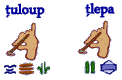 The solution was a mixed system: each word was represented by a logograph representing the lexeme, plus a syllabic representation which merged all the consonants. E.g. ṭuloup ‘we will write’ would be represented by a logograph ṬLP and syllabic glyphs $u-$o-u$, while ṭlepa ‘document’ would use the same logograph plus syllabic glyphs $$e-$a. The syllabic representation need not specify the actual consonants, since these are implied by the logograph.
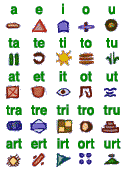 The logograph was known as a peşşep ‘signifier’, the syllabic representation as a triutta ‘spelling’. The word derives from the convention that one could say a triutta out loud by using t for all the consonants—— e.g. tu-to-ut for the first example above. A cluster was represented by tr, so the second example was spelled tre-ta.
A single syllabic glyph is a triuṭitta. The full set of triuṭittar is shown at right. (There are no three-consonant glyphs; if necessary, just ignore the extras: ḍspi is spelled tri.)
Peşşepe are written right to left. The triuttar are written normally written right to left underneath them, but they’re also sometimes written to the left of the peşşep, top to bottom. A Skourene would read the first line of the chart at right as u-o-i-e-a!
The samples are shown in color because the prototypical medium for the Iṭilik script is painting (as that for Chinese characters is brushwork, while medieval European calligraphy, and thus our typography, are based on writing with a bias-cut quill). Handwritten symbols at first closely matched the painted versions, but over the centuries were simplified and stylized much faster.
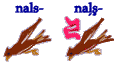 There were something over 700 peşşepe; but less than half of these were completely independent graphemes. Symbols could be combined to create a peşşep, or adapted from a similar-sounding root: e.g. the glyph for nals- ‘fly’, a picture of a hawk, was used for naḷş- ‘honor’ as well, with the addition of a ribbon (i.e. a mark of honor).
 Geographical names, especialy foreign ones, were something of a problem. For some old borrowings glyphs were devised; e.g. that for Skouras was a stylized picture of a river (also used for ḍel ‘river’), plus some stylized hills. For newer borrowings the usual expedient was to borrow a word with the same consonants; e.g. Aksun uses the glyph for kisn- ‘hear’, with a special initial triuṭitta that indicates that the word is a toponym.
By the way, the representation of Skouras, tro-u-ta-at, illustrates two fine points in writing triuttar:
Other cities adopted the Iṭilik system, but felt free to change the actual glyphs, in order to make it harder for outsiders to read one’s accounting or trade secrets. The result was a plethora of alternate scripts, one for each major city and its colonial empire.
By historical accident, from about 700 to 1000 Skouras was dominated by three different cities all using variations of the script of Guṭḷeli: Guṭḷeli itself, Meŋeland, and Kuḷiŋibor. This therefore became the standard script in the littoral; in Skouras proper, the Iṭilik script was the standard (to a somewhat lesser extent).
After the Tžuro invasion, most of the variants were removed from competition. Gurdago— yet another variant of Guṭḷeliki— had simplified its script; this influenced but did not replace the standard script in the littoral. This modified script is the ancestor of the modern Uṭandal and Gelihurendi scripts.
Lexicon |
|
|
|
| ||||