


|
| June 2026 |
|
|
These two comics ended up with a common meta-theme: I like them but I don’t love them. They’re trying new things, which comics needs, and they’re certainly not doing them badly. But they’re not entirely satisfying.
| A Degen: The Marchenoir Library | |
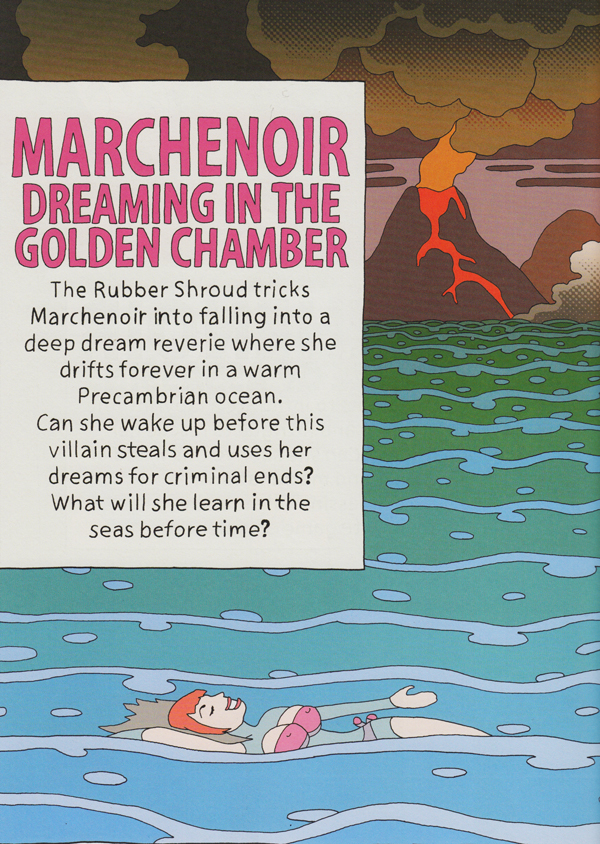 This is a comic for anyone who, discovering the Tintin comics, longingly perused the back covers, which featured thumbnails for 22 Tintin albums. It’s kind of a comic in itself, a promise of adventure (exotic locales, desperate-looking situations), some surrealism (why the giant mushroom? who are those men with flowing green hair and beards?), and unexpected coziness (Castafiore singing in a parlor). There’s even a meta-journey from relatively simple to dazzlingly precise linework.
Well, the Marchenoir Library is like that, only the underlying comics do not exist. Marchenoir is a superhero, in an orange jumpsuit with bunny ears, and pink boots and gloves. The first few pages introduce her sisters, her professor friend, and then her rogues’ gallery. The bulk of the book is the front and back covers of no less than 46 stories, each with a teaser. All feature Marchenoir, most feature some of the allies and villains we met in the intro. Sometimes an ally goes bad or a villain helps out. The pics are all visually stunning, especially the color work.
They also sound like a fun time. Marchenoir can apparently move between worlds, as can some of her villains, and the worlds she visits seem dreamlike, with the proviso that dreams include nightmares. There seem to be thematic resonances: Marchenoir is trapped in a false dream; Marchenoir falls in love; one of the sisters needs to be rescued. There’s a curious fascination with masks. Sometimes Marchenoir looks heroic, other times defeated. Sometimes she has to use the skills of her previous career as a singer-songwriter.
Occasionally her logo appears in Chinese — 黑步 Hēibù — from which we learn that her name doesn’t mean "black market" (marché noir), but "black step." Marchenoir is also a small village in France. (The title also appears once in Russian, with the same meaning.)
As with an actual comic series, the worried tone of the teasers is contradicted by the existence of the series. Marchenoir must evade all the threats, since she’s unharmed and apparently unchanged in the next story.
Now, this is a fascinating concept, and one I can relate to as it’s almost my stock in trade for Almea: I’m constantly inventing novels, comics, philosophers, and scriptures that I merely describe and sample, but don’t provide in full. It’s a fun little mini-art form, and perhaps it adds a special mystery or poignancy precisely because you can’t read them. I think the art, the atmosphere, the invocation of the special goofiness of a long-running superhero series, give the book a real charm. I don’t think Degen intends this as a prelude to writing one or all of the 46 Marchenoir books, but I’d certainly love to read some of them.
Still, this mini-form has its limitations, too. There is really no story, no emotional up and down, no resolutions, no change. I think that’s fine — that’s true of other experimental comics, like Matt Madden’s 99 Ways to Tell a Story: Exercises in Style. Sometimes you want to just play with the form, in a new and beautiful way.
| Boulet & Aseyn: Bolchoï Arena | |
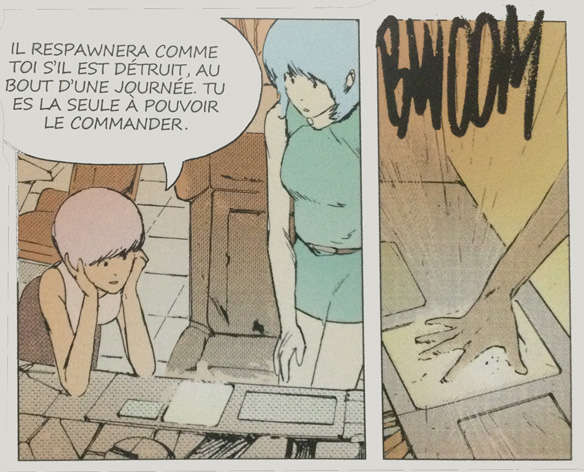 OK, sorry, this one is only in French. It’ll probably appear in English sometime — within your lifetime, if we’re lucky.
Boulet is my favorite living French cartoonist. He’s best known for short humor comics, about everyday life with a strong undercurrent of nerdery; he also became the artist for the main stories in Trondheim & Sfar’s Donjon. (That’s become a huge project: it once sounded absurd that they hoped to publish 300 volumes, but they’ve already published 67.) He also illustrated Zach Weinersmith’s Bea Wolf.
Anyway, Bolchoi Arena is focused on a late 21st century French girl, Marje, who is introduced by her best friend Dana to the Bolchoï, a virtual reality of truly cosmic scale. It includes not only our solar system, simulated in mind-numbing detail, but many others, and has billions of participants. It seems to be a fairly lawless place, where noobs (in French, les noobs) are attacked either by other players, or the virtual megacorps which have claimed all the best spots. You can also, of course, spend your time fighting zombies, PvP, racing, or flying spaceships. Marje is studying astrophysics, so she’s most interested in space exploration.
Marje is new to the Bolchoï, but turns out to have a natural gift for combat. She achieves some remarkable kills, but also pisses off one of the megacorps, Titanica. She also gets so focused on the Bolchoï that she annoys her thesis advistor, and also her boyfriend Colin. (Colin also enjoys the Bolchoï, where his avatar is a corgi, but gets annoyed with Marje missing dates because she gamin’.)
Being me, I have to explain the title. Bolchoï transliterates Russian большо́й ‘big, grand’, as in the Bolshoy Ballet. Arena ‘should be’ arène, but y’know, l’anglais, c’est cool. In the text Boulet writes Bolchoï but the title seems to always appear without the diaresis. (Without the diaresis French readers would be tempted to read [bol ʃwa].)
I’ve now read the book – this is volume 1 of 3 so far – three times, and there’s a lot to like, but it doesn’t quite click for me.
Part of the problem is pacing. The book is 162 pages long; this gives it a leisurely pace more typical of manga, but the story feels unstructured. The typical French BD album is precisely 48 pages, and there’s a helpful discipline to breaking down your epic into slices of that size: each one has to tell a coherent story and have at least some closure, since the next volume will take years to appear.
At almost all times we focus on Marje, which is fine for introducing a world that’s new to both her and to us; but that makes some of the other characters feel undeveloped, and loses the opportunity to explain things more efficiently.
It’s evident that Boulet understands video games, as a gamer; it may be a problem that he never takes the viewpoint of a developer. There’s little explanation of how the game works, who made it, why they made the choices they did. In interviews he’s cited Minecraft as an inspiration, but the Bolchoï seems more like the endless griefing and PvP space battles of EVE Online. I have a lot of questions...
I’ve never tried VR, but reports suggest the big problem is locomotion: you can’t exactly walk even ten feet in the VR, you’d crash into your wall. How does it work if your character is doing something very different from your pose in RL? (Boulet depicts the RL person completely quiescent. Perhaps that’s the key: your normal motor functions are intercepted? But this is somehow done only wearing a minimal headset. Oh well, future tech.
This is volume 1 of 3, with two more planned, so maybe all this is addressed later. I’ll probably get the next volume and see what happens. Reviews suggest that the later volumes address more of the problems the real world is facing.
What do I like about it? Well, I don’t know of any other graphic novel that covers this sort of thing; most sf comics are concerned with the usually dystopian society, not its games. I like the everyday nature of Marje’s life, and her expressiveness. (It was a good choice to make the character female... with a guy, there would be much more of a temptation to downplay his reactions, positive and negative.) And Boulet has a good instinct for how people do play MMOs: choosing avatars different from their own appearance, including aliens or pop culture references; getting way too invested in their games; nerding out over the best spaceship design.)
Aseyn is very good at drawing spaceships and busy interiors; his characters have the simplicity of manga but not quite the expressiveness. He’s also maybe too enamored of a moody desaturated palette. I guess he wanted to avoid imitating Moebius, but I like his art better when he deigns to make it colorful.